
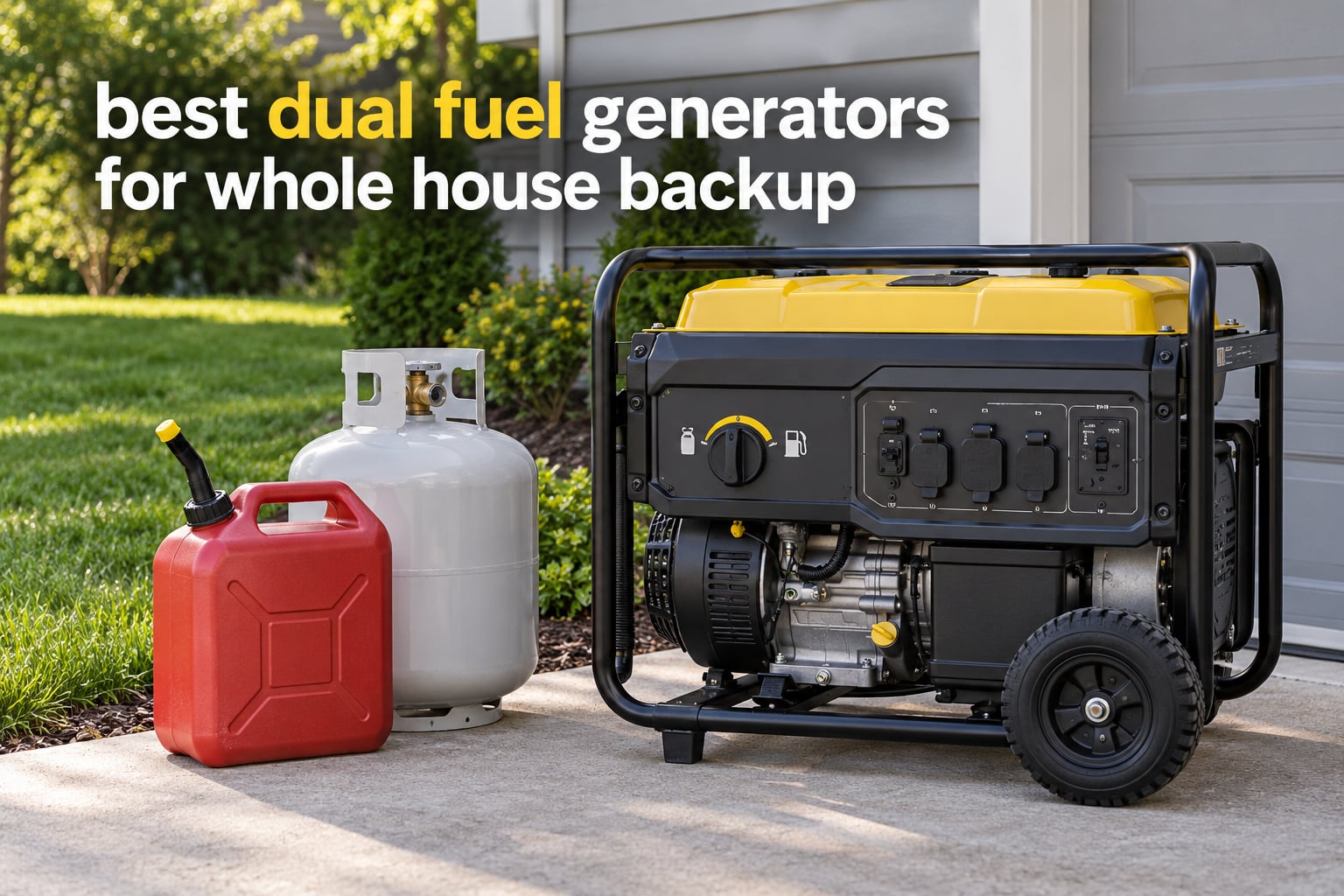
For whole house backup you want 7,500 to 12,500 running watts for essentials, and 20,000 watts or more if you plan to run central air, a well pump and an electric water heater at the same time. A dual fuel generator runs on both gasoline and propane, so you keep power on when one fuel runs short or goes bad in storage.
That is the short answer to the sizing question that comes up in nearly every generator forum thread. The rest of this guide breaks down eight dual fuel portable generators, shows what each one actually delivers on each fuel, and tells you plainly which ones can back up a house and which ones are only honest about covering the basics.
A dual fuel generator is a portable generator with one engine, a gasoline tank, a propane regulator with hose, and a fuel selector valve on the control panel. Turning the dial moves the engine from one fuel system to the other, usually while it is running. Gasoline is easy to find and burns more power per hour. Propane stores indefinitely and burns clean, which matters a lot when a storm knocks out the gas station three miles away.
We spent weeks reading spec sheets, comparing outlet layouts and cross-checking owner feedback across thousands of reviews for every model below. Where a maker claims a runtime, we note the tank size and load level behind that number. Where owners report a recurring fault, we say so. This site earns a commission when you buy through our links, and it does not change the order of the picks.
Table of Contents
Top 3 Dual Fuel Generators for Whole House Backup (October 2026)

Westinghouse WGen9500DF
- 9500 running watts on gas
- 8500 on propane
- Remote key fob start
- 30A and 50A outlets
- 210 lb


Quick Comparison of Every Generator in This Roundup in 2026
| Product | Specs | Action |
|---|---|---|
| Westinghouse WGen9500DF |
|
Check Latest Price |
| DuroMax XP13000EH |
|
Check Latest Price |
| Pulsar G12KBN |
|
Check Latest Price |
 DuroStar DS13000MX DuroStar DS13000MX |
|
Check Latest Price |
 WEN DF8000X WEN DF8000X |
|
Check Latest Price |
 Pulsar PG12000B Pulsar PG12000B |
|
Check Latest Price |
 Westinghouse WGen5300DFcv Westinghouse WGen5300DFcv |
|
Check Latest Price |
 WEN DF680iX WEN DF680iX |
|
Check Latest Price |
How Big a Generator Does a Whole House Actually Need
Start with running watts, not peak watts. Running watts is what the generator holds steady. Peak watts, also called surge or starting watts, is the burst a motor needs for a few seconds while it spins up. Sizing on peak numbers is the most common mistake, and it leads people to buy machines twice the size they need.
Here is a realistic starting-watt picture for the loads that matter in a home. These are typical residential figures for motor-driven appliances:
Refrigerator: roughly 400 running watts, about 1200 starting watts on the compressor
Chest freezer: roughly 200 running watts, about 1000 starting watts
Sump pump: roughly 400 running watts, up to 2000 starting watts
Well pump: roughly 1000 running watts, up to 2500 starting watts
Gas furnace with blower: roughly 400 running watts, about 1200 starting watts
Electric water heater: roughly 4000 running watts, about 9000 starting watts
Central air conditioner: roughly 3500 running watts, up to 9000 starting watts
Well pump plus central air plus refrigerator together: about 5000 running watts, well past 9000 starting watts
Add your simultaneous loads, then add 20 percent headroom. That 20 percent margin is not padding. It covers startup overlap, dirty filters, a freezer working harder during a heat wave and the plain fact that manufacturers rate continuous output in a laboratory, not in your garage in August.
A useful rule: 7,500 to 12,500 running watts handles refrigerator, freezer, lights, internet, sump pump or well pump, gas furnace and a couple of small circuits. Above 20,000 running watts you can add central air and an electric water heater without rearranging your life around the load.
One caution. Every model in this roundup produces less output on propane than on gasoline. Westinghouse rates the WGen9500DF at 9500 running watts on gasoline and 8500 on propane. Pulsar rates the G12KBN at 9500 on gasoline and 8550 on propane. WEN rates the DF8000X at 6500 on gasoline and 5850 on propane. Plan your load against the propane number, since that is often the fuel you will end up burning most.
1. Westinghouse WGen9500DF – Our Overall Pick for Whole House Backup
Westinghouse 12500 Watt Dual Fuel Home Backup Portable Generator, Remote Electric Start, Transfer Switch Ready, Gas and Propane Powered
9500 running watts gas
8500 running watts propane
210 lb dry weight
3-year warranty
Pros
- Transfer switch ready 30A and 50A outlets
- Remote key fob start with recoil backup
- Cast iron sleeve on the 457cc engine
- Fuel gauge and digital hour meter
- 12 hours on a 6.6 gallon tank
Cons
- Open frame is not weather protected
- 210 pounds needs two people to move
- Crankcase can arrive with only residual factory oil
The WGen9500DF is the model we keep coming back to, and it is the one we would put in a garage first. It delivers 9500 running watts and 12500 peak watts on gasoline, dropping to 8500 running and 11200 peak on propane. That is enough headroom for a well pump, a gas furnace, a refrigerator and freezer, and a good stretch of circuits, all at once.
Owner feedback is unusually consistent for a machine in this class. Across more than 8900 reviews the average rating holds at 4.7 stars, and the recurring praise is the same three things: starting power, dependable dual fuel runtime, and an easy hookup to a transfer switch. Several owners pair two of these together for larger homes, which is the pattern forum users recommend when a single frame cannot carry the whole load.
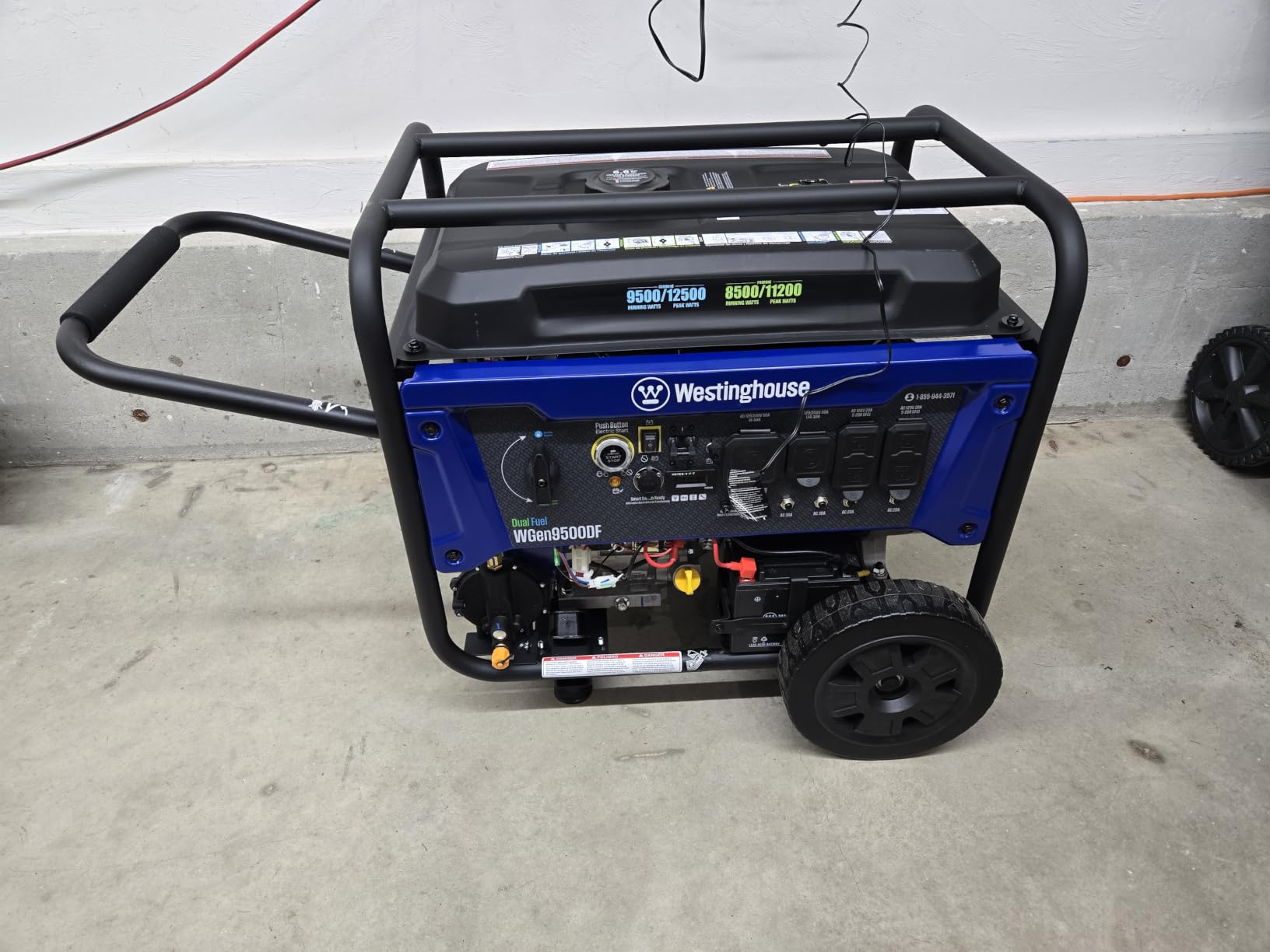
The engine is a 457cc four-stroke OHV with a cast iron cylinder sleeve, automatic low oil shutdown and a digital VFT hour meter. The sleeve matters more than most spec sheets admit. An aluminum sleeve is fine for occasional use, and a cast iron sleeve is what you want on a machine that sits in a damp shed and starts a few times a month for years.
Outlets are where this one earns its place in a whole house plan. You get two GFCI 120V 20A household receptacles, one transfer switch ready L14-30R 30A outlet, and one RV-ready 120/240V 14-50R 50A outlet. That 50A plug is the difference between running extension cords and actually back-feeding a panel, and it is the single feature most buyers in this category underrate before they buy.
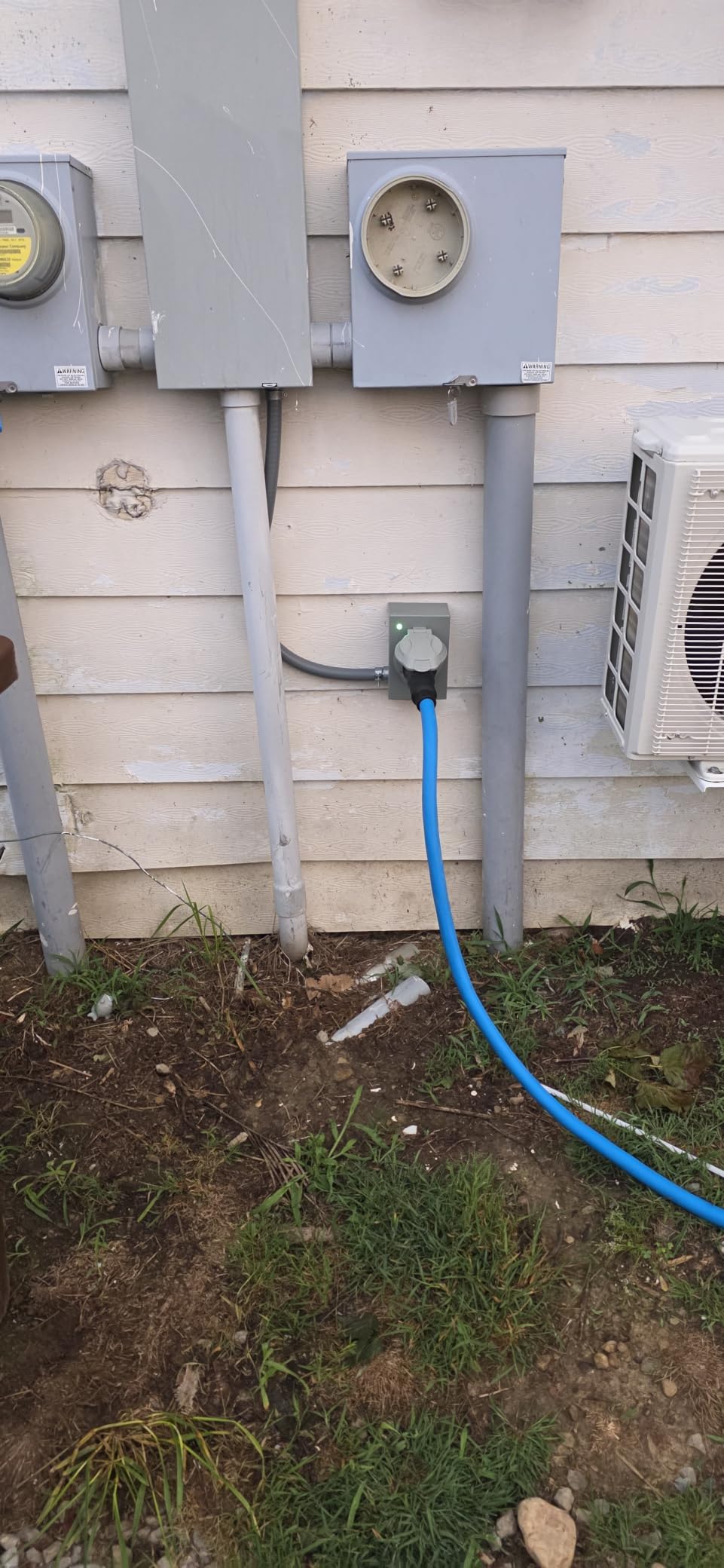
How it handles a real outage load
On a typical essentials circuit, the WGen9500DF has enough output that you are not counting amps. Refrigerator, freezer, internet router, a few LED circuits and a gas furnace blower together land somewhere near 2000 running watts, which leaves most of the 9500 for a sump pump or a window air conditioner.
Add a well pump at 1000 running watts and a central air compressor at 3500, and you are near 6500 running with a startup spike that can reach well past 9000. That fits inside 9500 running and 12500 peak on gasoline. Switch to propane and you have 8500 running and 11200 peak, so plan for one heavy motor at a time rather than two.
What to watch before the first run
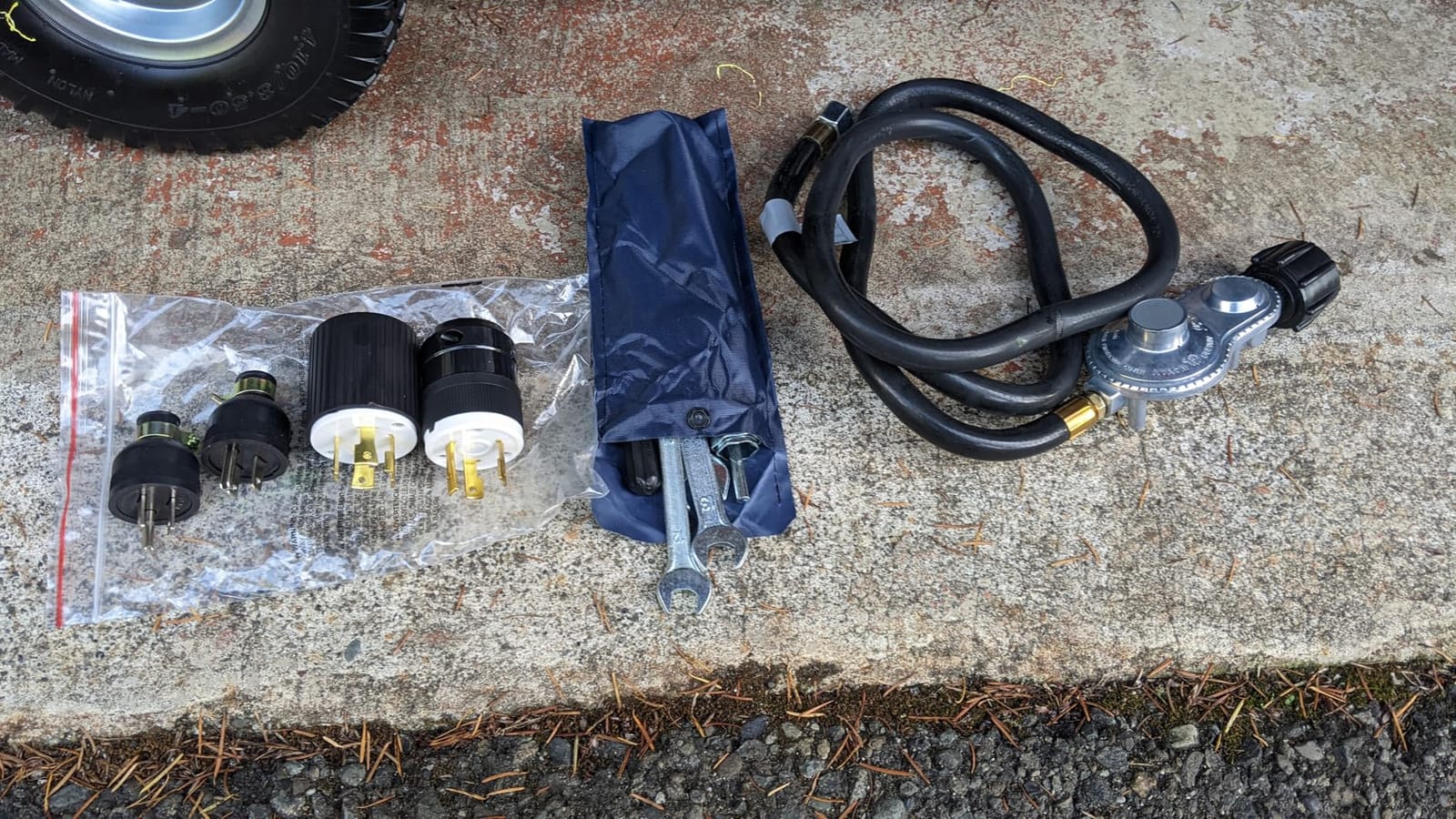
Check the crankcase before you start it. Owners report some examples of this model arriving with only residual factory oil, and running a four-stroke briefly without proper oil is how engines get damaged. The box does include oil, an oil funnel, a tool kit, the remote start key fob and a 12V battery charger.
Two other realities. At 210 pounds you will want a second person or a lift bracket to move it, and the open frame means it needs a generator cover if rain is forecast. Neither is a dealbreaker, but both are worth knowing before the storm arrives instead of during it.
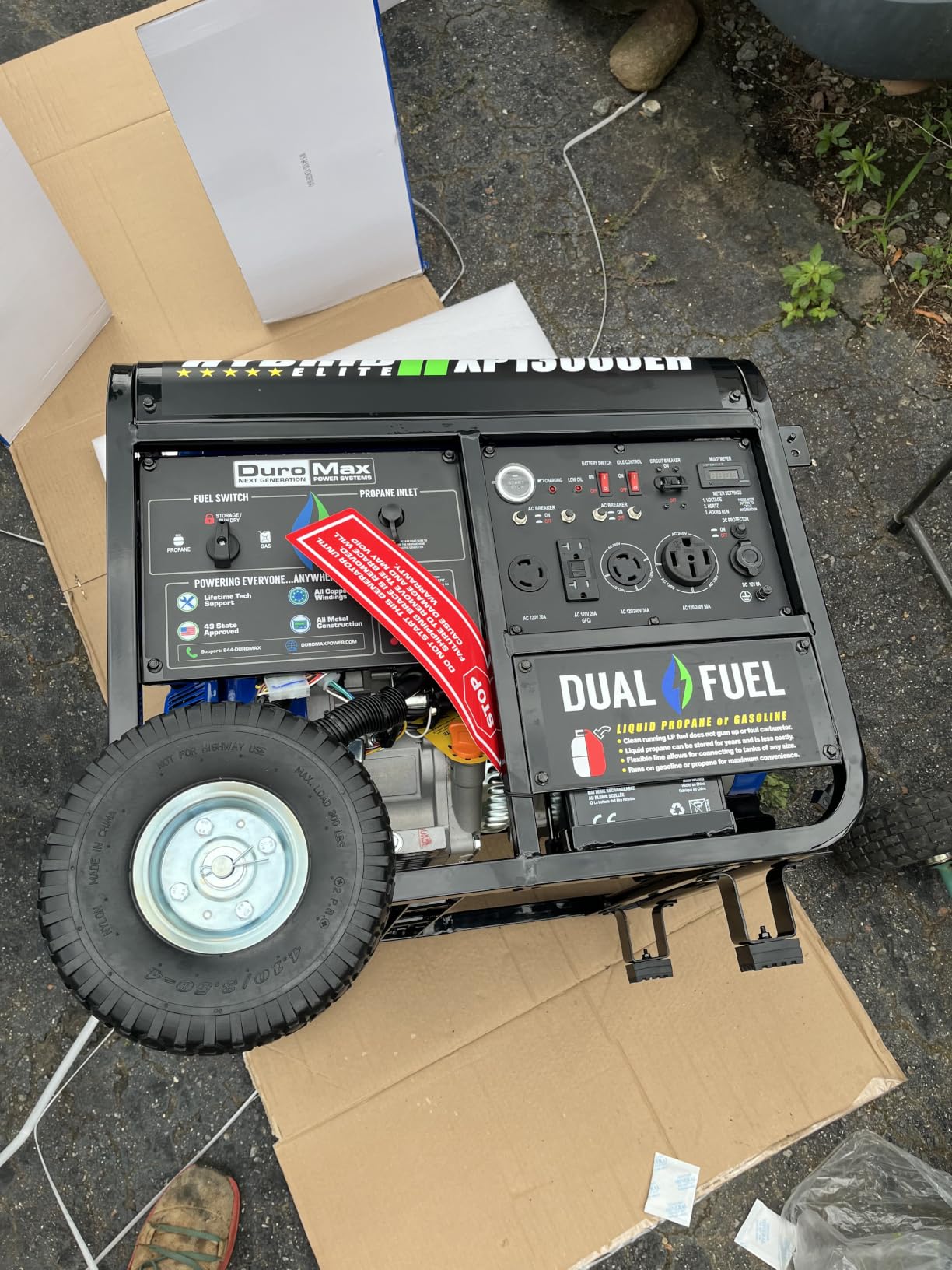
2. DuroMax XP13000EH – 13,000 Peak Watts With Copper Windings
DuroMax XP13000EH 13,000-Watt Dual Fuel Portable Generator – Gas & Propane, Electric Start, Whole Home Backup Power, Transfer Switch Ready, RV & Emergency Ready
10500 running watts gas
13000 peak watts
234 lb dry weight
3-year warranty
Pros
- High peak output for compressor loads
- All metal frame and power panel
- 100 percent copper windings
- Front facing fuel selector for quick switching
- Transfer switch ready 50A outlet
Cons
- Louder than expected under load
- Arrives without engine oil
- Choke sticker and manual are reversed
The XP13000EH is the brute in this group, with 10500 running watts and 13000 starting watts on gasoline from a 500cc four-stroke engine. Owners frequently pair it with a 50A transfer switch and report running an entire home, including heat pumps and refrigerators, through extended outages. The extra surge capacity is what makes it attractive when a central air compressor is on your list.
Build quality details set it apart at this output level. The frame and power panel contain no plastic parts, and the alternator uses 100 percent copper windings for heat dissipation and service life. In a machine that will run hot under sustained load, copper rather than aluminum is a genuine difference over the long haul.
The control layout is straightforward: push button electric start with recoil backup, and a fuel selector on the front panel so you can move between gasoline and propane without walking around the frame. A CO sensor and low oil shutdown are standard, and never-flat tires plus a foldable handle take some of the pain out of moving 234 pounds.
Rating sits at 4.5 stars across roughly 3990 reviews. Praise centers on raw output, the all-metal construction and the front fuel selector. The complaints are consistent too, so read them before you buy: several owners report more noise than expected under load, the choke instruction sticker and manual are reversed relative to the actual butterfly valve, and a few report starting or reliability failures with a slow warranty response.
Where its extra power actually pays off
The gap between this machine and a 9500 watt model shows up on startup loads. Water heaters, well pumps and central air compressors are the three that decide whether a generator browns out or holds steady. With 13000 peak watts on gasoline, you can start a compressor while the refrigerator, furnace blower and lights stay on without planning the sequence.
On propane the output drops, as it does on every dual fuel engine in this roundup. The practical move is to treat gasoline as your high load fuel and switch to propane for a steady base load of lights, refrigerator and electronics later in the outage. That keeps you away from the ceiling where engines work hardest.
What to watch before the first run
It does not come with engine oil. Owners hit this often enough that it is worth repeating: add oil to the crankcase and check the level before the first start, and again before every later start if the engine has been sitting.
Verify the choke position yourself rather than trusting the sticker. If the sticker and the butterfly valve disagree, the unit may choke when you want it to run or run when you want it to choke. Take a photo of the correct position on day one. Also budget for noise. This is not a quiet machine, and under sustained load it is louder than the Westinghouse it competes with.
3. Pulsar G12KBN – 8 Gallon Tank and Two Twist-Lock Outlets
Pulsar G12KBN Heavy Duty Portable Dual Fuel Generator – 9500 Rated Watts & 12000 Peak Watts – Gas & LPG – Electric Start – Transfer Switch & RV Ready – CARB Compliant
9500 rated watts gas
8550 rated watts on LPG
8 gallon tank
1-year warranty
Pros
- Large 8 gallon tank for fewer refuel stops
- Both 30A twist lock and 50A outlets
- Electric start with never-flat wheels
- Digital meter and low oil shutoff
- 81 percent of reviews are five star
Cons
- Only a 1-year limited warranty
- Listed item weight is inaccurate
- Non-inverter output for sensitive electronics
The G12KBN matches the Westinghouse on output, with 9500 rated watts and 12000 peak on gasoline and 8550 rated and 10800 peak on LPG. What separates it is tank size and outlet count. The 8 gallon tank is the largest in this roundup and delivers up to 12 hours at half load on gasoline, which means fewer refuel trips when the roads are not passable.
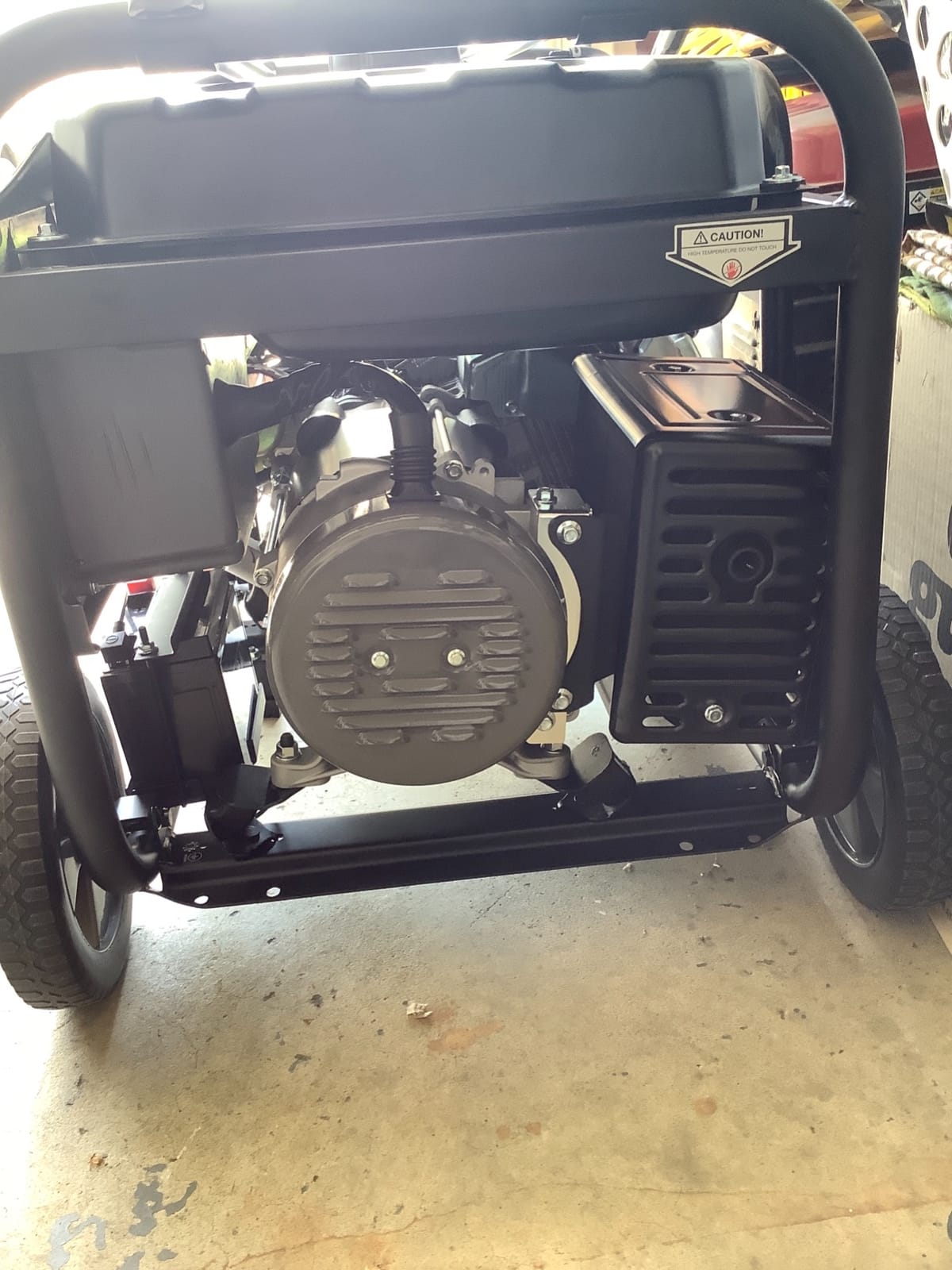
It also has the most complete outlet panel of any conventional open-frame machine here: four 120V 20A outlets, one 120/240V 30A twist-lock, one 120/240V 50A outlet and a 12V DC output. That spread lets you run household circuits, a transfer switch and a battery charger at the same time without hunting for a splitter.
The rating is 4.6 stars from about 1360 reviews, and the distribution is heavily positive at 81 percent five star. Buyers cite runtime, tank size and dual fuel flexibility for both home and RV use. The engine is a 457cc single-cylinder four-stroke air-cooled OHV with electric start, and the unit is CARB compliant with the propane hose included.
The main limitation is warranty length. A 1-year limited warranty is the shortest warranty in this roundup, against three years on the Westinghouse and DuroMax models and two years on the smaller Pulsar. It is not a reason to skip the machine, but it changes how we think about owning it past year three.
How it fits an essentials-plus plan
With 9500 rated watts you have the same usable ceiling as the WGen9500DF, but with roughly 1.4 gallons more fuel on board. For a household running a refrigerator, freezer, furnace blower, internet and a sump pump, that extra capacity is worth more than a small wattage increase would be.
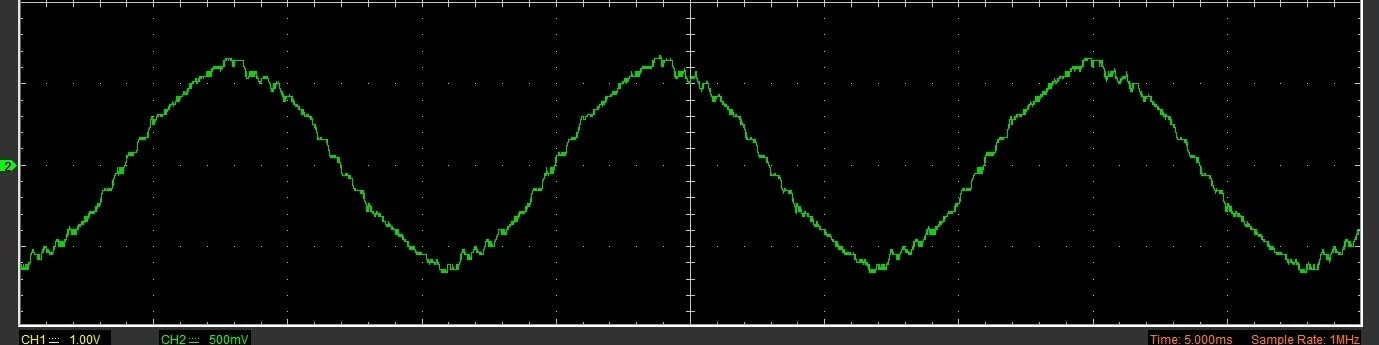
Because output is not inverter controlled, sensitive electronics deserve care. If your essential list includes a desktop computer, a large television or audio gear with a big power supply, keep those on a separate circuit and expect the same mild flicker you would see on a conventional generator anywhere.
What to watch before the first run
Check the weight yourself before planning the move. The listed item weight in the product specifications is inaccurate, so confirm the real figure before you decide whether one person can reposition it. It ships with drop-down handles and 10-inch never-flat tires, which helps on gravel and grass.
Plan the fuel budget in propane too. A standard 20 lb cylinder on this machine gives you a useful evening of base load rather than a full night at full output, so have a second cylinder ready. And if you store it through winter, remember that the 1-year warranty does not cover anything the storage did.
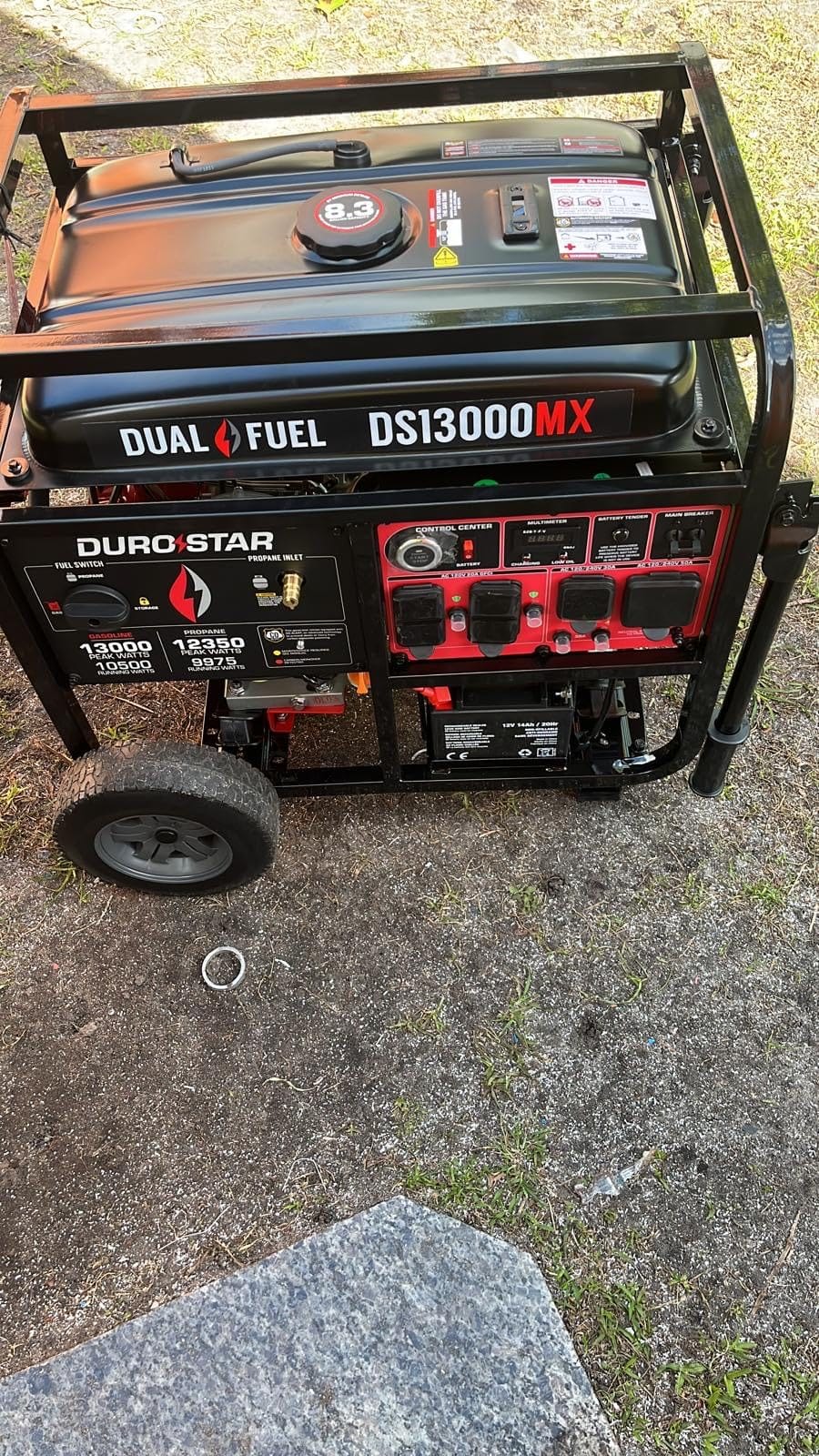
4. DuroStar DS13000MX – 500cc With Remote Start and CO Alert
DuroStar DS13000MX 13,000-Watt 500cc Dual Fuel Portable Generator – Gas and Propane, Remote Electric Start, Whole Home Power Backup, Transfer Switch Ready, RV & Emergency Ready
10500 running watts gas
13000 surge watts
220 lb dry weight
3-year warranty
Pros
- 13000 surge watts in a compact package
- 8.3 gallon tank with long claimed runtime
- CO Alert shutdown sensor
- Remote control plus push button start
- Transfer switch ready 50A outlet
Cons
- Ten percent of reviews are one star
- 220 pound steel frame limits portability
- Remote start needs a charged 12V battery
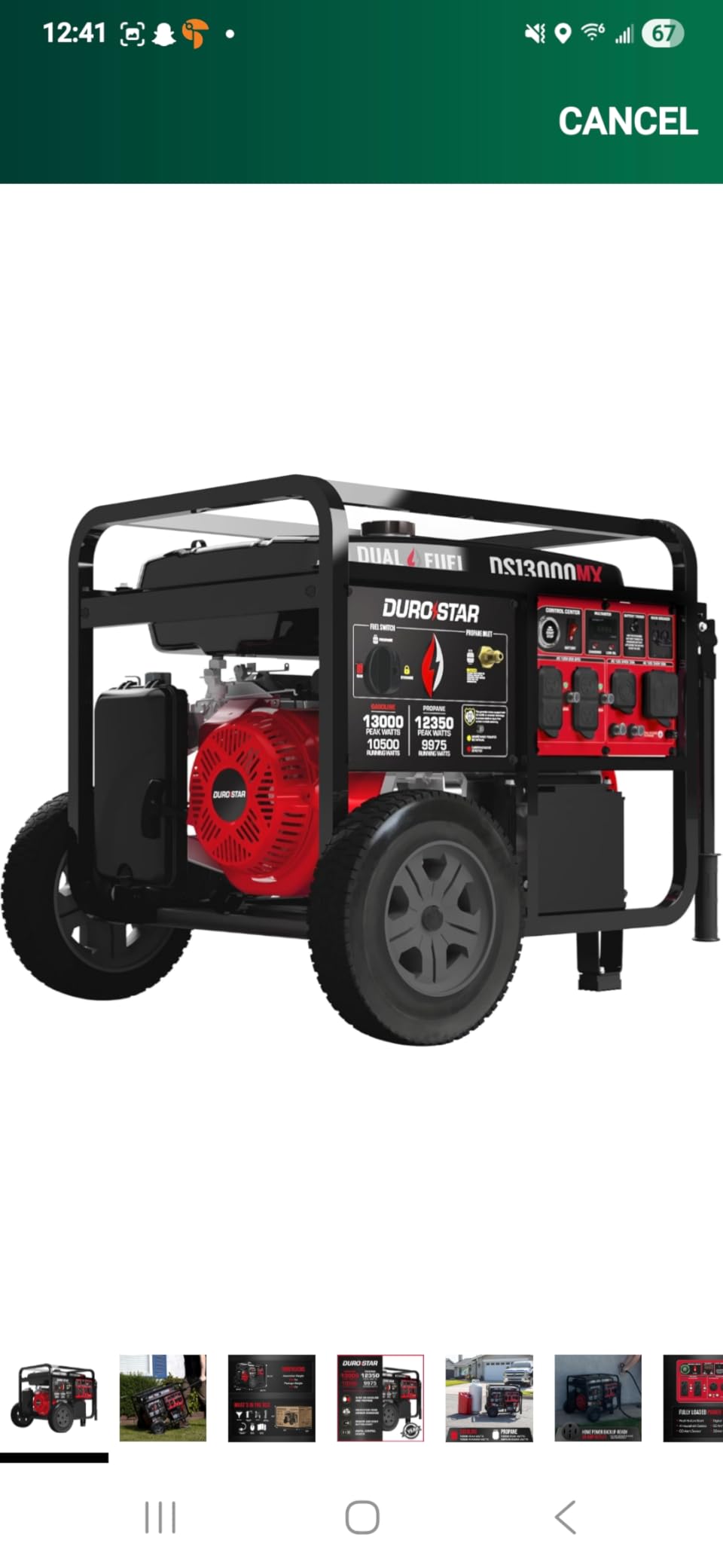
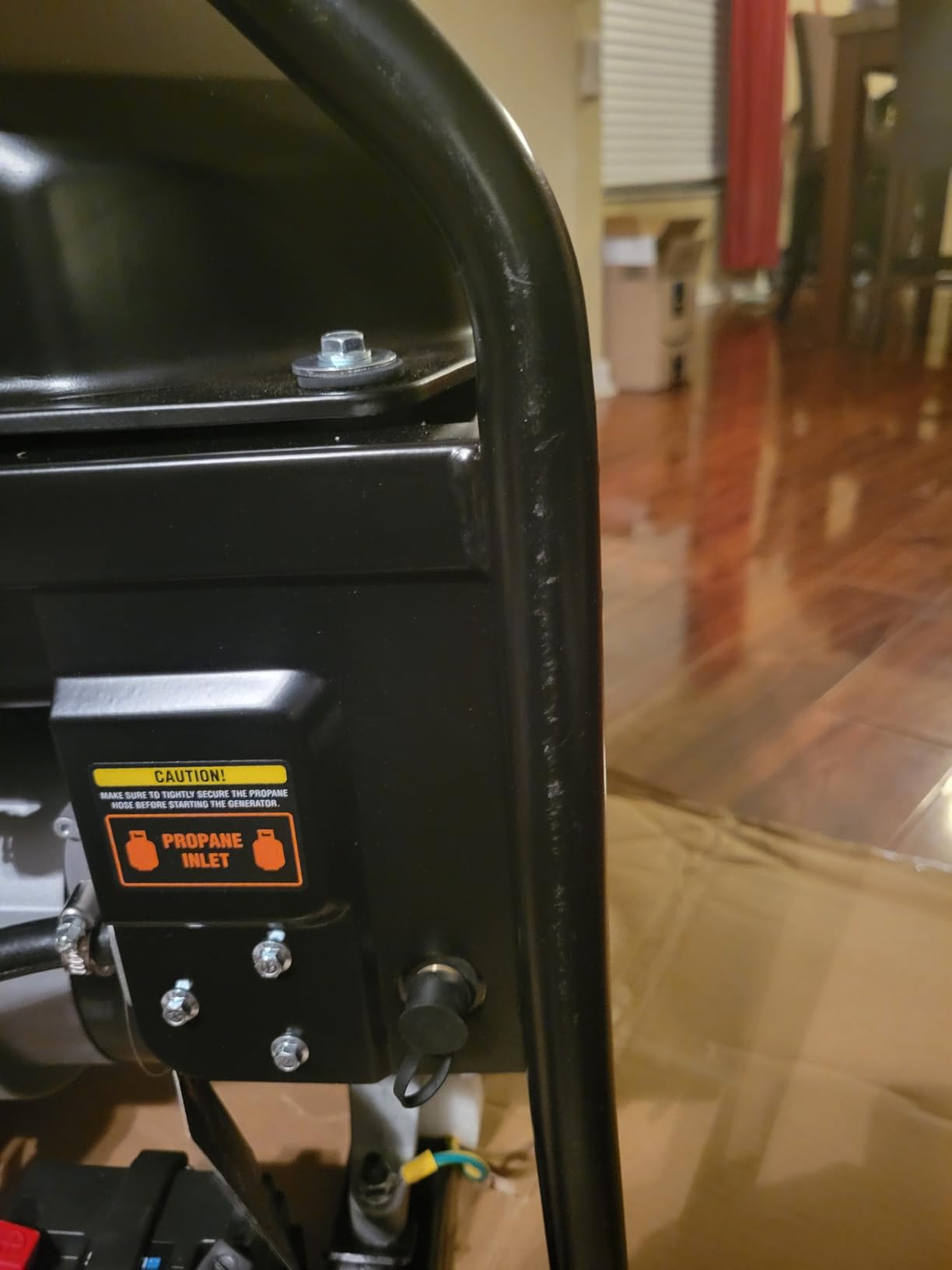
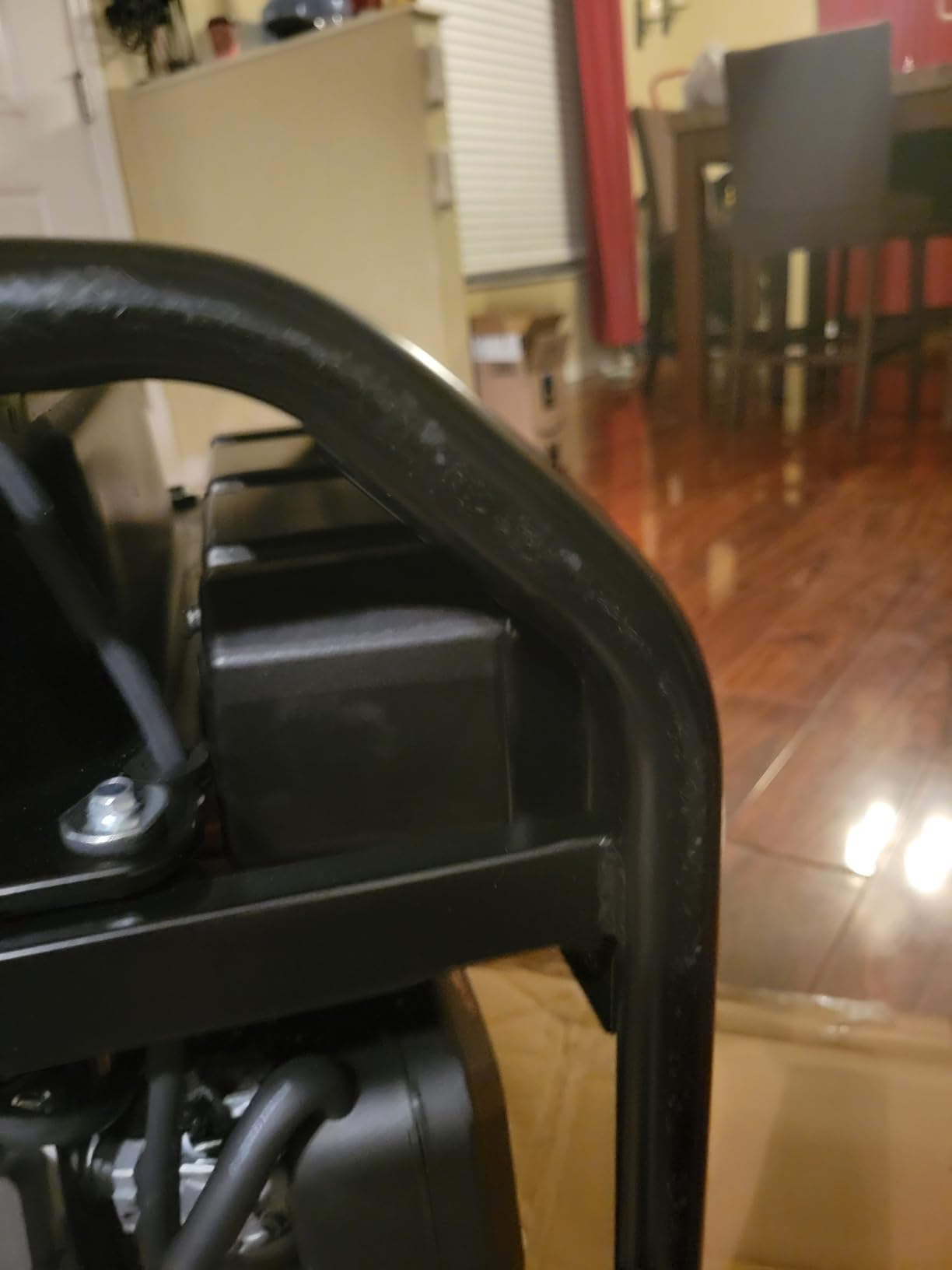
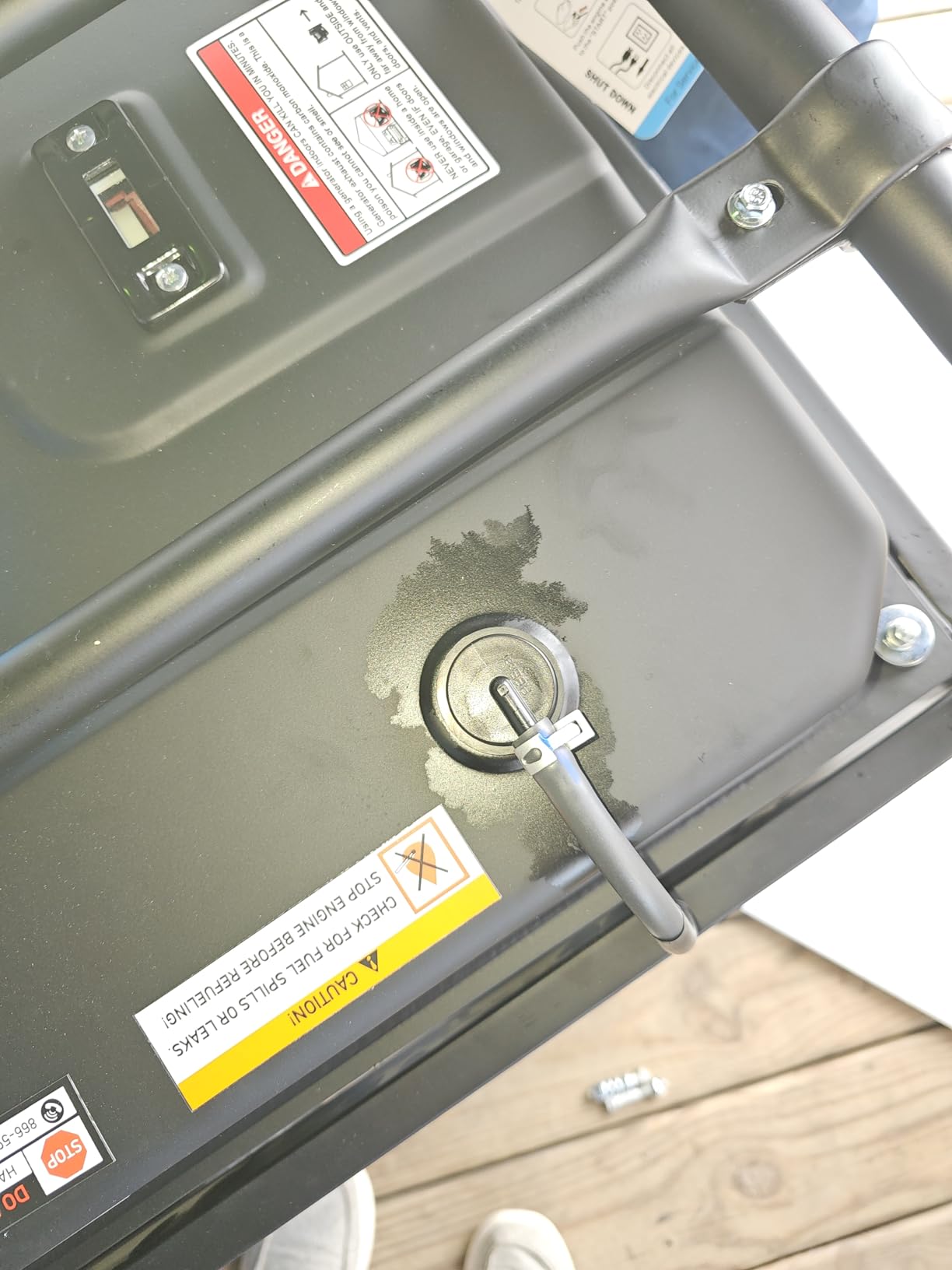
The DS13000MX matches the DuroMax on headline numbers, 13000 surge watts and 10500 rated watts from a 500cc four-stroke, with gasoline or propane selected from the front control panel. The differentiator is the CO Alert sensor that shuts the unit down at dangerous carbon monoxide levels, paired with a 3-year limited factory warranty.
Its 8.3 gallon tank is the second largest here, and the manufacturer claims a 17 hour runtime figure. Treat that as a best case under light load rather than a planning number for full output. The package includes an oil funnel, spark plug wrench, tool set, wheel and handle kit, propane regulator and remote control.
This is where we would be honest with you: the review base is thin at about 312 ratings averaging 4.4 stars, and it is polarized. Roughly ten percent of reviews are one star, with the negative feedback concentrating on start-up and durability rather than output. With a sample that size, a few early failures move the percentage a long way, so the rating tells you less than the rating on the Westinghouse does.
On the other side, reviewers praise the power to size ratio, the large tank, the CO Alert sensor and the convenience of remote start. The steel frame and reinforced power panel feel robust in hand, and the transfer switch ready 50A outlet is the correct outlet for whole home hookup.
How it performs on a mixed load
At 10500 rated watts on gasoline this sits in the same band as the DuroMax, which means a well pump plus refrigerator plus furnace plus lights is comfortable, and a central air compressor is possible with careful sequencing. The 13000 surge figure gives motors room to start without the lights dimming.
Remote start is genuinely useful in rain or darkness, but it depends on the 12V battery holding a charge in storage. If you are not running the generator monthly, put it on a maintainer. Remote start that does nothing at 2am because the battery died is a bad first impression.
What to watch before the first run
At 220 pounds with a steel frame, plan the placement before you need it. Moving it across a garage floor solo is awkward, and repositioning it during an outage in the dark is worse. Set the pad, confirm the 20 foot setback from the house, and lay out the path before the storm.
Given the split ratings, keep the receipt and the original packaging. A 3-year warranty is a meaningful advantage over the one-year coverage on the Pulsar G12KBN, but it only helps if the service process is straightforward, and the reviews suggest support responsiveness varies.
5. WEN DF8000X – The Smallest 8,000 Peak Watt Dual Fuel Engine
WEN 8000-Watt 120V/240V Dual Fuel Portable Generator, Electric Start, 340cc, Transfer-Switch and RV-Ready with CO Watchdog (DF8000X)
6500 running watts gas
5850 running watts propane
340cc engine
3-year warranty
Pros
- Compact 340cc footprint for 8000 peak watts
- Transfer switch ready L14-30R plus RV TT-30R
- WEN Watchdog CO shutdown
- Electric start with 6.7 gallon tank
- Three-year limited warranty
Cons
- Lowest output in this roundup
- Fifteen percent of reviews are one star
- Open frame with no weather protection
The DF8000X answers a different question than the rest of this list. It produces 6500 running watts and 8000 surge on gasoline, and 5850 running with 7200 surge on propane, from a 340cc engine that is noticeably smaller than the 457cc and 500cc machines elsewhere in this roundup. If your garage space is tight, that footprint matters.
Outlets include four 120V 5-20R 20A household outlets, one RV-ready TT-30R 30A, one transfer switch ready NEMA L14-30R 30A twist lock and a 12V DC receptacle. Note what is missing compared to the Westinghouse and Pulsar: there is no 14-50R 50A outlet here, so a 50A transfer switch is not an option without an adapter arrangement we would not recommend.
The 6.7 gallon tank gives up to 10.5 hours at half load, electric start takes the effort out of cold mornings, and the WEN Watchdog CO shutdown sensor adds a safety layer. A wheel kit is included and the warranty is three years limited, which is better coverage than the Pulsar G12KBN carries.
The honest weakness is the rating. At 4.2 stars from about 130 reviews, this is the softest score in the group, and fifteen percent of those reviews are one star, the highest one-star share here. Those negative reviews usually describe starting trouble and hardware durability concerns rather than noise or capacity.
What this size class can and cannot run
At 6500 running watts you can cover refrigerator, freezer, lights, internet, a gas furnace blower and a sump pump with room to spare. You can run a well pump, but not at the same time as a central air compressor, because the surge overlap will trip the overload protection.
If your goal is powering the house you live in rather than the house you are camping near, the ceiling here is the limit. Above 8000 peak watts, your options open up sharply, and the cost difference between this class and the 9500 watt class is usually smaller than people assume.
What to watch before the first run
Confirm your essential load before buying. Write down what you actually plan to run and add 20 percent. If the total lands under 5000 running watts, this machine is a genuine fit. If it lands above 6500, move up a size rather than planning to ration which appliances get power.
The open frame means no weather protection, so a generator cover is part of the purchase, not an accessory you add later. Also confirm your transfer switch amperage before you buy. The L14-30R outlet matches a 30A switch, and a 30A switch is a common and perfectly sensible choice for an essentials-only installation.
6. Pulsar PG12000B – Switch and Go Fuel Changing With the Engine Running
Pulsar 12,000W Dual Fuel Portable Generator with Electric Start and Switch & Go Technology, CARB Approved PG12000B
9500 rated watts gas
8550 rated watts on LPG
209 lb dry weight
2-year warranty
Pros
- Switch and Go fuel change without engine shutdown
- Electric push start with recoil backup
- 50A RV outlet plus twist lock
- Reports running two A/C units
- Includes mobility kit and propane hose
Cons
- Open frame noise
- Arrives without engine oil
- Cold weather propane performance
- Small 85-review rating base
The PG12000B shares the 457cc OHV CARB-approved engine platform and output numbers with the G12KBN, with 9500 rated and 12000 peak watts on gasoline and 8550 rated with 10800 peak on LPG. The feature that sets it apart is Switch and Go technology, which lets owners toggle fuel type without shutting the engine down.
That matters more in practice than it sounds. Imagine your gasoline runs low at hour nine of an outage with stations closed and no safe containers in the house. On most dual fuel machines you stop, drain the carburetor line, swap to propane and restart. On this one you turn the dial. Owners wired to a 50A back-fed circuit report running furnaces, pumps, refrigerators and dishwashers, and in some cases two air conditioning units, without issue.
At 209 pounds it is the lightest of the 9500 watt class, and the 3-in-1 digital meter, drop-down handles and 10-inch never-flat wheels make it manageable. Outlets are four 120V, one 120/240V twist lock, one 120/240V 50A RV outlet and a 12V DC output, with a mobility kit and propane hose in the box.
The rating is 4.5 stars from about 85 reviews. That is a much thinner base than the Westinghouse, so treat the score as encouraging rather than conclusive. Complaints cluster around open-frame noise, no included oil, cold-weather propane performance, and a few build details including nicked fuel lines found after assembly and a battery that discharges in storage.
When hot fuel switching changes the outcome
This is the generator for households whose fuel supply is the weak link. If you live past the last gas station on a rural road, or if the failure mode you fear is a supply line that stays down for days, being able to move to a propane cylinder mid-run removes a whole category of stress.
One caution from owners on cold weather runs: small 20 lb propane tanks can freeze up and stop delivering vapor during extended cold-weather runtime. If you expect a winter storm outage, keep full size cylinders available and know that very cold ambient temperatures reduce propane output.
What to watch before the first run
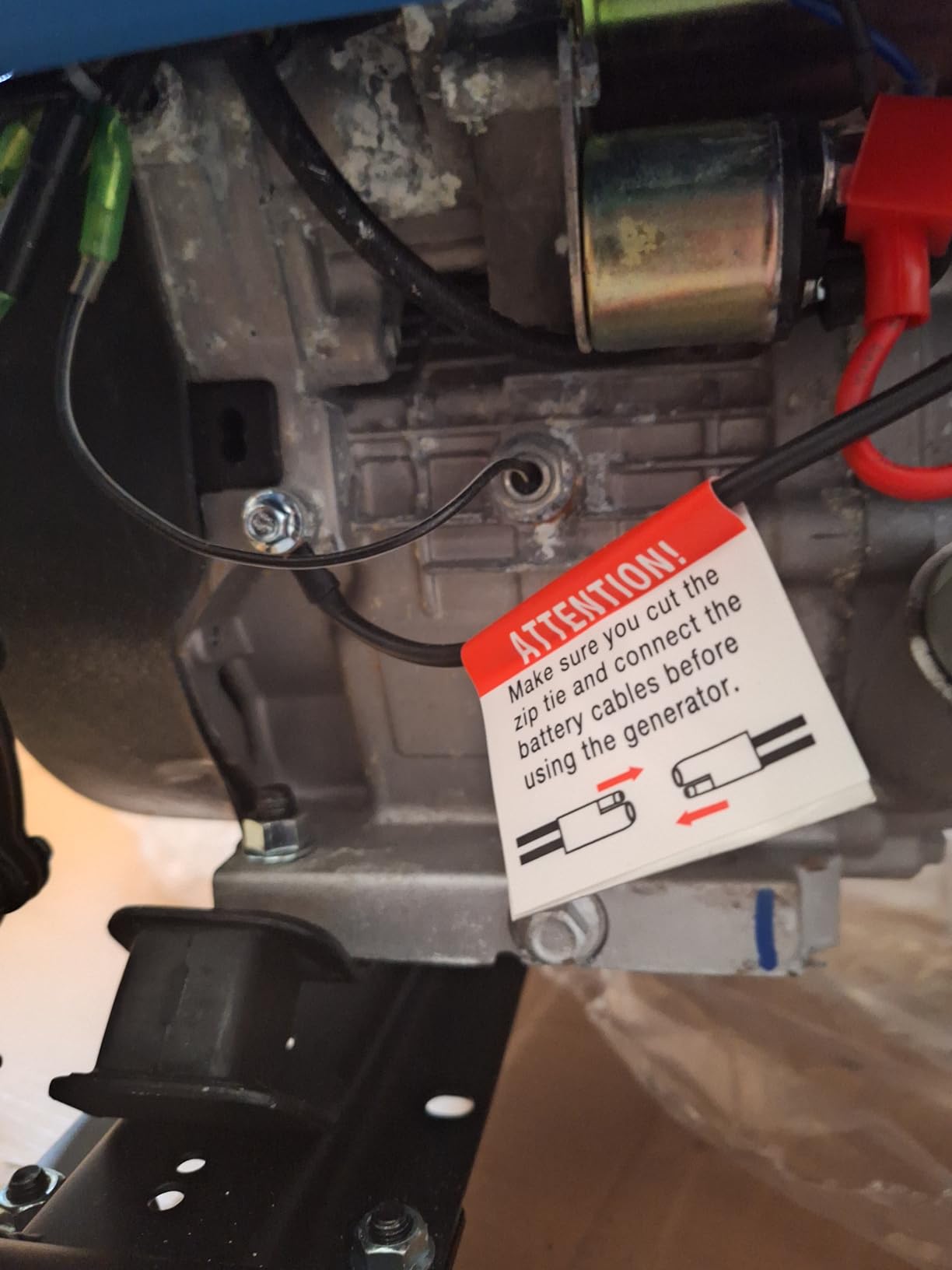
Add engine oil before the first start, as the box does not include it. Inspect the fuel line connections during assembly, since a few owners found cuts in the fuel lines before first use, and check the terminals if the electric start behaves erratically after a long storage period.
Also set expectations on noise. At this output level with an open frame, this is not a conversation-friendly machine. Place it far enough from the house and far enough from neighbors that the sound does not become the argument that decides how long you are allowed to run it.
7. Westinghouse WGen5300DFcv – 5,300 Watts for Essentials, Not Full Home Backup
Westinghouse 6500 Watt Dual Fuel Home Backup Portable Generator, Transfer Switch Ready 30A Outlet, RV Ready 30A Outlet, CO Sensor
5300 running watts gas
4800 running watts propane
135.6 lb dry weight
3-year warranty
Pros
- Lightest Westinghouse here at 135.6 pounds
- 4.7 gallon tank with 14.5 hour claim
- CO sensor with automatic shutdown
- Cast iron cylinder sleeve
- Oil hose wheel kit and manual included
Cons
- Only 5300 running watts on gasoline
- Magneto ignition instead of electric start
- Open frame needs a weatherproof cover
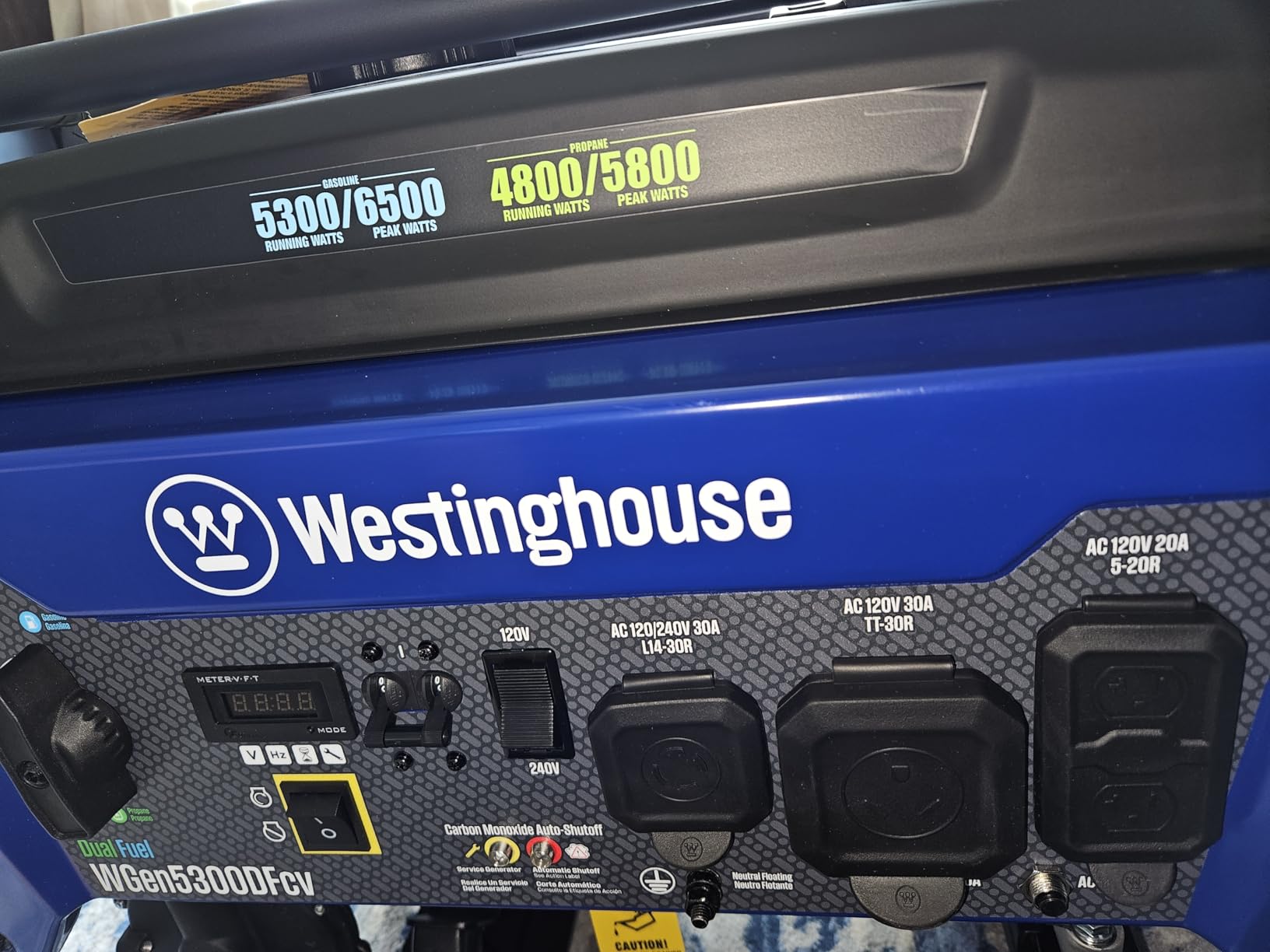
We put this one in the roundup to be direct about its limits. The WGen5300DFcv produces 5300 running watts and 6500 peak on gasoline, and 4800 running with 5800 peak on propane, from a 274cc four-stroke OHV engine with a cast iron sleeve. That is an essentials machine, not a whole house machine, and the packaging around it does not pretend otherwise.
What it does offer is accessibility. At 135.6 pounds it is roughly half the weight of the 9500 watt models, the 4.7 gallon tank carries a claimed 14.5 hours of runtime with a fuel gauge, and a 120/240V volt selector switch lets you choose the output you need. The plug-and-play kit includes oil, an oil funnel, propane hose, tool kit and wheel kit.
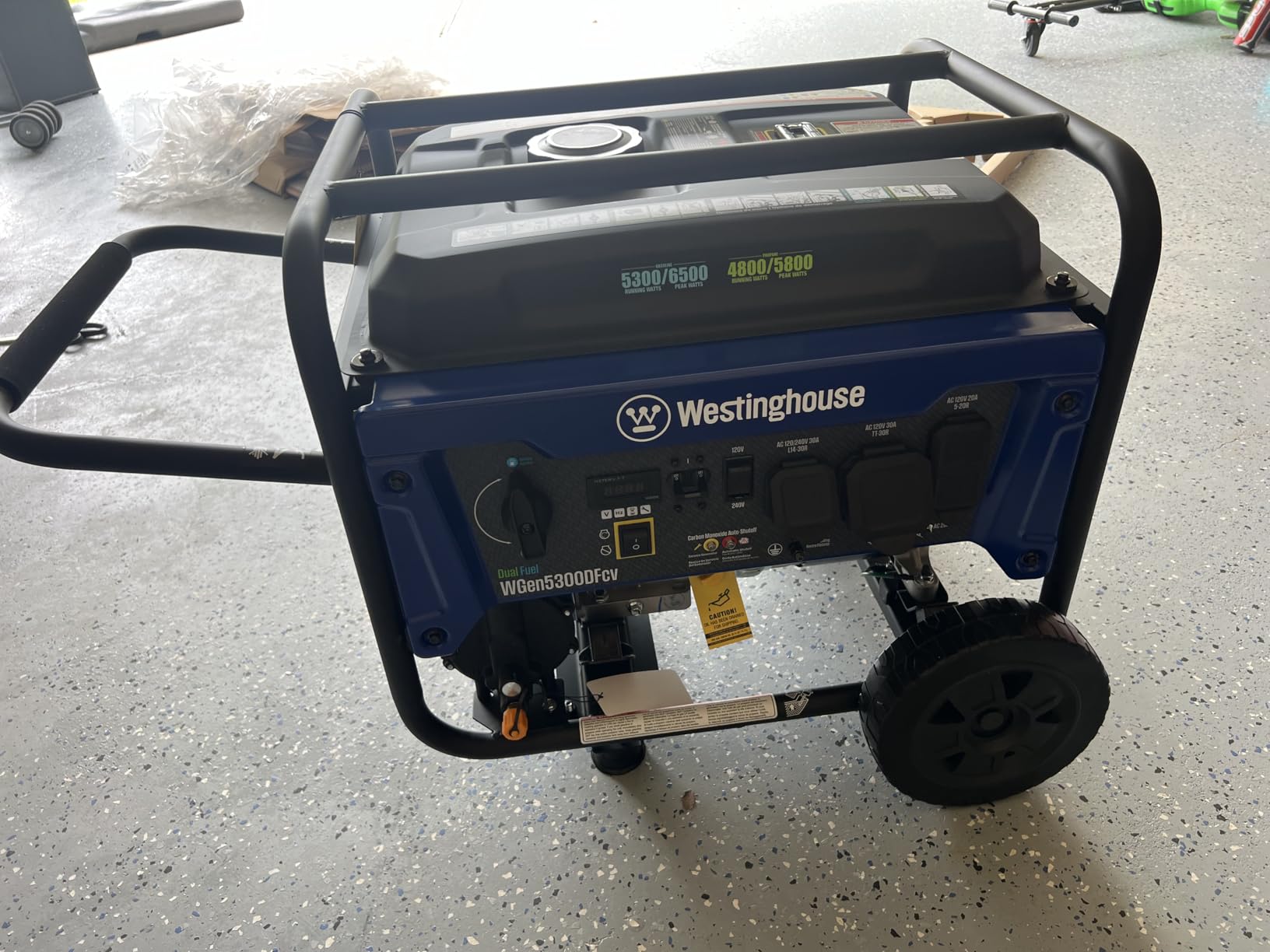
Safety features are genuinely good for the money: a CO sensor with automatic shutdown, low oil shutdown and overload protection. Owners treat it as an affordable backup or jobsite generator and rate it 4.5 stars from just under 1000 reviews. The consistent note in that feedback is that the power ceiling suits essentials and partial-home loads rather than full whole home backup.
Outlets are one 5-20R 120V duplex receptacle, one RV-ready TT-30R 30A and one transfer switch ready L14-30R 30A receptacle. So it pairs with a 30A transfer switch, which is the right pairing for the load it can carry.
How to know if this is the right size for you
Add up what you would actually plug in during an outage. Refrigerator, freezer, a few lights, internet equipment and a gas furnace blower comes to roughly 1600 running watts. That leaves comfortable room inside 5300 for a sump pump, a coffee maker and a battery charger, and still leaves headroom.
What it will not do is carry an electric water heater at 4000 watts and anything else substantial at the same time. It also cannot start a central air compressor alongside a well pump. If either of those is in your plan, this is the wrong size and the smaller number on the label is telling you the truth.
What to watch before the first run
This variant uses magneto ignition rather than electric start, so plan on a recoil pull. That is one more reason many buyers in this roundup prefer the slightly larger electric start models, especially if the generator is being started by someone other than the owner during a night outage.
The open frame needs a weatherproof cover outdoors, and the cast iron sleeve is a real plus for a machine expected to sit for years between runs. At 135.6 pounds with a wheel kit, one person can reposition it, which matters if your outlet placement or setback distance is not ideal on the first try.
8. WEN DF680iX – Inverter Power for Electronics and EV Charging
WEN 6800-Watt Dual Fuel RV-Ready Electric Start Portable Inverter Generator with Fuel Shut Off and CO Watchdog for Electric Vehicle Backup (DF680iX)
5100 rated watts gas
4500 rated watts propane
99.2 lb dry weight
3-year warranty
Pros
- Inverter output suited to sensitive electronics
- Bonded neutral 240V supports Level 2 EV charging
- Lightest model here at 99.2 pounds
- Tool-free LPG quick connector
- Fuel shutoff burns off carburetor fuel
Cons
- Only two 120V household outlets
- Loud under heavy load despite quiet idle
- 5100 rated watt ceiling
- Some reports of no-spark failure
The DF680iX is the only true inverter generator in this roundup, and that changes what you can safely connect to it. On gasoline it delivers 5100 rated watts with 6800 surge, and on propane 4500 rated with 6000 surge, from a 224cc dual-fuel engine with electric start. Inverter units regulate output so sensitive electronics see clean power rather than the mild flicker a conventional generator produces.
It is also the easiest machine here to move, at 99.2 pounds, with onboard wheels, a telescoping pull handle and a tool-free LPG quick connector. RV owners report running multiple 15,000 BTU air conditioners, all RV lighting and appliances off it, with about 12 hours on a standard propane bottle and roughly 28 to 30 hours on a 40 lb bottle.
The bonded-neutral 240V configuration is designed for Level 2 EV charging, and the outlet panel includes one L14-30R 120/240V, two 120V three-prong outlets, one TT-30R RV outlet, one 12V DC and two 5V USB ports. A WEN Watchdog CO sensor and a fuel shutoff system that burns off remaining carburetor fuel before shutdown round out the safety picture.
The 4.4 star average comes from about 400 reviews. Complaints center on loudness under heavy load despite quiet idle behavior, only two 120V household outlets, and an isolated but notable no-spark failure combined with unresponsive support. Note the trade: quiet idle means less noise at light load, not a quiet machine at full output.
Where inverter power earns its place
If your essential list includes computers, network gear, a home office setup, medical equipment or an electric vehicle, power quality stops being a nicety and starts being the reason you bought the machine. Inverter output is the correct call for that list, and this is the model to look at first even though it is the smallest.
At 5100 rated watts on gasoline it will run a refrigerator, freezer, internet, lights and a small air conditioner without strain. It is not the choice for a well pump and central air together, so if your house is defined by those two loads, a conventional 9500 watt model remains the better answer.
What to watch before the first run
Two 120V household outlets is genuinely few for a home backup scenario. Plan what plugs where, and remember the TT-30R and L14-30R twist locks need properly rated plugs rather than household adapters for anything beyond a light load.
Also expect noise when you load it up. Owners describe it as quiet at idle and noticeably loud under heavy load, so the dB rating alone does not tell the whole story. At 99.2 pounds it is the one machine in this roundup a single person can easily reposition, which lets you place it where the exhaust stays away from doors and windows.
Dual Fuel Portable vs Tri Fuel and Natural Gas Standby
This is the question forum users ask most often and no roundup answers directly, so here is our take. A dual fuel portable runs on gasoline and propane you supply yourself. A tri fuel unit adds natural gas, which only works if your home has a gas line that stayed pressurized through the outage. A natural gas standby unit is permanently installed and starts on its own within seconds.
The case for a dual fuel portable is cost and control. You buy the machine once, it sits in the garage, and you choose the fuel depending on what is available. The case for standby is automation: no one has to be awake, and it keeps running when the power is out for days because the gas line is the fuel supply.
The honest limitation of the portable approach is fuel logistics. Homeowners with standby units report that neighbors running portable generators constantly run dry and need supply runs. If your outage risk is a multi-day event with no fuel deliveries, that is a real risk to weigh, and it is the argument most often made for a permanently installed system.
Our take: a dual fuel portable covers the first 24 to 48 hours of most outages very well, which is when the critical loads run. Beyond that, you are managing fuel. If your outages routinely run longer and your fuel supply is uncertain, budget for both, or plan for a standby system instead.
Buying Guide: Sizing, Transfer Switches, Fuel and Safety
Calculate your wattage in four steps
Step one: list every load you want to run during an outage, not the loads you hope to run. Step two: get the running watts and the starting watts for each, from the appliance label rather than from memory. Step three: add the running watts together, then add the single largest starting watt figure on top of that total, because only one motor typically starts at a time. Step four: add 20 percent headroom and choose from the band that results.
A soft start or surge suppressor on a large compressor load can reduce the total estate load enough to drop you into a smaller generator. Homeowners with central air frequently save significant capacity this way, and it is a cheap addition compared with buying a larger machine.
30 amp vs 50 amp transfer switch
The amperage of your transfer switch has to match the outlet on the generator, not the other way around. An L14-30R outlet is a 30 amp connection and pairs with a 30A transfer switch. A 14-50R outlet is a 50 amp connection and pairs with a 50A switch. The Westinghouse WGen9500DF, the DuroMax XP13000EH, both Pulsar 12,000 watt models and the DuroStar all give you the 50A option. The WEN DF8000X and Westinghouse WGen5300DFcv give you 30A only.
Is 30 amp enough? For an essentials installation, yes. A 30A switch at 240V gives you 7200 watts, which covers refrigerator, freezer, lights, internet, gas furnace and a sump or well pump. Go to 50A when you intend to run a central air conditioner or an electric water heater.
What transfer switch ready actually means
It means the generator has a properly wired twist-lock receptacle intended to connect to the inlet of a transfer switch, which prevents back-feeding utility power into the grid. It does not mean the generator is safe to plug straight into your panel. Use a licensed electrician for the transfer switch, the inlet box and any panel work, and never connect a portable generator directly to a breaker without an approved interlock device.
Beyond the machine itself, you are paying for a transfer switch, an inlet box, wiring from the switch to the panel, and labor. Homeowners regularly cite this as the surprise in the total cost, and it is the reason a homeowner who only planned to budget for a generator ends up with a much larger number. Ask for an itemized quote covering hardware, conduit and labor separately.
Total installed cost, size by size
Plan in bands rather than exact figures, since panel condition, distance and local labor all move the total. For a 30A essentials installation with a 5000 to 6500 watt machine, the generator is one part of a total that includes the transfer switch, an inlet box, feeder wiring and electrician labor. For a 50A installation with a 9500 to 13000 watt machine, the switch and wiring side of the job grows because of the heavier conductor required.
The rule that saves money: decide the transfer switch amperage before you buy the generator, then buy a machine whose outlet matches. Owners who buy the generator first and then discover their outlet is 30A when they wanted 50A end up buying an adapter chain or a second machine. That is the single most expensive sequencing mistake in this category.
Inverter vs conventional output
Conventional generators in this roundup use raw alternator output with total harmonic distortion high enough to make sensitive electronics reset or flicker. Inverter generators use a digital conversion stage that holds distortion low and steps the engine speed down at light load, which is both quieter and more fuel efficient.
If your essential list is a refrigerator, furnace, lights, a well pump and a sump pump, conventional output is fine. If it includes computers, network equipment, medical devices or an electric vehicle, inverter output is the safer choice. The WEN DF680iX is the inverter option here, and forum owners consistently recommend a pair of inverter machines sized to base load over one oversized conventional unit.
Propane vs gasoline
Gasoline gives you roughly 10 percent more output than propane on the same engine, and gasoline is easier to find in a normal week. The problem is storage. Gasoline goes stale, absorbs moisture and is a fire hazard in quantity, so owners store it with stabilizer and rotate it.
Propane stores indefinitely, burns cleanly and keeps its full rating if the cylinder is sealed. The trade is output and logistics: every model here produces less on propane, and small 20 lb cylinders run down in an evening at full load. For outages that last days, propane wins on storage. For a single night of heavy motor loads, gasoline wins on power.
Runtime and refuel planning
Runtimes in this roundup run from about 10.5 hours at half load for the WEN DF8000X up to a 17 hour manufacturer claim for the DuroStar on its 8.3 gallon tank. Those figures assume half load, and half load is a laboratory condition rather than an outage condition.
Plan for a three to seven day event by counting fuel rather than hours. For a full output event, budget enough gasoline or enough exchangeable propane cylinders to cover your base load for several days, because the constraint in most outages is delivery, not tank size. Store spare fuel safely, away from the house, in approved containers.
Noise, placement and the 20 foot setback
Run any generator at least 20 feet from the house, with the exhaust pointed away from doors, windows and vents. That distance matters for carbon monoxide safety and it is also what keeps neighbor friction from becoming the reason your generator gets shut off mid-outage.
Use the manufacturer’s published decibel figure as a rough guide rather than a promise. For reference, a refrigerator runs near 45 dB, an ordinary conversation sits around 60 dB and a vacuum cleaner hits about 70 dB. Open-frame conventional machines in the 10,000 watt class are loud enough at idle that placement does more for your household peace than any purchase decision between two similar models.
Maintenance before and between outages
Add oil to the crankcase before the first start on any model that does not include it, and check the level before every start after long storage. Run the machine for 30 minutes unloaded after installation to break it in. After that, run it monthly for 15 to 20 minutes under a modest load so fuel does not varnish in the carburetor and the battery stays charged.
Change the oil on the schedule in your manual, use fuel stabilizer for stored gasoline, and exercise the transfer switch every few months so it does not seize. Most emergency failures we hear about are not engine failures at all. They are stale fuel, a flat battery, or a starting switch nobody has tested since the last outage.
Frequently Asked Questions
What size generator do you need to run a whole house?
For a whole house you need 7,500 to 12,500 running watts to cover essentials such as a refrigerator, freezer, lights, internet, gas furnace and a sump or well pump. Add 20 percent headroom on top. If you plan to run a central air conditioner and an electric water heater at the same time, look at 20,000 running watts or more.
What is the disadvantage of a dual fuel generator?
The main drawbacks are that it costs more than a gasoline-only generator, is heavier, and produces less output on propane than on gasoline, typically by about 10 percent. It also needs both fuel types on hand, and propane cylinders can stop delivering vapor in very cold weather during long runs.
Is a 30 amp transfer switch enough?
A 30 amp transfer switch is enough for an essentials installation. At 240V it delivers about 7200 watts, which covers a refrigerator, freezer, lights, internet, a gas furnace and either a sump pump or a well pump. Move to a 50 amp switch if you intend to run a central air conditioner or an electric water heater.
What does it mean when a generator says transfer switch ready?
It means the generator has a correctly wired twist-lock receptacle designed to plug into the inlet of a transfer switch, which stops utility power from back-feeding the grid. It does not mean you can plug the generator straight into your panel. A licensed electrician should install the switch, inlet box and any panel work.
Is it worth it to buy a dual fuel generator?
It is worth it if your outage risk is longer than a few hours or your fuel supply is uncertain. Propane stores indefinitely and burns cleanly, gasoline is easier to find in normal conditions, and the ability to switch between them means one fuel running low is not the end of your power. If outages are rare and short, a gasoline-only machine costs less.
How long does propane last in a generator?
It depends on cylinder size and load. Owners running a 6,800 watt dual fuel inverter on a standard bottle report about 12 hours, and roughly 28 to 30 hours on a 40 lb bottle. Larger 10,000 watt machines use propane faster, so a standard bottle covers an evening of base load rather than a full night at full output.
How far from the house should I run a generator?
Run any generator at least 20 feet from the house with the exhaust pointed away from doors, windows and vents. That distance limits carbon monoxide intrusion and also reduces noise complaints with neighbors, which is a common reason generators get shut off during long outages.
Should I buy a dual fuel generator or a natural gas standby unit?
A dual fuel portable covers the first 24 to 48 hours of most outages well and costs far less up front, but you manage the fuel yourself and someone has to start it. A natural gas standby unit starts on its own within seconds and keeps running as long as the gas line holds pressure. Choose standby if your outages routinely run past a few days and your fuel deliveries are uncertain.
Final Verdict for Whole House Backup Power in 2026
The Westinghouse WGen9500DF is our pick for the best dual fuel generators for whole house backup in 2026. It pairs 9500 running watts on gasoline with 8500 on propane, remote key fob start, a cast iron sleeve engine, and both 30A and 50A outlets, and it holds a 4.7 star average across more than 8900 reviews. Very few machines in any price band have that much owner history behind them.
Buy the DuroMax XP13000EH if you need the extra surge capacity for central air and an electric water heater, and the Pulsar G12KBN if fuel logistics matter most and you want the largest tank here. If your load is electronics and an electric vehicle rather than motors and pumps, the WEN DF680iX gives you inverter power quality at the lowest weight in the roundup.
Whatever you choose, decide the transfer switch amperage first, add oil before the first start, and run the machine monthly. That preparation does more for you in a real outage than the gap between two similar generators.