
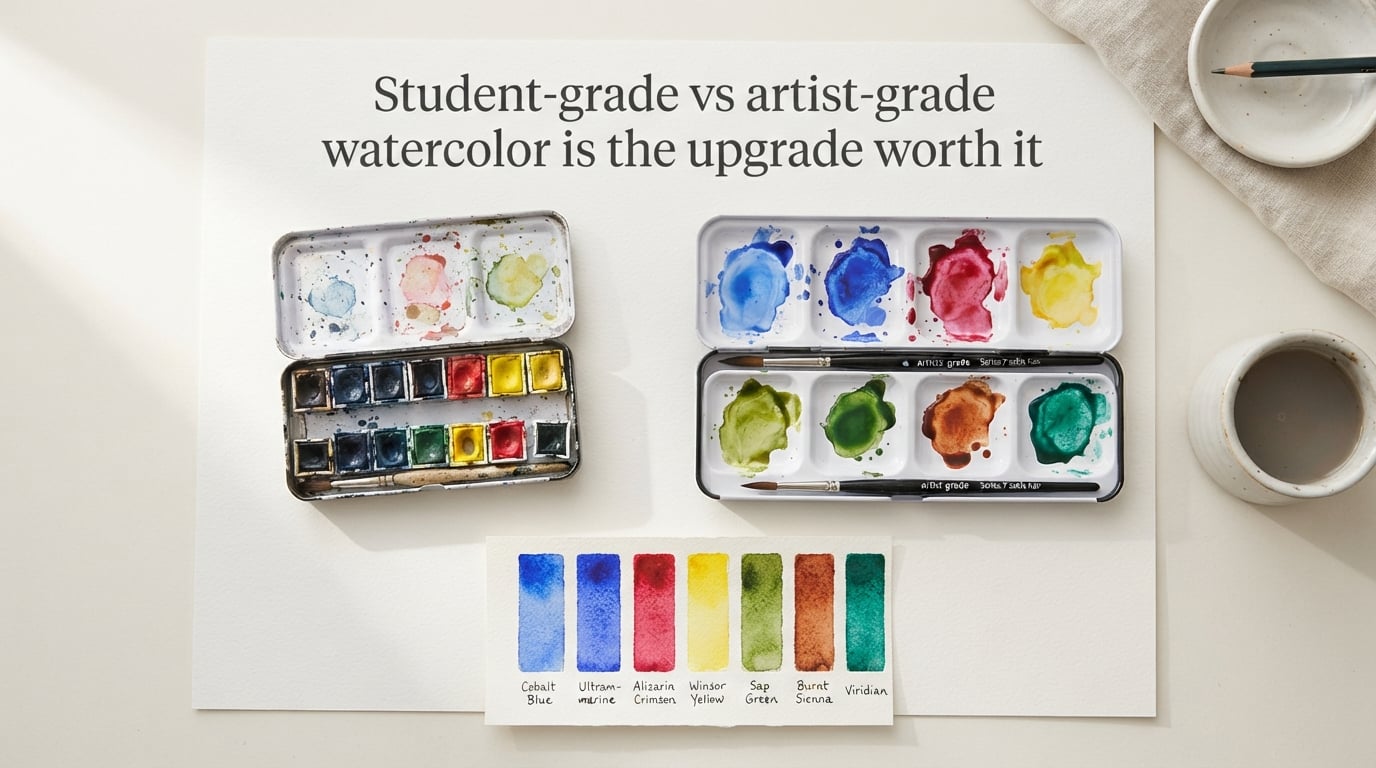
If you’re staring at your Cotman half-pan set and wondering whether it’s finally time to drop serious money on a Daniel Smith tube, the honest answer to “is the student grade vs artist grade watercolor upgrade worth it?” is this: yes, once you know what watercolor can do — but not before. The upgrade rewards commitment, pigment knowledge, and a clear goal (sale, archive, or just richer color). If you’re still learning how water moves on paper, a quality student-grade set is the better tool for the job in 2026.
The rest of this article breaks down exactly what changes between the two grades, why artist-grade paint costs what it does, and how to upgrade one tube at a time without wrecking your budget.
Table of Contents
Student Grade vs Artist Grade Watercolor: Quick Comparison
Before we go deeper, here’s the side-by-side. This is the table most readers bookmark.
| Attribute | Student Grade | Artist Grade |
|---|---|---|
| Pigment load | Lower — more filler per tube or pan | Higher — more pigment, less filler |
| Fillers | Yes — chalk, dextrin, or dextrin substitutes | Little to none |
| Single pigments | Often replaced with hue mixtures | Wide range of true single-pigment colors |
| Mixing predictability | Good, but surprises happen with hues | Excellent — color theory works as expected |
| Granulation | Usually smooth, less character | Often pronounced — pigment “magic” visible |
| Lightfastness | Variable — some fugitive colors | Generally rated permanent or semi-permanent |
| Wash vibrancy | Pleasant, slightly chalky at high dilution | Deep, luminous, intense at any dilution |
| Price per pigment gram | Lower up-front, higher per gram of pigment | Higher up-front, better pigment value |
What Is Student Grade Watercolor?
Student-grade watercolor is paint made by major manufacturers with cost and ease-of-use prioritized over maximum vibrancy. To hit a friendly price point, brands swap a portion of expensive pigment for inert fillers like chalk, dextrin, or other extenders. The result is paint that performs reliably, mixes without drama, and lets beginners practice without worrying about waste.
The most recognized student-grade line is Winsor & Newton Cotman, a smaller-pigment-set version of the brand’s professional line. Other solid student-grade options include Daniel Smith’s Primateck line, Sakura’s Koi, and White Nights full-pan sets. All deliver a workable, reasonably vibrant wash that’s more than enough for sketchbooks, journaling, and learning technique.
Student-grade paint comes in two formats: half pans and tubes. Half pans dry into the palette and rewet on demand — great for travel and slow painting. Tubes are wet, concentrated, and give richer puddles. If you find Cotman pans look a little washed out, try a tube of the same pigment; the wet form almost always looks more vivid.
What Is Artist Grade Watercolor?
Artist-grade (also called professional-grade) watercolor is paint formulated with maximum pigment concentration and minimum filler. Every pigment used is rated for lightfastness, and the line typically offers a much broader pigment selection — including rare and unusual pigments like Lapis Lazuli, transparent pyrrole oranges, and quinacridone violets.
The leading artist-grade brands are Daniel Smith, Schmincke, Winsor & Newton Professional, Holbein, Sennelier, and MaimeriBlu. Each has a slightly different personality: Daniel Smith is famous for granulating earth pigments, Schmincke for luminous transparent washes, Holbein for buttery rewetability, Winsor Professional for clean color theory.
Artist-grade paint almost exclusively lists its pigment code on the tube — something like PB15 (Phthalo Blue) or PR112 — so you know exactly what’s inside. That transparency makes mixing more predictable, especially once you start combining transparent pigments for glazing effects.
Why Artist Grade Costs More
The price difference comes down to three things: the pigment itself, the grinding process, and the labor of producing small batches of varied colors.
Pigment is the expensive ingredient. Some synthetic pigments are cheap, but historically important colors — cadmiums, cobalts, ultramarines — require heavy metal compounds or complex chemistry. Lapis Lazuli, the original “ultramarine,” is literally ground from semi-precious stone. Student-grade lines often recreate these expensive pigments as hue mixtures — blends of cheaper pigments that approximate the original color.
Grinding matters too. Artist-grade pigments are milled longer and finer, which means they disperse more evenly in water and resettle less on the paper. That extra milling is part of the labor cost.
Finally, artist-grade lines offer wider color ranges — sometimes 70 to 100 individual pigments in a single brand. Student lines might offer 24 or 48 colors total. Smaller runs of more SKUs means higher per-unit cost.
Pigment Concentration vs Fillers Explained
Here’s the simplest way to think about it: imagine two glasses of orange juice. One is fresh-squeezed concentrate with a little water. The other is mostly water with concentrate, sugar, and pulp. They’re both orange juice. One is just denser in the expensive ingredient.
Student grade adds fillers — usually chalk or dextrin — to bulk up the pan or tube. A Cotman half pan might contain real pigment at maybe a third of what a Daniel Smith pan contains. The chalk doesn’t help the color; it just makes the paint go further in the pan and keeps the price down. There’s nothing wrong with that for learning, but you’ll notice it as a slight chalkiness when you push a wash very thin or layer colors heavily.
This is also where the term single-pigment comes in. A single-pigment paint uses one pigment (plus binder and minor additives). A hue mixture uses two or more cheaper pigments blended to look like a single color. Single-pigment paints mix more cleanly because each color in your mixture shifts the result predictably; hue mixtures can produce muddy surprises when you cross-mix them. Most artist-grade lines offer both single pigments and hues — student lines lean heavily on hues for cost reasons.
Granulation and Pigment Magic
This is the upgrade moment most people describe as “night and day.” Granulation is the texture that appears when heavier pigments settle into the tooth of watercolor paper, creating soft mottled patterns instead of a flat wash. Some pigments — earth tones like burnt sienna, raw umber, and Daniel Smith’s Moonshadow — granulate dramatically.
In a student-grade pan, that same pigment is typically a hue mixture made of smoother particles, so the granulation never really shows. In an artist-grade tube, especially one containing the actual iron oxide pigment, the granulation is unmistakable. Painters call the visible difference “pigment magic” — the moment when the paint stops looking like a stain and starts looking alive on the paper.
If you love wet-on-wet techniques, the upgrade is particularly obvious here. Artist-grade pigments separate and dance in a wet wash; student-grade pigments tend to blend into a more uniform tint.
Lightfastness, Permanence, and Work Longevity
One underrated reason to upgrade is permanence. Lightfastness measures how well a pigment resists fading when exposed to light. Student lines commonly include fugitive colors — bright violets, opera pinks, certain cadmium hues — that fade noticeably over months of window light. Artist lines flag these explicitly with permanence ratings (usually ASTM I or II).
If you’re painting for a sketchbook no one but you sees, fugitives are fine. If you’re selling prints, gifting work, or building a portfolio, fugitive colors are a quiet liability. A drawing that looked vivid on day one can look washed out in a year, and you can never restore the lost saturation.
Permanent pigments cost more to produce — that’s part of why the price is higher. It’s also part of why many serious artists will never paint on a palette that mixes cheap violets with expensive cobalts.
Is the Upgrade Worth It? A Reader-Segment Decision Tree
The honest answer depends entirely on where you are in your watercolor journey. Here’s how I think about it.
If You’re an Absolute Beginner (0 to 6 Months In)
Stay on student grade for now. A solid Cotman or Koi set will outlast your learning curve, and you’ll waste far less paint on early experiments. The upgrade will reward you more once your brush control is consistent enough to actually showcase what artist-grade pigment can do.
If You’re a Serious Beginner (6 to 18 Months)
This is the upgrade window. You’ll start noticing when a color “doesn’t pop” the way a friend’s Holbein does, and you’ll feel the difference in wet-on-wet work. Buy one or two artist-grade tubes — a quinacridone rose and a phthalo blue are popular first choices — and use them alongside your Cotman set to feel the difference directly.
If You’re a Serious Hobbyist or Urban Sketcher
Upgrade most of your core palette. The vibrancy, mixability, and granulation are visible in nearly every sketch you make. You’ll likely keep one or two Cotman colors you genuinely love (some Cotman hues have devoted fans), but the rest will migrate to artist-grade equivalents.
If You Sell, Exhibit, or Archive Work
Upgrade the entire palette and stick to permanent pigments only. Fugitive colors aren’t worth the risk on work that needs to last.
There’s also a real Reddit community of painters who say they couldn’t tell the difference until they painted with both side by side. That’s not a reason to avoid upgrading — it’s a reason to test before you commit. Most makers sell sample tubes or half pans. Try one color, paint with it, compare it to your existing Cotman of the same pigment, and let the swatches decide.
A Practical Upgrade Path on a Budget
You don’t have to replace your entire palette overnight. A sensible six-month plan looks like this:
- Month 1: Buy a sampler set of three single-pigment artist tubes (a yellow, a red, a blue). Paint swatch sheets — small labeled grids of diluted pigment — to log each color’s behavior.
- Month 2: Add the artist-grade version of your single most-used Cotman color. Most painters replace their go-to blue or red first because that’s where the difference is most obvious.
- Month 3: If you love wet-on-wet, swap in one granulating earth tone (burnt sienna, raw umber, or a Moonshadow) and try it in a sketch.
- Month 4: Add one unique artist-grade pigment you couldn’t get in student grade — quinacridone gold, phthalo green, or a Daniel Smith Primatek.
- Month 5: Audit your Cotman pans. Keep the ones you genuinely love; replace the rest as the artist-grade tubes run out.
- Month 6: Re-swatch your entire palette. You’ll have a coherent set that mixes predictably and looks closer to the colors you picture in your head.
Sample tubes, dot cards from watercolor societies, and brand trial packs are the budget-friendly way to test before committing to full tubes. Many artist-grade brands also sell sets of three or six single-pigment tubes that cost less than a single professional Cotman half-pan set.
Frequently Asked Questions
What are the key differences between student-grade and artist-grade watercolor?
Student-grade paint uses less pigment and more fillers (like chalk and dextrin) to keep the price low, while artist-grade paint uses more pigment and little to no filler. Student lines often substitute hue mixtures for expensive pigments, which makes cross-mixing less predictable. Artist-grade paint typically offers better lightfastness, stronger granulation, and a wider pigment selection.
What is artist grade watercolor?
Artist-grade (also called professional-grade) watercolor is paint made with maximum pigment concentration, minimal filler, and pigments rated for lightfastness. Brands like Daniel Smith, Schmincke, Winsor u0026amp; Newton Professional, Holbein, and Sennelier publish each tube’s pigment code, so you know exactly what you’re mixing. The price is higher because real pigment is the most expensive ingredient.
Is the upgrade from student grade to artist grade watercolor worth it?
Yes, once you’ve been painting consistently for six to twelve months and can already see the difference. The upgrade rewards you with richer washes, more predictable mixing, visible granulation, and permanent pigments that won’t fade. If you’re still learning the basics, a quality Cotman or White Nights set will serve you just as well and save you money while you build skill.
What is the best student grade watercolor paint?
Winsor u0026amp; Newton Cotman is the most widely recommended student grade line because it mirrors the brand’s professional pigment selection with a friendlier price. Daniel Smith Primateck, Sakura Koi, and White Nights full-pan sets are also strong choices. Cotman tubes generally look more vivid than Cotman pans of the same color, so if you’re after vibrancy, try the tube form first.
Which watercolor grade is better for beginners?
Student-grade paint is better for absolute beginners because it’s less expensive, more forgiving, and lets you practice mixing and brush control without worrying about wasting pigment. Once you’re confident in your technique and want richer color or archival permanence, you can upgrade one tube at a time without having to replace your whole palette.
The Real Answer on the Upgrade
Whether the student grade vs artist grade watercolor upgrade is worth it comes down to commitment. If you paint weekly and can already name your favorite colors, you’ll feel the upgrade the moment a quinacridone or cobalt glides onto your paper — and you’ll wonder why you waited.
If you’re still in the first few months, there’s no shame in staying on Cotman or Koi. Save the artist-grade money, learn your technique, and start the upgrade one tube at a time when you’re ready. The pigments aren’t going anywhere, and neither is the moment when the upgrade finally makes sense.