
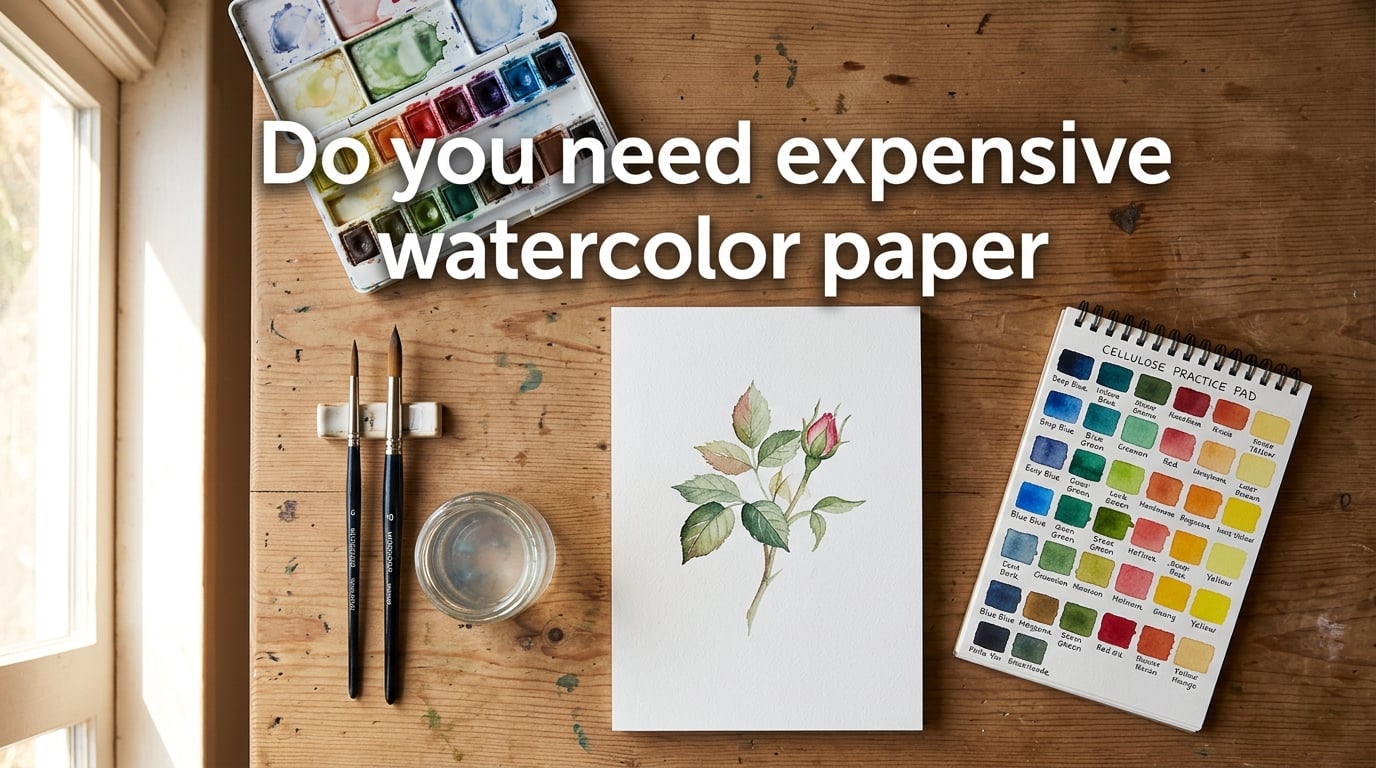
You do not always need expensive watercolor paper, but quality matters far more than most beginners realize. Paper is the foundation of every painting, and cheap cellulose sheets buckle, pill, and suck pigment into dull flatness within minutes.
The honest answer is this: use student-grade paper for practice and color studies, but switch to 100% cotton artist paper for finished work, wet-on-wet techniques, and anything you plan to keep, frame, or sell. The “golden rule” experienced watercolorists repeat on forums is that bad paper makes good paint look bad, and good paper makes even student paint look respectable.
In this guide, I break down what actually separates a premium sheet from a budget pad, where mid-range papers fit, and how to build a simple framework so you stop wasting money on the wrong grades. By the end, you’ll know exactly when the extra cost pays off and when it’s pure guilt.
Table of Contents
Why Paper Quality Is the Most Important Decision in Watercolor
Here’s something almost every watercolor teacher repeats: paper matters more than paint, more than brushes, and arguably more than skill level at the start. I learned this the hard way with a set of expensive pigments on a five-dollar pad that turned every wash into a sad, muddy puddle.
Watercolor behaves differently than acrylic or oil because the support itself does most of the work. Cotton fibers absorb water evenly, hold pigment on the surface long enough to lift or blend, and then release cleanly when dry. Cellulose fibers absorb too fast, leave pigment uneven, and buckle badly under heavy washes.
That single difference changes how forgiving the medium feels. On cotton paper, you can lift a mistake, soften an edge, or push pigment around for 30 seconds. On cheap paper, the surface locks everything in within five seconds, so the painting either works or it doesn’t, and there’s no rescue.
For beginners, this gap is huge. A learner on decent cotton paper makes steady progress. The same learner on budget cellulose paper spends most of their energy fighting the surface, not learning watercolor.
Cotton vs Wood Pulp: What Makes Expensive Paper Expensive
The single biggest factor in watercolor paper price is the fiber source. Cotton paper is made from cotton linter (the short fuzz around cotton seeds), while cheaper paper uses wood pulp processed into cellulose fibers.
Cotton fibers are longer, stronger, and more absorbent than cellulose. They resist breaking down when soaked, rewet, or scrubbed. Cellulose fibers are shorter and weaker, which is why cheap paper pills, tears at the edges, and yellows within a few years.
Cotton also gives paint more “room to live.” Pigment sits on top of the fibers instead of sinking in, so colors stay vibrant and granulation effects (the speckled look in earthy pigments) actually show up. On cellulose, the same paint looks flatter and chalkier because the pigment gets dragged into the fiber structure.
Cotton vs Wood Pulp at a Glance
| Property | 100% Cotton Paper | Wood Pulp (Cellulose) Paper |
|---|---|---|
| Durability when wet | Stays intact, rewets cleanly | Pills, tears, weakens |
| Absorbency | Controlled, even | Fast, uneven, often blotchy |
| Color vibrancy | High; pigment sits on surface | Muted; pigment sinks in |
| Lifting and correcting | Easy, paint lifts cleanly | Difficult, often damages surface |
| Longevity | Archival (50+ years) | Yellows within 5–10 years |
| Typical cost (per sheet) | Higher | Lower |
Reddit users in r/watercolor and r/Watercolor101 are nearly unanimous on this: once they switched to cotton, their enjoyment of the medium jumped overnight. One user described it as “the difference between painting on a sponge versus a cloud.”
Paper Weight and Thickness: Why 140 lb / 300 gsm Is the Standard
Paper weight is measured two ways: pounds (lb), which is the weight of 500 sheets at a standard size, and grams per square meter (gsm), which is universal. A 140 lb sheet equals 300 gsm, and that weight has become the de facto standard for watercolor work.
Lighter papers, around 90 lb / 190 gsm, buckle badly. They absorb so much water that even a single wash warps the sheet into a taco shape. Heavy papers, around 300 lb / 640 gsm, are stiff enough to stay flat without stretching, but they cost more and don’t feel as natural under the brush.
Paper Weight Comparison
| Weight | Thickness | Buckling | Best For |
|---|---|---|---|
| 90 lb / 190 gsm | Light | Severe | Quick sketches, light washes, practice only |
| 140 lb / 300 gsm | Medium | Minor, manageable | All-purpose work, the universal standard |
| 300 lb / 640 gsm | Heavy | Minimal | Wet-on-wet, large washes, no stretching needed |
For most artists, 140 lb / 300 gsm hits the sweet spot. It absorbs enough water to handle multi-layer work, holds up to lifting and corrections, and stays flat with light taping or stretching. If you only own one weight, this is the one.
Paper Texture: Hot Press, Cold Press, and Rough
Beyond fiber and weight, watercolor paper comes in three surface textures. Texture affects how paint flows, how details hold up, and how the finished painting reads.
Hot press is the smoothest. It’s pressed between heated rollers during manufacturing, which flattens the fibers. Hot press is ideal for detailed illustration, fine line work, botanical art, and tight representational pieces. The downside: pigment can pool in small spots because there’s no tooth to catch it.
Cold press is the most popular and what I recommend beginners start with. It’s pressed without heat, leaving a moderate texture. Cold press handles both broad washes and detail reasonably well, which is why experienced watercolorists call it the “all-purpose” surface.
Rough paper has the most pronounced tooth, with visible peaks and valleys across the surface. Rough excels at granulation effects, soft washes, and atmospheric landscapes. It’s harder to control for fine detail and not the first choice for beginners.
Texture at a Glance
| Texture | Surface Feel | Best For | Beginner Friendly |
|---|---|---|---|
| Hot Press | Smooth, almost like drawing paper | Detail, illustration, tight realism | Moderate |
| Cold Press | Medium tooth, slight texture | General painting, landscapes, portraits | Yes (most popular) |
| Rough | Heavy texture, visible peaks | Granulation, atmospheric work | Not really |
If you’re not sure, buy a small block of cold press first. It forgives the widest range of techniques and is what most professional watercolor artists actually use day to day.
Student Grade vs Artist Grade: The Real Difference
Paper brands usually group sheets into two or three tiers. Student grade is affordable, often cellulose or a cotton-cellulose blend, and is meant for learning and practice. Artist grade is 100% cotton, acid-free, and built for finished work and archival longevity.
Within artist grade, you’ll sometimes see “professional” or “extra” labels. These are mostly marketing tiers, but they often signal mould-made production (where the sheet is formed in a traditional frame) versus machine-made. Mould-made paper has more random fiber distribution, which gives a slightly more organic look and better dimensional stability.
Grade Comparison
| Factor | Student Grade | Artist Grade |
|---|---|---|
| Fiber content | 25–50% cotton, rest cellulose | 100% cotton |
| Sizing | Often surface sizing only | Internal and surface sizing |
| Wet strength | Moderate | High |
| Archival (acid-free) | Sometimes, varies by brand | Yes, always |
| Cost | Lower per sheet | Higher per sheet |
The sizing detail matters. Internal sizing means the sizing agent (usually gelatin or synthetic) is mixed into the pulp before forming the sheet, so water absorption is controlled throughout the paper’s depth. Surface sizing is just a coating on top. Both work, but internally sized paper survives more washes and rewetting.
When Expensive Paper Is Worth It (and When It Isn’t)
This is the section most guides skip, and it’s the one that actually answers your question. Here’s the simple framework I use:
Use expensive (100% cotton) paper for: finished artwork you intend to keep, frame, gift, or sell. Anything using wet-on-wet blending. Glazing work with multiple transparent layers. Detailed pieces where lifting mistakes is essential.
Use cheap (student grade) paper for: daily practice, color swatching, value studies, thumbnail composition sketches, technique experiments, and the first 50 to 100 paintings of your learning journey.
Forum regulars in r/watercolor often point out the hidden cost of doing everything on premium paper: anxiety. Several users describe literally freezing up when they put a brush to an Arches sheet. The fear of “wasting” it ruins the painting more than the paper helps it. That’s not a paper problem; that’s a workflow problem.
The solution is to budget your paper use. Keep two stacks: one for finished work, one for everything else. When you practice, you should feel free to make mistakes. When you sit down to a finished piece, you’ve earned the right to be there.
How to Make Expensive Paper Last (and Beat the Anxiety)
Here are the practical habits that experienced watercolorists use to get the most out of premium sheets without guilt.
1. Cut full sheets into smaller sizes. A 22 by 30 inch Arches sheet can become four 11 by 15 inch paintings or eight postcards. Smaller sizes lower the stakes per piece and let you finish a “complete” painting more often.
2. Swatch colors on scrap first. Before you commit pigment to your final piece, test mixes on a corner of the same paper. Same paper, same absorbency, same result.
3. Plan the composition before painting. Lightly sketch with a pencil, decide your values, and know where the dark spots will go. The premium paper doesn’t reward spontaneity the way cheap paper forgives it.
4. Work from background to foreground. Wet-on-wet backgrounds lay down first. Sharper details come last when the paper is drier. This sequence keeps your best paper looking its best.
One of my favorite Reddit insights is that some artists deliberately reserve their “best” paper for moments when they have uninterrupted time. Painting on cotton without distractions turns into a small ritual, which is part of why the medium attracts so many people who find it therapeutic.
Mid-Range and Budget Papers Worth Considering
Most reviews jump straight from budget to Arches, but there’s a middle tier that delivers roughly 80% of the cotton experience for a much friendlier cost.
Stonehenge Legion is a 100% cotton paper made in the US and often priced noticeably below European equivalents. It handles wet-on-wet beautifully and is popular among illustrators.
Baohong is a Chinese cotton paper brand that has gained a strong following on Reddit and YouTube for offering excellent quality at a fraction of the cost of Arches. Cold press blocks in particular are widely recommended for both beginners and intermediate painters.
Phoenix is another budget-friendly cotton option that competes closely with Baohong. Both are solid choices for the price.
Canson XL is the standard student-grade recommendation. It’s cellulose-based, so it doesn’t compare to cotton, but it’s forgiving enough to learn on and cheap enough to waste without stress.
Fabriano Studio sits between Canson XL and cotton. It’s not 100% cotton, but the surface handles better than pure cellulose pads and costs less than premium brands.
Arches remains the gold standard 100% cotton paper. It’s mould-made in France, internally sized, and trusted by professionals worldwide. If you buy one premium paper for finished work, this is the safe choice.
Frequently Asked Questions
What paper do professional watercolor artists use?
Most professional watercolor artists use 100% cotton, acid-free paper from brands like Arches, Fabriano Artistico, Saunders Waterford, or Stonehenge Legion. The paper is typically 140 lb (300 gsm) cold press, which balances absorbency, durability, and texture for finished work.
What is the best watercolor paper for value?
For best value, look at mid-range 100% cotton papers like Baohong, Phoenix, and Stonehenge Legion. They deliver roughly 80 percent of the performance of premium European papers at a much friendlier cost, and are widely recommended on r/watercolor for both beginners and intermediate painters.
What is the golden rule of watercolor?
The golden rule is that good paper matters more than good paint or good brushes. Cheap cellulose paper makes even expensive pigments look dull and uneven, while 100% cotton paper makes almost any paint look respectable. Start with quality paper and your technique will improve faster.
What is the difference between 140 lb and 300 lb watercolor paper?
140 lb (300 gsm) is the standard medium-weight paper. It absorbs enough water for layering and stays mostly flat with light stretching. 300 lb (640 gsm) is heavy paper that needs no stretching and handles very wet washes without buckling, but costs more and feels stiff.
What are the differences between wood pulp and cotton watercolor paper?
Cotton paper is stronger, more absorbent, more durable when wet, and lasts decades without yellowing. Wood pulp paper (cellulose) is cheaper but weaker, absorbs unevenly, pills when scrubbed, and tends to yellow within a few years. Cotton is the better choice for finished or archival work.
What’s the best watercolor paper for beginners?
For practice, a student-grade cellulose pad like Canson XL is fine and cheap enough to use without stress. For learning techniques that actually matter, jump to 140 lb (300 gsm) cold press cotton paper, even mid-range brands like Baohong or Phoenix. Cold press is the most forgiving texture to start with.
Which GSM paper is best for watercolor for beginners?
300 gsm (140 lb) is the recommended starting weight. Lighter 190 gsm paper buckles badly and limits what you can do, while heavier 640 gsm paper is expensive and stiff. 300 gsm gives the widest room to learn washes, glazes, and corrections without constant frustration.
The Bottom Line
You don’t need expensive watercolor paper for every painting, but you do need to know which painting deserves it. Cheap cellulose pads are perfect for practice and learning the basics. The moment you start working on finished pieces, glazing, or wet-on-wet washes, the upgrade to 100% cotton paper pays for itself in saved frustration and better results.
My practical recommendation: buy a cheap cellulose pad for daily practice, and a single block of mid-range cotton cold press (Baohong, Phoenix, or Stonehenge Legion) at 140 lb / 300 gsm for everything else. As your skills grow, your paper investment grows with them. That’s the simple, sustainable way to enjoy the craft without burning through money or feeling guilty every time the brush hits the sheet.