
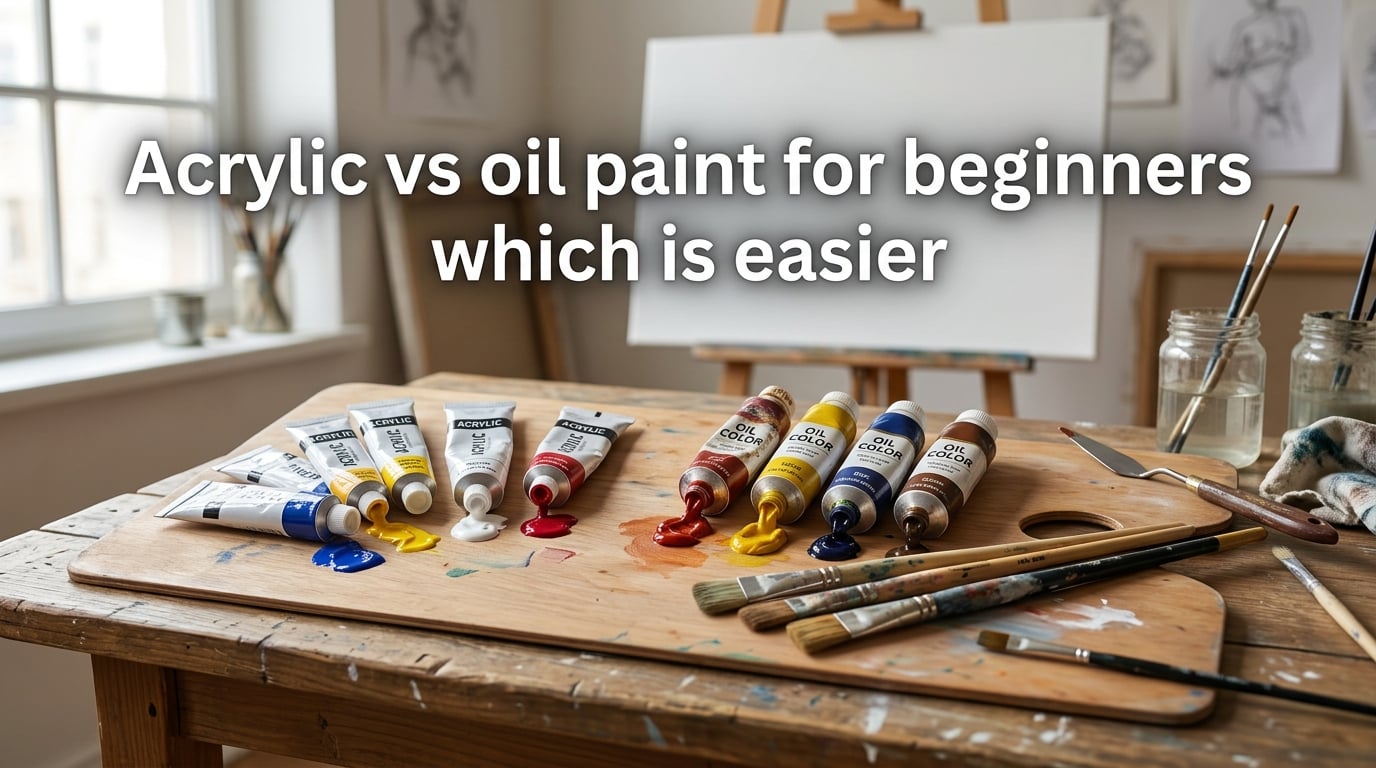
For most beginners, acrylic paint is easier to learn with. It dries within minutes, cleans up with just soap and water, costs less to start, and has virtually no fumes. Oil paint offers smoother blending and more working time, but it demands solvents, ventilation, and more patience upfront. In this guide, we’ll walk you through both mediums so you can pick the one that fits your goals and comfort level.
I’ve spent years painting with both acrylic and oil, and I’ve watched dozens of students wrestle with this same decision. Some thrive with acrylic’s fast pace. Others find oil’s slow, forgiving nature more natural. The answer isn’t one-size-fits-all, but by the time you finish reading, you’ll know exactly which medium to grab first — and what supplies you actually need to get started.
Table of Contents
Acrylic vs Oil Paint: Quick Comparison
Here’s a side-by-side look at how the two paints stack up for beginners across the factors that matter most. Bookmark this table if you want a quick reference later — it captures the core differences in one view.
| Factor | Acrylic Paint | Oil Paint |
|---|---|---|
| Drying time | 10 to 30 minutes | 2 to 14 days (or longer) |
| Blending ease | Harder — dries fast | Easier — stays workable |
| Cleanup | Soap and water | Solvents (turpentine, mineral spirits) |
| Cost to start | Lower | Higher |
| Toxicity / fumes | Virtually none | Solvent fumes; requires ventilation |
| Color accuracy | Dries slightly darker | Dries close to wet color |
| Layering | Fast layering; paint over quickly | Must follow “fat over lean” rule |
| Surface versatility | Paints on almost anything | Needs primed canvas or board |
Why Acrylic Paint Is Easier for Beginners
Acrylic is the medium most art teachers recommend for people who have never picked up a brush. The reasons go beyond just price — it’s about how forgiving and accessible the whole experience feels from day one. If you want to sit down, start painting, and learn by doing, acrylic makes that possible without a long setup or safety checklist.
Fast Drying Time Means Faster Learning
Acrylic paint dries to the touch in roughly 10 to 30 minutes, depending on how thick you apply it and the humidity in your room. That speed lets you paint over mistakes almost immediately, layer colors without waiting, and finish a piece in a single sitting. When you’re learning, being able to experiment quickly builds your confidence faster than waiting hours between layers.
You can complete an entire practice session — color studies, value scales, a simple landscape — in one evening. With oil, that same session might stretch across a week. For beginners who want visible progress fast, acrylic keeps momentum going.
For miniatures and models, this is a big deal too. Reddit’s r/minipainting community largely recommends acrylic for beginners because you can batch-paint multiple figures without your palette drying out or your workspace turning into a chemistry lab. Speed matters when you’re painting dozens of small details.
Water-Based Cleanup and Low Odor
You clean acrylic brushes and palettes with plain water. There’s no need to buy mineral spirits or turpentine, and you don’t need to worry about fumes in a small apartment. You can paint at your kitchen table, wash your brushes in the sink, and be done in minutes.
That simplicity removes a massive barrier for first-time painters. No safety gear, no ventilation setup, no special disposal procedures. You open the tube, paint, and clean up with whatever water source you have. Students in dorm rooms, renters with shared spaces, and parents painting around kids all benefit from this low-hassle approach.
Affordable and Widely Available
A basic acrylic starter set costs significantly less than an equivalent oil set. Student-grade acrylics from brands like Liquitex Basics, Golden Heavy Body, or Artist’s Loft are available at any craft store, big-box retailer, or online shop. You don’t need special mediums, solvents, or canvas primers — you can paint on paper, cardboard, or pre-primed canvas right out of the tube.
You can literally start painting with a basic set of tubes and a pad of mixed-media paper for very little money. Try doing that with oil — you’d still need solvents, a proper palette, and primed surfaces before making a single brushstroke.
Forgiving of Mistakes
Because acrylic dries fast and forms a permanent, water-resistant film, you can paint directly over errors without them bleeding through. Made a sky too dark? Let it dry for 20 minutes and paint a lighter layer on top. Changed your mind about a color choice? Cover it completely. This paint-over capability is incredibly freeing when you’re still developing your eye for color and value.
Oil paint also allows overpainting, but the rules are stricter. Each new layer needs to be “fatter” (more oil-rich) than the last to prevent cracking. Acrylic has no such constraint — you can stack layers in any order without worrying about adhesion problems down the line.
Where Acrylic Paint Gets Frustrating
Acrylic isn’t perfect. That fast drying time that makes layering easy also makes blending hard. If you want to create a smooth gradient from dark to light — something oil painters do effortlessly — you’ll need to work fast or use a blending medium to extend the drying window.
Colors also shift as they dry. Acrylics typically dry about 10 to 15 percent darker than they look wet. Beginners often mix what looks like the perfect shade, only to find it’s noticeably different once it cures. This color shift is one of the most common frustrations new acrylic painters face, and learning to compensate for it takes real practice.
Brush maintenance is another friction point. If acrylic paint dries on your brush, it’s there for good — the polymer binder becomes plastic-hard and ruins the bristles. You have to keep brushes wet or clean them frequently during a session, which interrupts your flow when you’re still figuring out technique.
The fast working time also limits your ability to blend wet paint directly on the canvas. Techniques like wet-on-wet — popular in portraiture and landscape work — are much harder with acrylic unless you add a retarder medium to slow drying. Some beginners find this speed frustrating rather than liberating, especially if their painting style leans toward smooth transitions and subtle color work.
Why Oil Paint Wins for Blending and Control
Oil paint has a reputation for being “advanced,” but plenty of beginners find it surprisingly intuitive once they try it. The slow drying time that feels like a disadvantage when you’re eager to finish actually becomes a huge advantage when you’re learning to blend.
Extended Working Time
Oil paint stays workable for hours, sometimes days, depending on the pigment and medium you use. Colors like titanium white and ivory black dry slowly; earth tones like burnt umber and raw sienna dry faster. You can push paint around the canvas, adjust shapes, and fix colors without any rush. This gives you room to think and experiment at your own pace, which many beginners find less stressful than acrylic’s fast-tack approach.
If you’re someone who likes to step back, look at your work, and adjust — oil gives you that luxury. Acrylic demands decisions in minutes; oil lets you deliberate for hours.
Smooth Blending and Gradient Work
Blending is where oil paint genuinely shines. The Evolve Artist team ran a gradient test comparing both mediums and found that oil paint produced a noticeably smoother, softer gradient with less effort. For beginners learning how to transition between values and create depth, that extra working time makes a real difference.
Portraits, skies, and landscapes all rely on smooth transitions. Oil lets you feather edges and build subtle gradations in a way acrylic can only mimic with special blending mediums or retarders. If your goal is realism or impressionistic work with soft edges, oil gives you the tools out of the box.
Rich, Luminous Colors
Oil paint has a natural depth and richness that comes from the oil binder itself. Colors appear more saturated and luminous on canvas, partly because oil dries with a slight translucency that lets light pass through layers. The effect is a glow that acrylic — which dries to a uniform matte or satin finish — struggles to match without varnishing.
For beginners who want their paintings to look “finished” quickly, this visual richness is encouraging. Even simple color studies in oil tend to look more polished than their acrylic counterparts, which can boost confidence early in the learning process.
Natural Color Accuracy
Oil paint dries very close to how it looks when wet. What you see on your palette is what you get on the canvas. This consistency makes color mixing more predictable and less frustrating — you don’t have to mentally compensate for a 10 to 15 percent darkening shift the way you do with acrylic.
For beginners still developing their color-mixing intuition, this predictability is a genuine learning advantage. You can focus on understanding color relationships rather than constantly second-guessing how the paint will look once dry.
Where Oil Paint Challenges Beginners
The downsides of oil paint are real, and they’re worth knowing before you invest in supplies.
First, solvents. Traditional oil painting requires turpentine or mineral spirits for thinning paint and cleaning brushes. These chemicals produce fumes that are unpleasant in small spaces and potentially harmful with prolonged exposure. You need good ventilation — an open window at minimum, or better yet, a dedicated studio space. For apartment dwellers or people painting around children, this is a serious consideration.
Second, cost. Oil paints, solvents, mediums, and properly primed canvases add up fast. A basic oil setup costs roughly double what you’d spend on an equivalent acrylic kit. Student-grade oils from brands like Winsor and Newton Winton or Gamblin 1980 help, but you’ll still notice the price difference across your full supply list.
Third, patience. Oil paintings take days or weeks to dry between layers. If you’re the kind of person who wants immediate results, the waiting can be frustrating. A painting that would take one evening in acrylic might need a week or more of layering and drying time in oil.
Fourth, technical rules. The “fat over lean” principle — each layer must contain more oil than the one beneath it — prevents cracking but adds a layer of technical knowledge acrylic painters don’t need. You also need to understand solvent-to-medium ratios, surface preparation, and safe disposal of solvent-soaked rags (which can spontaneously combust if not handled properly).
Water-Mixable Oils: The Hidden Middle Ground
If you’re torn between the two, water-mixable oil paints deserve your attention. They use modified linseed oil that mixes and cleans with water, so you get oil paint’s blending and working time without the solvent fumes. This category is one of the most overlooked options for beginners, and it solves several problems at once.
Water-mixable oils have improved dramatically in recent years. Brands like Winsor and Newton Artisan, Royal Talens Cobra, and Holbein Duo offer colors that behave almost identically to traditional oils. They dry a bit faster than conventional oils but much slower than acrylics, landing in a comfortable middle zone that gives you breathing room without endless waiting.
The cleanup advantage alone makes them worth considering for beginners painting at home. You still get the slow-drying, easily blended workflow that makes oil painting feel approachable, but you can wash your brushes in the sink without special disposal requirements. No turpentine bottles, no ventilation fans, no fumes lingering in your living room.
The color range in water-mixable oils has expanded significantly. You can find most traditional oil pigments in water-mixable form now, and the quality gap between them and conventional oils has narrowed considerably. For learning purposes, you’d be hard-pressed to tell the difference on canvas.
One thing to note: water-mixable oils are not watercolors. They’re real oil paints with modified binders. They still feel, mix, and apply like oil — they just happen to clean up with water. This makes them an excellent stepping stone if you want the oil experience without the solvent overhead.
Canvas and Surface Preparation
Another difference worth understanding is how each medium interacts with surfaces. Acrylic paint is incredibly versatile — it sticks to paper, canvas, wood, cardboard, fabric, and even some plastics without special preparation. You can practice on a stack of mixed-media paper and not worry about wasting expensive canvas.
Oil paint is pickier. It needs a primed surface to prevent the oil from seeping into the fabric or wood and causing deterioration over time. Pre-primed canvases are widely available and not expensive, but it’s one more thing to buy. If you want to paint on wood panels, you’ll need to apply gesso primer first — an extra step that adds time and cost.
For beginners who want to practice freely without worrying about surface costs, acrylic wins here. You can paint on almost anything, practice on scrap materials, and not feel guilty about “wasting” a canvas on a study.
Which Should You Choose? A Decision Guide
Here’s a straightforward way to decide based on your situation and priorities.
Choose acrylic if you want to paint in a small space without ventilation, you’re on a tight budget, you like finishing pieces quickly, or you want a forgiving medium that lets you paint over mistakes easily. Acrylic is also the better choice for mixed-media work, craft projects, and painting on non-traditional surfaces like wood or fabric.
Choose oil if blending and smooth transitions matter most to you, you have patience for longer drying times, you can work in a ventilated area, and you’re willing to invest a bit more upfront. Oil is the traditional choice for portraiture, classical landscapes, and any work where color subtlety and luminous depth are priorities.
Choose water-mixable oils if you want oil’s blending benefits without the solvent requirements. This is the sweet spot for home painters who want the oil experience with acrylic-level convenience. Many experienced painters who switched to water-mixable oils say they’d never go back to traditional solvents.
One more thing: you can absolutely switch later. Many professional artists started with acrylic and moved to oil once they understood fundamentals like color mixing, value structure, and composition. Starting with acrylic doesn’t lock you out of oil painting — it builds the core skills you’ll carry into any medium. The reverse is also true: if you start with oil and find the logistics overwhelming, switching to acrylic is painless.
Essential Supplies for Getting Started
Beginner Acrylic Starter Kit
You don’t need much to start painting with acrylic. Pick up a set of 10 to 12 student-grade colors (brands like Liquitex Basics, Golden Heavy Body, or Artist’s Loft work well), a pack of synthetic brushes in flat and round shapes, a palette (a disposable paper palette pad works fine), a cup for water, and a pad of canvas paper or a few pre-stretched canvases. That’s enough to complete dozens of paintings while you learn.
A basic palette should include titanium white, ivory black, cadmium yellow (or a safe alternative like hansa yellow), cadmium red (or naphthol red), ultramarine blue, phthalo green, burnt umber, and burnt sienna. With these eight colors, you can mix nearly any shade you’ll need.
Beginner Oil Starter Kit
For oil painting, you’ll need a basic color set (Winsor and Newton Winton or Gamblin 1980 are solid student-grade options), a bottle of odorless mineral spirits or water-mixable oil medium, linseed oil, a palette (glass or wood works best), hog bristle brushes, and primed canvas. Add a jar with a lid for solvent storage and some rags for brush wiping. The initial investment is higher, but these supplies last a long time.
If you go the water-mixable oil route, swap the mineral spirits for water and grab a water-mixable medium instead of linseed oil. The rest of your supply list stays the same. You’ll save money on solvents and skip the ventilation concerns entirely.
Frequently Asked Questions
Should beginner painters use oil or acrylic?
Most beginners should start with acrylic paint. It dries fast, cleans with water, costs less, and has no fumes. Oil paint is easier to blend and more forgiving of mistakes, but it requires solvents, ventilation, and more patience. If blending is your priority and you have a ventilated workspace, water-mixable oils offer a middle ground.
What is the best paint to start with as a beginner?
Student-grade acrylic paint is the best starting point for most beginners. Brands like Liquitex Basics, Golden Heavy Body, or Artist’s Loft offer good quality at an affordable price. A basic set of 10 to 12 colors plus a few synthetic brushes and canvas paper is all you need to begin learning color mixing, brush control, and composition.
Did Bob Ross use acrylic or oil?
Bob Ross used oil paint almost exclusively on his show The Joy of Painting. He worked with wet-on-wet oil technique, applying layers of oil paint over a thin base coat without waiting for layers to dry. This technique relies on oil paint’s slow drying time, which is why acrylics would not work the same way for his style of painting.
Is it harder to paint with oil or acrylic?
Neither medium is universally harder. Acrylic has a steeper learning curve for blending because it dries quickly, but it is simpler to set up, clean, and afford. Oil paint is harder to manage logistically with solvents, ventilation, and drying times, but the actual painting process is more forgiving because you can push paint around for hours. Your learning style and workspace determine which feels harder to you.
Conclusion
When it comes to acrylic vs oil paint for beginners, acrylic wins on convenience, cost, and safety — while oil wins on blending and working time. For most people starting out, acrylic is the easier path into painting. It lets you focus on learning color, composition, and brushwork without juggling solvents and drying schedules. Once you’ve built those fundamentals, oil paint becomes a natural and exciting next step.
Whichever you choose, the most important thing is to start painting. Every session teaches you something no article can, and the medium that feels right is the one you’ll actually use. Pick one, grab some brushes, and make something.