

The best food dehydrators in this price range fall into three very different groups, and the right one for you depends less on the brand name than on three things: where the fan sits, how hot the chamber actually gets, and how much drying space you can fit on your counter. Our top pick is the Cosori 6-Tray, a stainless steel box unit with 6.5 square feet of drying space, a rear-mounted fan, and a brushless motor that stays under 48 dB while it runs. For a low-cost starter machine, the Cosori 5-Tray is hard to argue with. For serious jerky, the all-stainless Magic Mill Pro reaches 176F with a rear fan and no tray rotation.
We compared all ten machines in this roundup on the criteria that actually change results in a kitchen: tray count and total square footage, temperature ceiling and control increments, whether airflow comes from the rear or the base, timer and automatic shutoff, noise, and how the trays behave after a twelve-hour run. Every machine below sits inside this price band, and we list wattage, dimensions, and weight so you can measure your counter before you order. Prices in this category move constantly, so treat the buttons as the live source and use the specs here as the deciding factors.
A quick note on what we did not do. We did not run laboratory moisture tests, and we say so plainly rather than dressing up a spec sheet as a lab result. What we did was work through published specifications, manufacturer documentation, and a large body of long-term owner feedback on each model, then rank them by how well the design solves a real drying job. Numbers like temperature ceiling and wattage come straight from the manufacturer, and owner reports on evenness, noise, and durability come from people who have lived with these machines for years.
If you want the one-line answer: the best food dehydrators in this price range for most homes is the Cosori 6-Tray. The best value pick is the Cosori 5-Tray. The best budget dehydrator is also the Cosori 5-Tray, and the NESCO FD-75A is the model most often recommended by experienced owners in forums. Keep reading and we will explain why, and where each machine falls short.
Table of Contents
Top 3 Food Dehydrators in This Price Range (October 2026)

Cosori 6-Tray Stainless Steel
- 6.5 sq ft across 6 stainless trays
- 600W rear-mounted fan
- Under 48 dB brushless motor
- 95-165F digital control
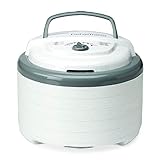
NESCO FD-75A Snackmaster Pro
- 600W Converga-Flow drying system
- Expands from 5 to 12 trays
- Adjustable 95-160F temperature control

Cosori 5-Tray BPA-Free
- 165F max in 1F steps
- 5 trays expandable to 7
- 48-hour timer
- Under 47 dB
Those three cover most shopping lists. The Cosori 6-Tray wins on capacity plus quiet operation, the NESCO wins on build quality and expandability, and the 5-Tray Cosori wins on price and precision control for the least money.
All 10 Best Food Dehydrators in This Price Range for 2026
Here is the full field, so you can compare before reading the individual reviews. Every entry includes its tray count, wattage, and temperature ceiling, because those three numbers predict drying speed and food safety better than any other spec.
| Product | Specs | Action |
|---|---|---|
| Cosori 6 Stainless Steel Trays |
|
Check Latest Price |
| NESCO FD-75A Snackmaster Pro |
|
Check Latest Price |
| Cosori 5 BPA-Free Trays |
|
Check Latest Price |
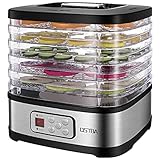 OSTBA 5-Tray 240W OSTBA 5-Tray 240W |
|
Check Latest Price |
 Hamilton Beach 32100A Hamilton Beach 32100A |
|
Check Latest Price |
 Magic Mill MFD-5000 Magic Mill MFD-5000 |
|
Check Latest Price |
 Commercial Chef CCD100W6 Commercial Chef CCD100W6 |
|
Check Latest Price |
 Magic Mill MFD-7100 Magic Mill MFD-7100 |
|
Check Latest Price |
 Magic Mill Pro MFD-7700 Magic Mill Pro MFD-7700 |
|
Check Latest Price |
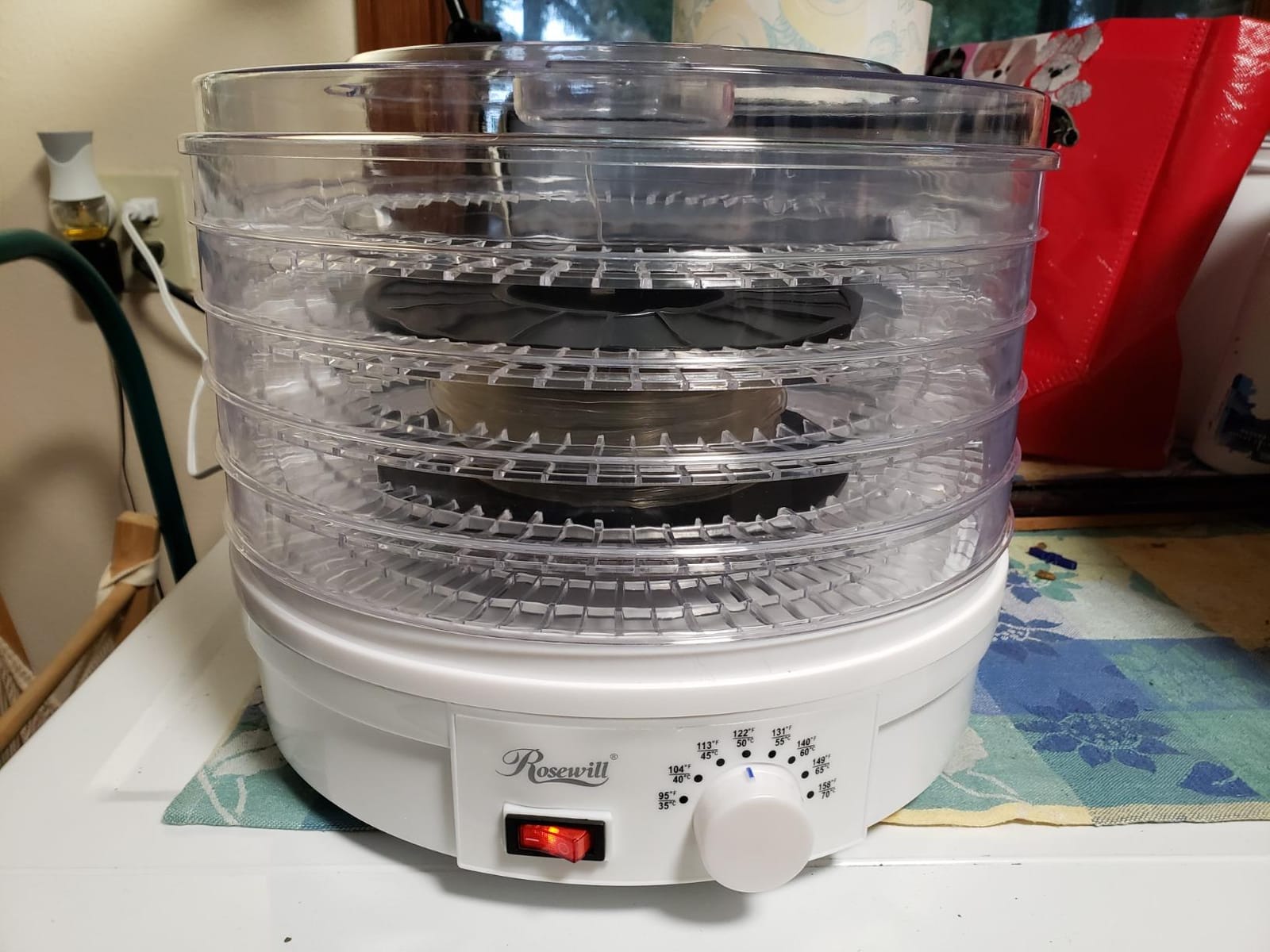
 Rosewill RHFD-15001 Rosewill RHFD-15001 |
|
Check Latest Price |
Two patterns jump out immediately. Only three of these ten reach 165F or higher, and jerky makers should treat that as a hard filter. Only four use a rear-mounted fan, and that single design choice does more for even drying than any other spec on the sheet.
1. Cosori Food Dehydrator with 6 Stainless Steel Trays – Best Overall
Cosori Food Dehydrator, 6 Stainless Steel Trays with 6.5 ft² Drying Space
6 trays
6.5 sq ft
95-165F
600W rear fan
Under 48 dB
Pros
- Largest drying area in this class at 6.5 sq ft
- Quiet brushless motor under 48 dB
- Digital control to 165F with 48-hour timer
- Dishwasher-safe trays plus mesh and fruit roll sheet
- Cookbook and manual included
Cons
- Heaviest and largest footprint here at 18.1 lb
- 600W draws more power than entry models
This is the machine we keep coming back to, and the reason is simple arithmetic. Six stainless steel trays across 6.5 square feet is more usable drying area than anything else on this list except the ten-tray Magic Mill, and it does it in a body you can still move with one hand. The stainless trays are the right call for someone who plans to dry tomatoes with skins, thick-cut pears, or marinated meat that would stick to plastic.
The rear-mounted fan and heater is the part that earns the top spot. Air moves across the trays from the back of the cabinet rather than up from the base, so the bottom shelf does not cook while the top shelf waits. Owners consistently report even results from the rear fan, and the 600W motor is strong enough to move moisture out of dense fruit without a very long cycle.
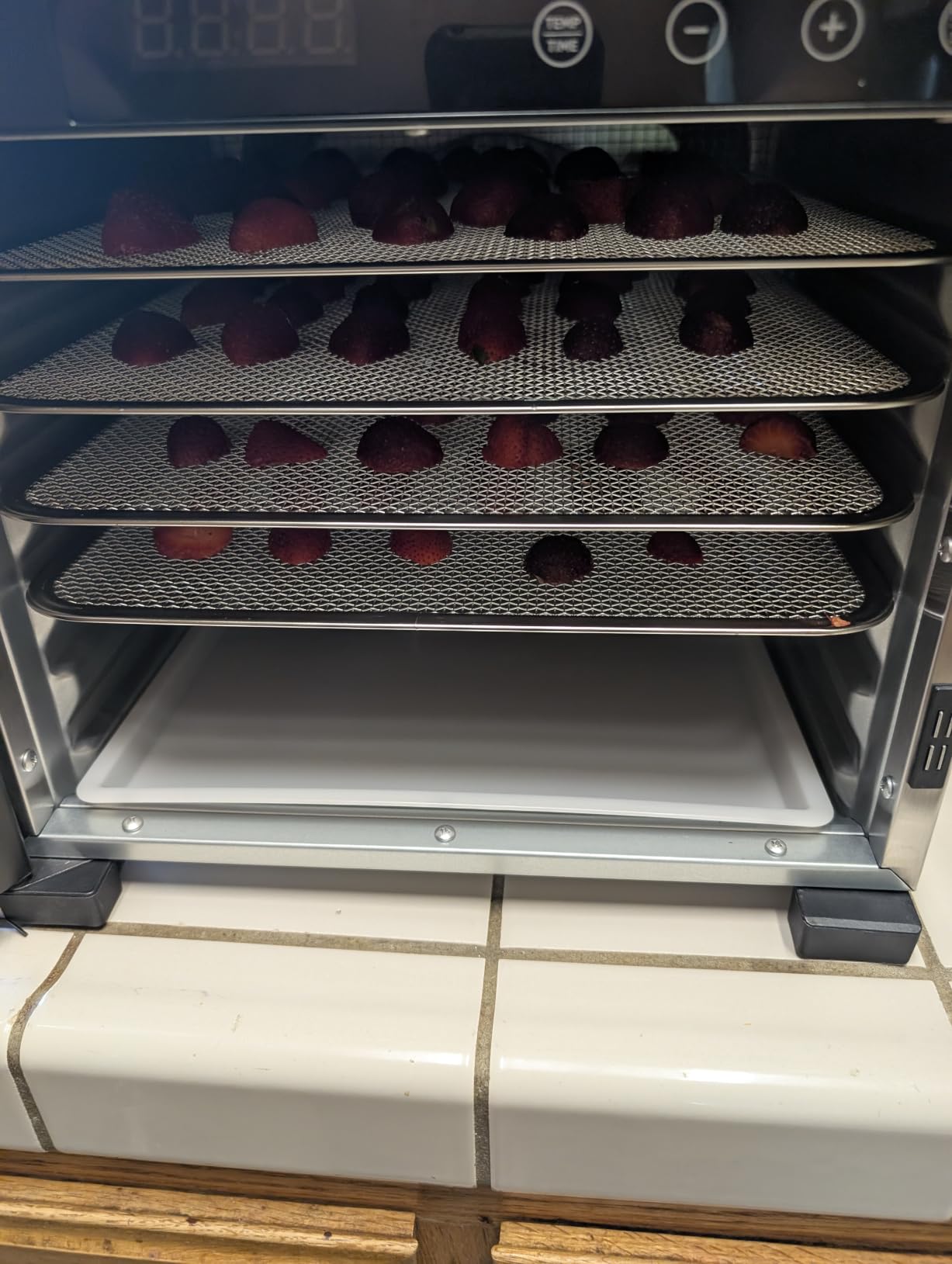
Noise is the quiet surprise here. The brushless motor runs below 48 dB, which is low enough to run overnight in a bedroom-adjacent kitchen without the fan carrying down the hall. That matters more than most spec sheets admit, because a fruit leather or thick-cut vegetable run can easily go eight to twelve hours, and a noisy machine gets unplugged before it finishes.
The 95-165F digital control gives you single-degree or fine-step adjustment depending on the panel, and the 48-hour timer covers everything from herb drying to full batches of venison. Trays, mesh screen, and fruit roll sheet all go in the dishwasher, which is the detail that tells you this is a machine built for repeat use rather than a novelty.
Who the Cosori 6-Tray suits best
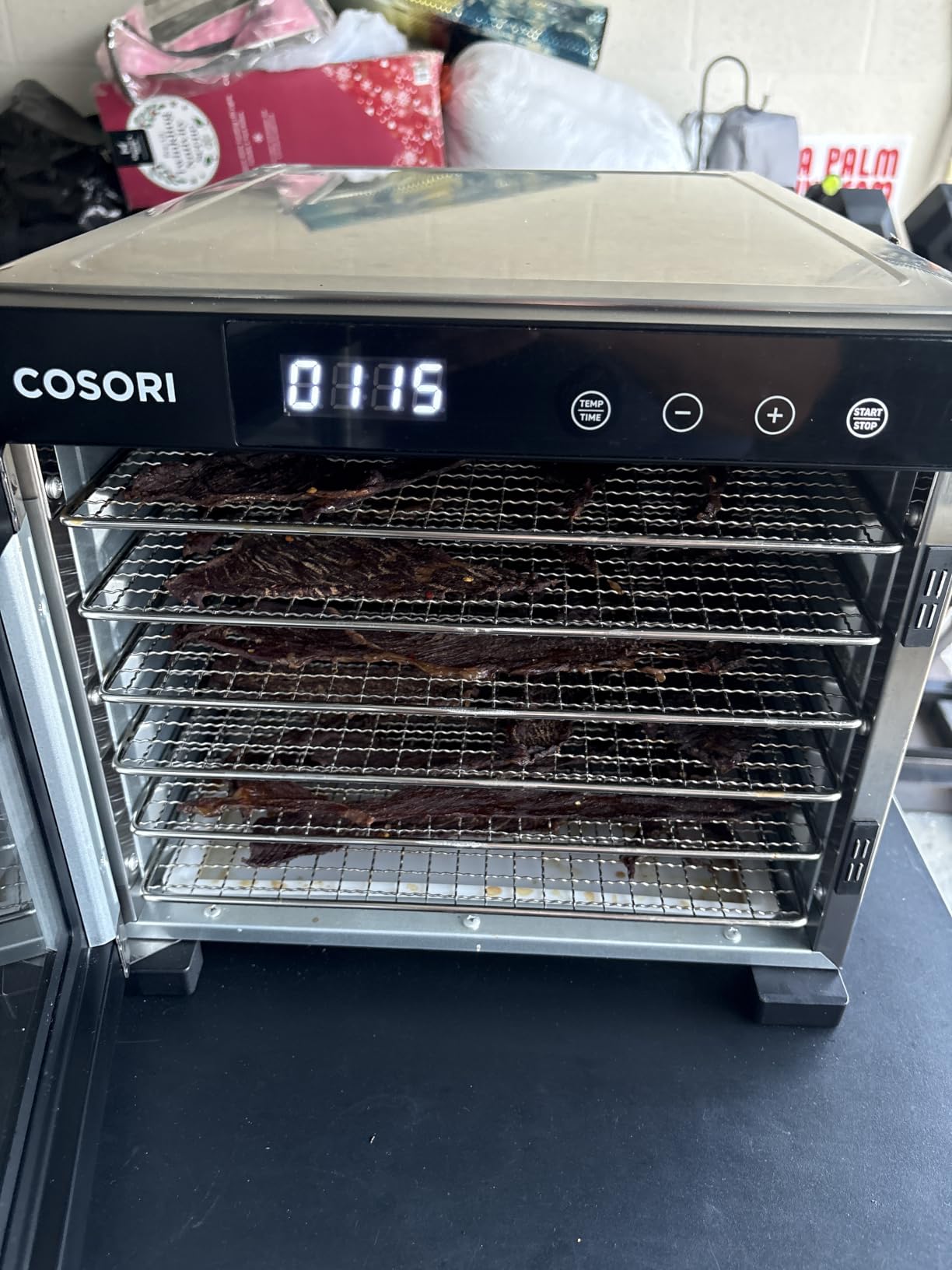
It suits households with a real counter to give up. At 17.8 by 13.4 by 12.4 inches and 18.1 pounds, you want a permanent spot, not a corner of the counter you clear every morning. In return you get enough area to dry a full round of sliced apples or a serious week of jerky in one load without babysitting it.
It also suits anyone who runs the machine overnight. Below 48 dB and with a rear fan that keeps trays even, you can start a load before bed and check it in the morning rather than rotating shelves at hour four.
Where it falls short
The 600W draw is the highest paired with the Cosori’s size, so a full eight-hour cycle uses meaningfully more electricity than a 240W starter box. Over a year of weekly jerky batches that adds up on a meter, though it stays modest against a household load.
Weight and footprint are the real trade-off. If you are in a small apartment or an RV and need the machine to live in a cupboard when not in use, this is too much machine. The NESCO or the Hamilton Beach are the versions of that idea that fit.
2. NESCO FD-75A Snackmaster Pro – Best Built and Top Rated
NESCO FD-75A Snackmaster Pro Food Dehydrator, For Snacks, Fruit, Beef Jerky, Gray
5 trays expanding to 12
600W
95-160F
Top-mounted fan
Pros
- Expandable from 5 to 12 trays
- Very quiet
- Lightweight at 3.5 kg
- Trays release dried fruit easily
- Assembled in the USA
Cons
- No built-in timer or on-off switch
- Top trays dry faster than bottom trays
- Loose trays are fiddly to clean
If you read forums before you buy, you will keep seeing one name repeated: NESCO. In a Reddit thread in r/jerky, an owner described buying one years earlier and said it works great and is priced well. That is not a sponsored line, it is the most common ownership report in this entire category, and it matches what the long-term reviews show.
The design is a stacked round box, not a rectangular one, and that shape is an advantage. The Converga-Flow system circulates heated air without you rotating trays, and the top-mounted fan means a dripping piece of meat cannot fall onto the heating element, which is a genuine long-term reliability argument. Buy it with five trays and add more as your harvest grows, up to twelve.
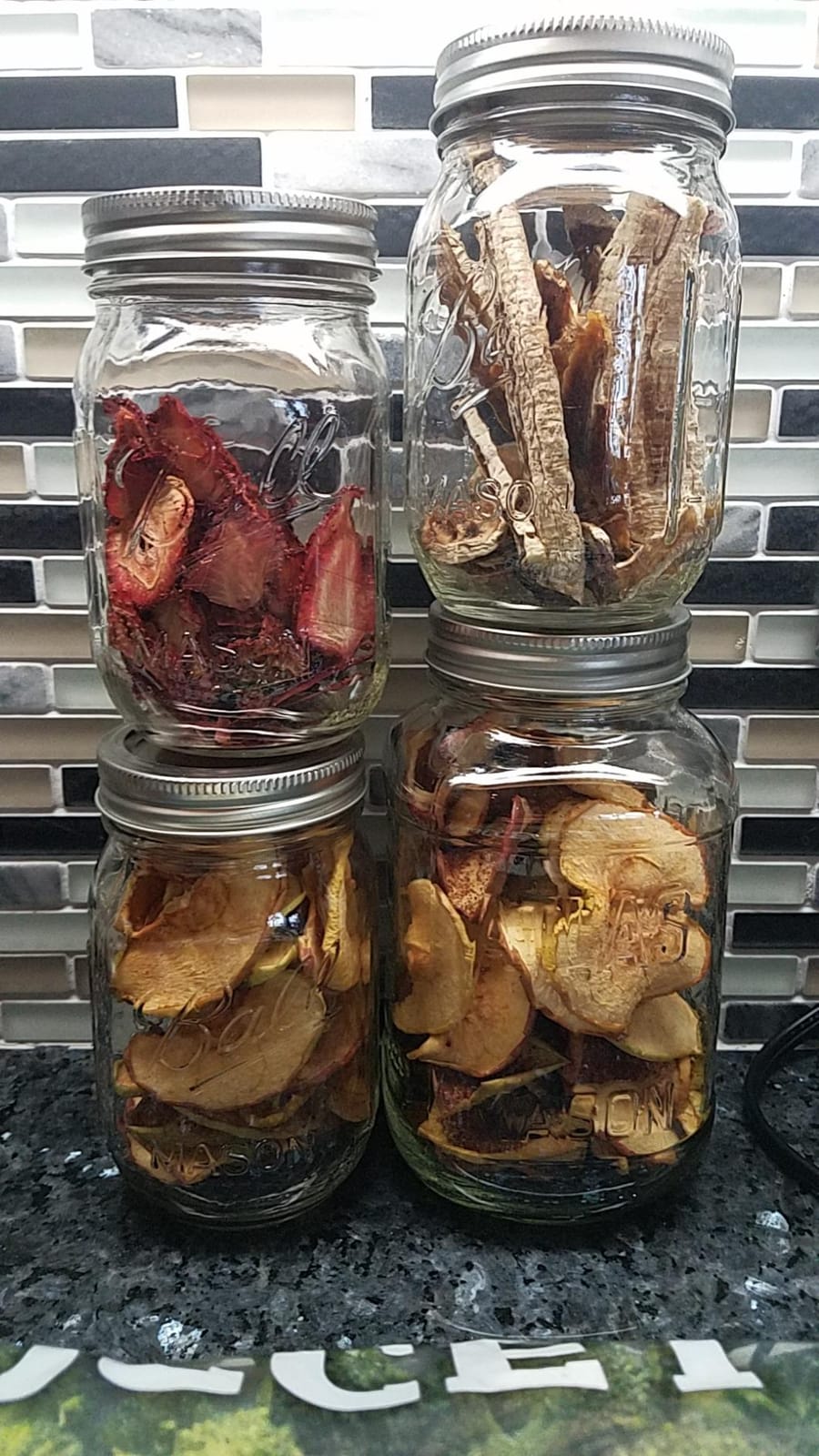
At 3.5 kg and 13 inches square, it is one of the easiest machines here to move and store, and owners call out how quietly it runs, comparable to or quieter than a household box fan. Long-term owners also tend to buy extra trays rather than replacements, which is about as strong a durability signal as you can get from consumer feedback.
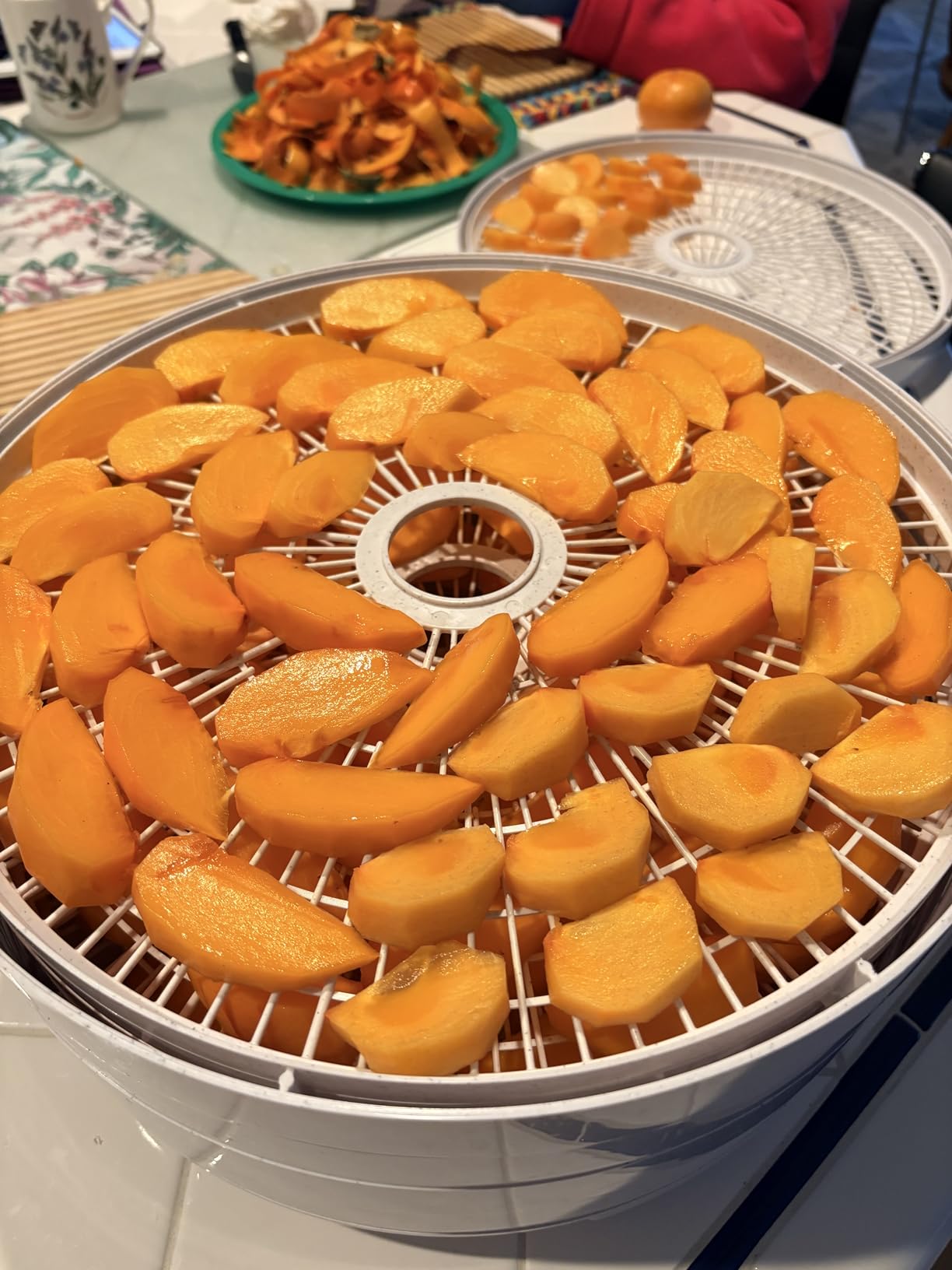
Trays are clear, so you can watch progress without opening the lid and disrupting airflow, and dried fruit releases with very little residue. That last point is not a small thing. Fruit that sticks to a tray is fruit you scrape off with a knife, and scraping damages the slice.
Who the Snackmaster Pro suits best
It suits beginners who want a machine that will not need replacing in three years, and it suits apartment or RV living better than almost anything else here. The footprint is modest, the weight is manageable, and the low noise means you can run it in a small space overnight without rethinking your neighbours.
It also suits growers who start small. Buying the base five trays and expanding later is cheaper than guessing wrong on a big box, and the accessory kit that ships with it includes Clean-A-Screens, fruit roll sheets, and a jerky seasoning sample, so you can make something the first week.
Where it falls short
There is no built-in timer and no on-off switch. You need a kitchen timer, and you need to be present at the end of the cycle, because a machine you cannot time is a machine you will walk away from nervously. Several of the picks below solve this with a digital countdown.
Owners also report that top trays dry faster than bottom trays on long runs, so swapping shelves partway through improves results. And while dry runs on thick slices in humid conditions can stretch to twelve to twenty-four hours, the temperature ceiling of 160F is adequate for fruit, herbs, and vegetable chips, though a serious meat maker may want more headroom.
3. Cosori Food Dehydrator with 5 BPA-Free Trays – Best Value
Cosori Food Dehydrator, 5 BPA-Free Trays, 165°F Temperature Control, 350W
5 trays expanding to 7
350W
95-165F in 1F steps
Under 47 dB
Pros
- 165F maximum in 1F increments for meat safety
- Quiet under 47 dB for overnight runs
- Trays clean with hot water and a sponge
- Recipe and drying chart booklet included
Cons
- Fruit leather and jerky mats not included
- Bottom trays finish before top trays on long runs
- Touch panel is easy to bump
This is the box we recommend to anyone starting out who is not ready to spend serious money. The headline number is the temperature ceiling: 165F in one-degree increments. Many competing units stop at 158F, which is exactly the temperature we do not want you drying meat at, and the extra degrees here are a real safety margin rather than a marketing line.
It is also built as a solid body rather than a clear shell, which matters more than it sounds like it should. Clear plastic walls become brittle after a few seasons of heat, and reviewers here specifically call out the solid construction as the reason the machine still looks and works well after repeated use.
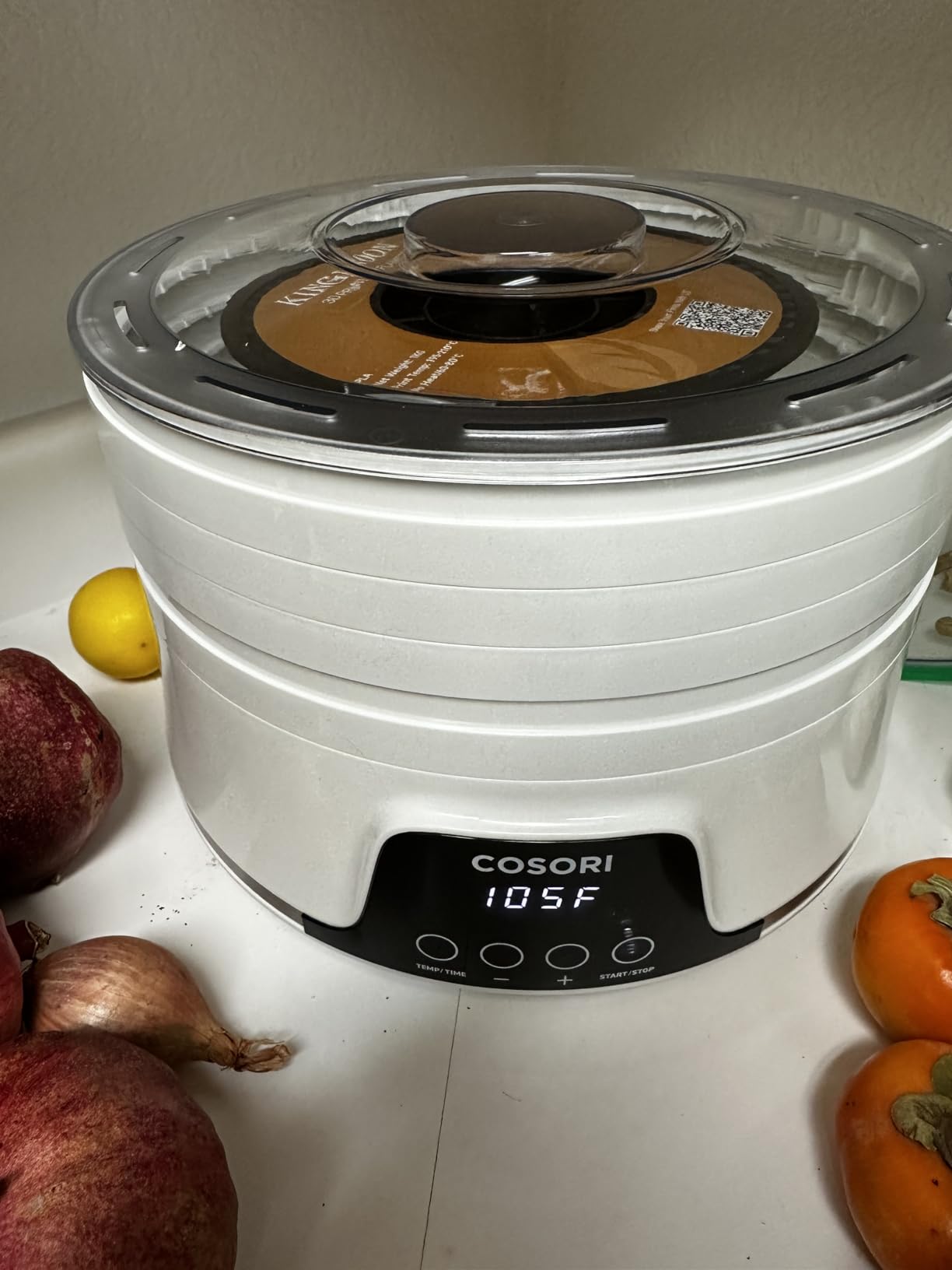
Cleaning is the feature owners mention most warmly. A hot soapy sponge and a sponge pad is the entire cleanup process, and the trays release food with very little residue. A recipe book and drying chart are in the box, which sounds minor until you are drying fruit leather for the first time and have no idea what consistency to stop at.
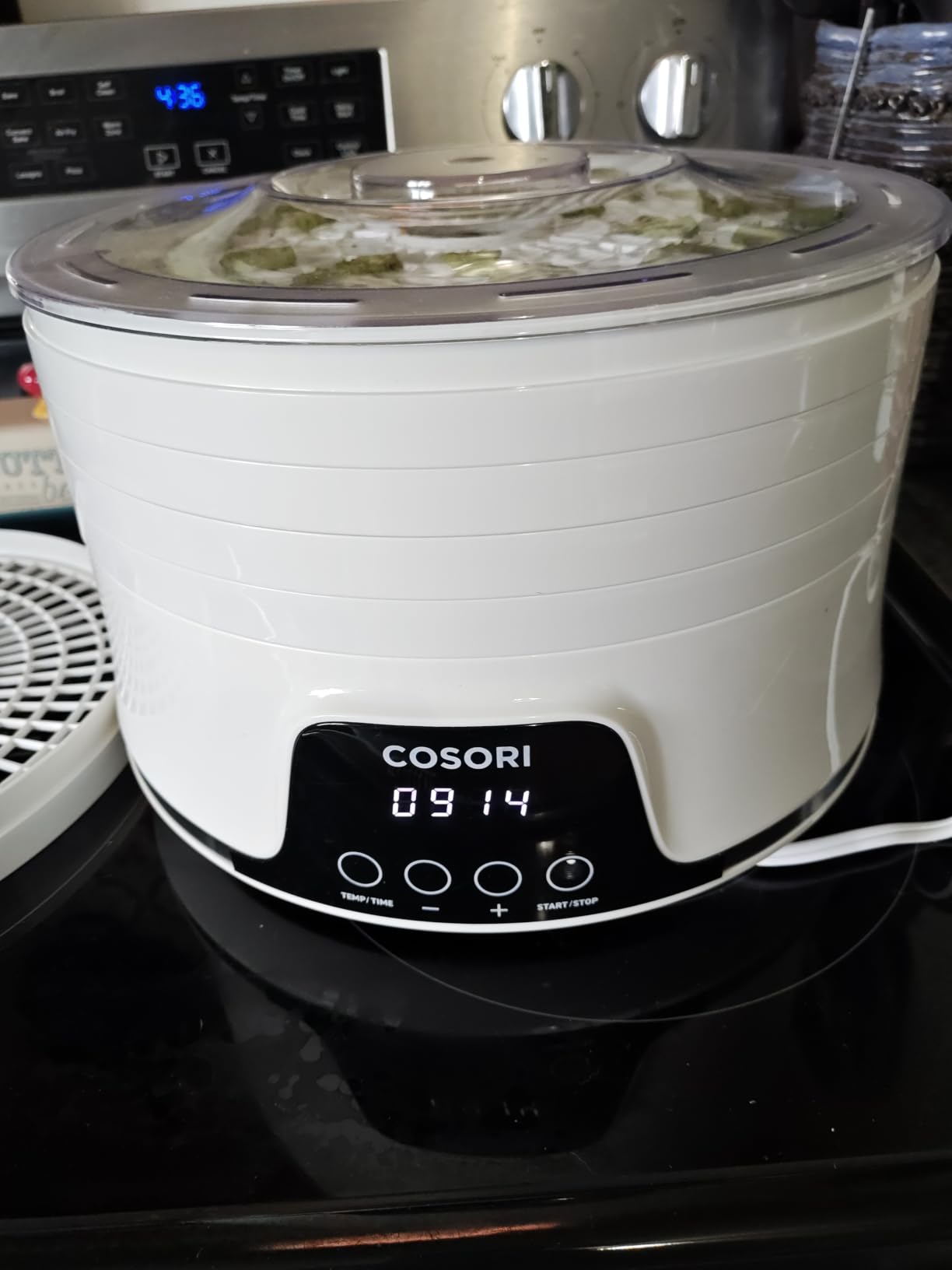
Noise lands under 47 dB, quiet enough for a bedroom wall, and the 48-hour runtime in half-hour increments means a single load of herbs, a tray of apple slices, or a full small batch of jerky runs without babysitting. Trays expand to seven with add-ons if your volume grows.
Who the 5-Tray Cosori suits best
It suits first-time buyers and small households, and it is the most honest recommendation in this roundup for anyone who wants a safe jerky temperature without paying for a large stainless box. Four point six across more than nine thousand reviews is a well-earned score for a machine this simple.
It also suits anyone who wants precise control for herbs and fruit. One-degree increments let you hold a low temperature for delicate herbs without overshooting, and the recipe chart removes the guesswork on timing.
Where it falls short
The fruit leather and jerky mats are not in the box. You will need liners, and while there are workarounds like silicone baking mats or parchment, buying a proper set early is the difference between a good first run and a disappointing one.
On long runs the bottom trays finish before the top ones, so rotating shelves improves results. The touch panel is also sensitive enough to be bumped when you open the lid to check food, and one report describes a lid cracking under sustained high heat, which is not a widespread complaint but is worth knowing about.
4. OSTBA 5-Tray 240W Dehydrator – Best Compact Most Versatile
OSTBA Food Dehydrator, 5 Trays, 240W Dryer for Jerky, Fruit & Snacks
5 stackable trays
240W
95-160F
1-72 hour timer with shutoff
Pros
- Very compact and stacks for storage
- Dishwasher-safe trays
- See-through window for monitoring
- 72-hour timer with automatic shutoff
- 24 month warranty and ETL certified
Cons
- Tray size smaller than most buyers expect
- Some machines do not auto-shut off
- Presets run a little hot for meat and low for herbs
The OSTBA is the one to buy if your counter space is genuinely limited. The trays stack for compact storage, the body is 9.45 by 10.24 by 8.27 inches, and at 4.1 pounds you can move it with one hand to reach a shelf. For herbs, vegetable chips, and dog treats, that footprint is worth more than extra square footage.
The LED digital panel and 1-72 hour timer with automatic shutoff cover the long-run problem better than most machines at this level. A see-through window lets you monitor progress without cracking the door, and 360-degree circulation airflow is aimed at even heat distribution across a small chamber, which is the harder problem in a compact box.
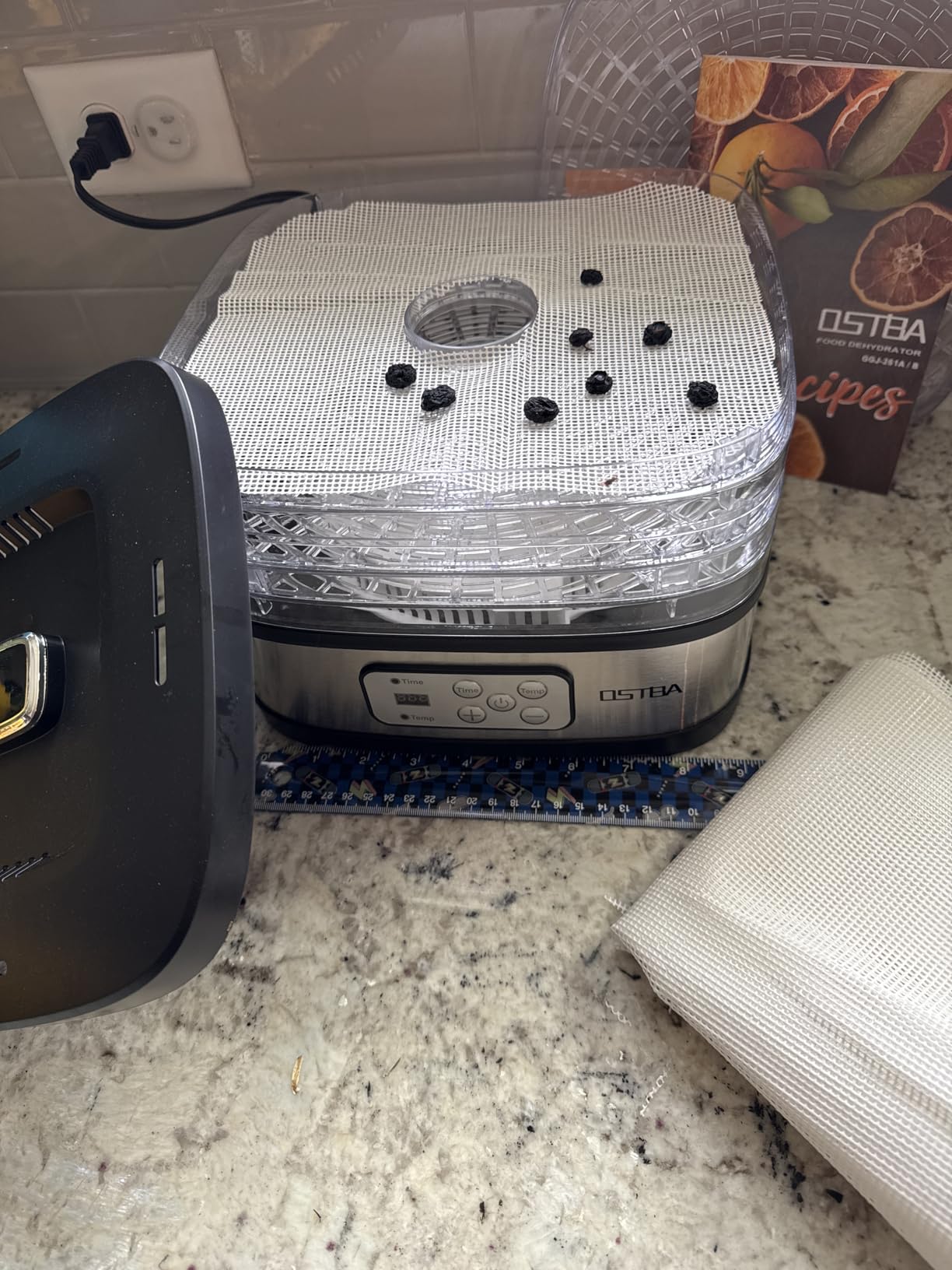
Owners who read the dimensions carefully tend to be very happy. The recurring complaint is not quality but expectation: people who expected a full-size drying surface find the trays smaller than they imagined. Read the tray dimensions before you order, and this becomes a very dependable small-batch workhorse.
A loud completion alert sounds when the cycle ends, which is genuinely useful when you are not in the room. Dishwasher-safe trays wipe clean with a damp cloth, and a 24 month warranty plus ETL certification is more assurance than many units in this bracket offer.
Who the OSTBA suits best
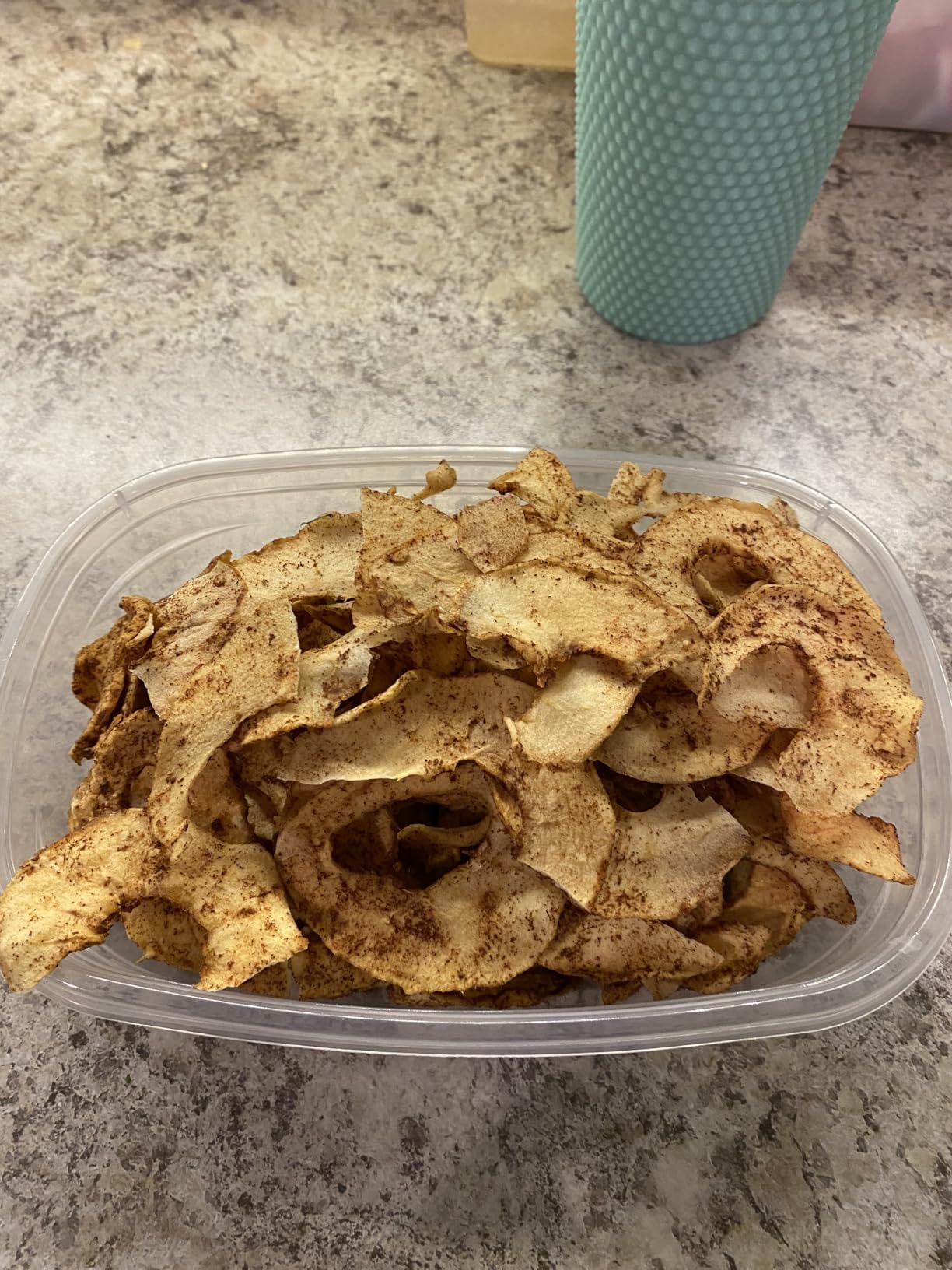
It suits small kitchens, renters, and anyone drying herbs, vegetable chips, or pet treats in modest volume. If your total output is a few trays a week, the smaller footprint costs you nothing real and saves you a permanent block of counter.
It also suits people who want a timer they can trust across a long unattended run, because a 72-hour countdown with automatic shutoff is more flexibility than the dial machines below can offer.
Where it falls short
The temperature presets are not well matched to real foods. Reviewers report they run a little hot for meat and a little low for herbs, so you will want to override the presets and set the dial yourself rather than trusting the one-touch options.
Some machines have failed to shut off automatically as specified, and the white plastic fan cover stains easily enough that it needs cleaning after every session. Drying times for fruit also run slow, so this is not the machine for a big end-of-season fruit harvest.
5. Hamilton Beach 32100A Digital Dehydrator – Best for Small Kitchens
Hamilton Beach Digital Food Dehydrator for Fruit, Jerky, Vegetables & More
5 stackable trays
4.2 sq ft
500W
100-160F
48-hour timer
Pros
- Square shape stores under cabinets
- Reliable 48-hour digital timer with shutoff
- Many owners do not rotate trays
- Clear lid for checking progress
- Dishwasher-safe trays and lid
Cons
- Fan audible in a quiet room
- Only one mesh screen included
- Drying takes longer in humid conditions
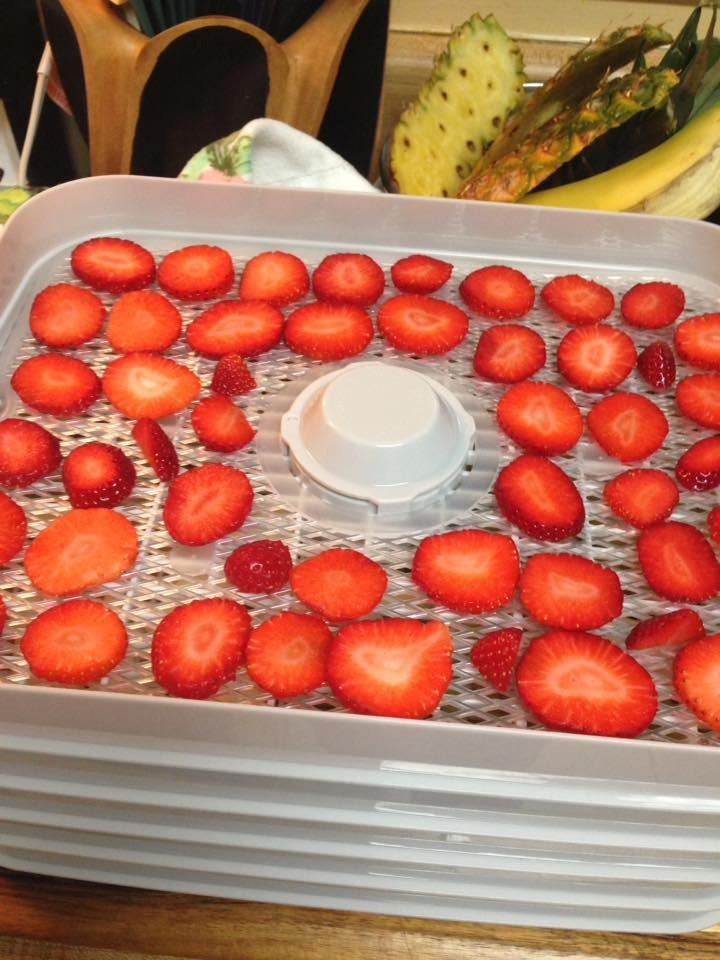
The Hamilton Beach is the most sensible starter box on this list, and the reason is the shape. Square units pack into corners and under cabinets in a way round stacked dehydrators never do, and with 5 stackable trays giving up to 4.2 square feet of drying space, you are not sacrificing real capacity to get that tidiness.
The digital timer counts down from 1 to 48 hours and shuts the machine off, which removes the single biggest failure mode of untimed budget units: finishing a twelve-hour run and walking in hours later to a machine still cooking. The 500W base-mounted heater with a quiet fan is sized to the chamber rather than oversized, and many owners report not needing to rotate trays at all.
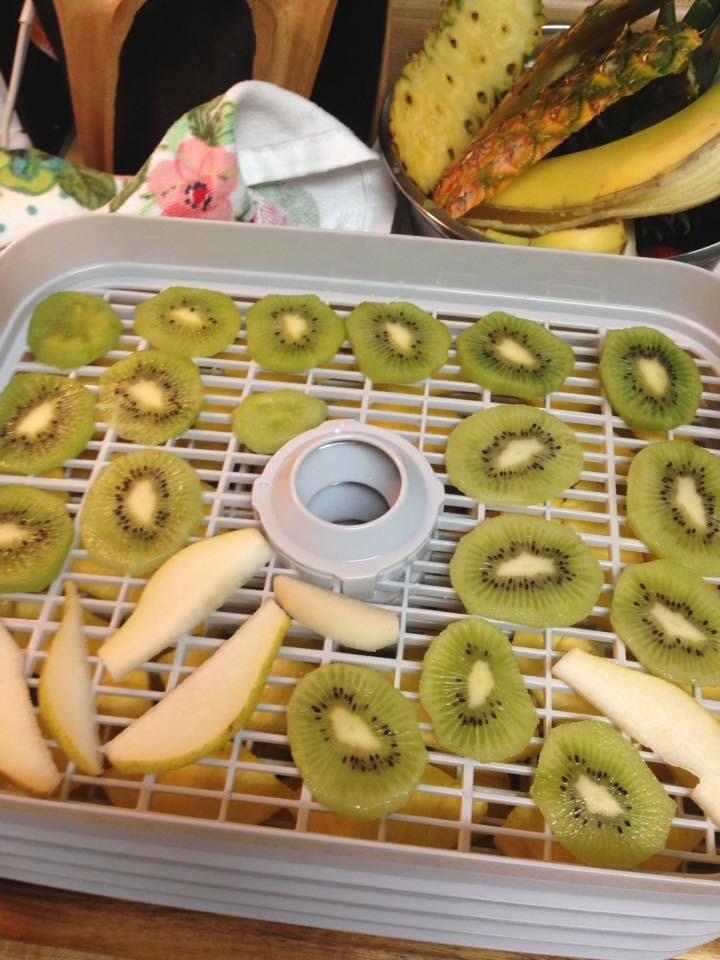
A mesh screen for herbs and a solid sheet for fruit leather are both included, which is more than several picks above it manage. Trays and lid are dishwasher safe, though the mesh screen needs a hand wash. Clear vented lid and nonslip silicone feet round out a design that was clearly thought through for a normal kitchen.
At 8 pounds and 10.4 by 13.2 by 11.3 inches, it is a machine you can pull out for a weekend project and put back. For a household that dries fruit, vegetables, and the occasional batch of jerky at home, that flexibility is the feature that matters most.
Who the Hamilton Beach suits best
It suits apartment kitchens, condo counters, and anyone who wants a full-featured dehydrator without giving up a permanent counter block. The 4.2 square feet figure is the one to compare against your volume: a household of two, or a couple of small garden beds, is well served.
It also suits anyone who wants a timer and does not want to pay for stainless steel construction they will not notice. A one-year warranty covers the first year, and the feature set here is closer to mid-range than to the entry tier.
Where it falls short
Fan noise is the most common complaint, with some owners comparing it to a window or box fan. It is not a dealbreaker in a kitchen, but it is a fair reason to look at the Cosori units if you plan overnight cycles next to where you sleep.
Only one mesh screen is included, and it is coarse enough that small herb leaves and nuts can fall through. Drying also runs longer in humid conditions, which is worth factoring in if you live somewhere with high summer humidity or are drying indoors rather than on a porch.
6. Magic Mill MFD-5000 Stainless Steel – Best Stainless Trays on a Budget
Magic Mill Food Dehydrator Machine | 5 Stackable Stainless Steel Trays, 48H Digital Adjustable Timer & Temperature Control Upto 167° Electric Dryer & Preserver for Jerky, Fruit, Dog Treats & Much More
5 stainless trays
240W
95-167F
Tray height 0.6-1.1 in
Pros
- Food-grade stainless steel trays at a low price
- Adjustable tray height for thin slices or thick jerky
- Trays detach and are dishwasher safe
- Compact at 2.75 kg
- Clear digital readout
Cons
- 240W means longer drying times
- Plastic body is less durable than all-metal over years of heat
Stainless steel trays are usually a sign you are moving up a price tier, which makes this one unusual. Five food-grade stainless trays, detachable and dishwasher safe, at a cost that keeps it firmly inside the budget band. If the thing you dislike about cheap dehydrators is food welded onto plastic, this solves that without solving nothing else.
The adjustable tray height is the sleeper feature, moving from 0.6 to 1.1 inches. That lets you load thin apple chips close to the heat for speed and thicker cuts of meat or vegetable with air moving around them, which is the single most practical adjustment on a machine that otherwise has fixed spacing.
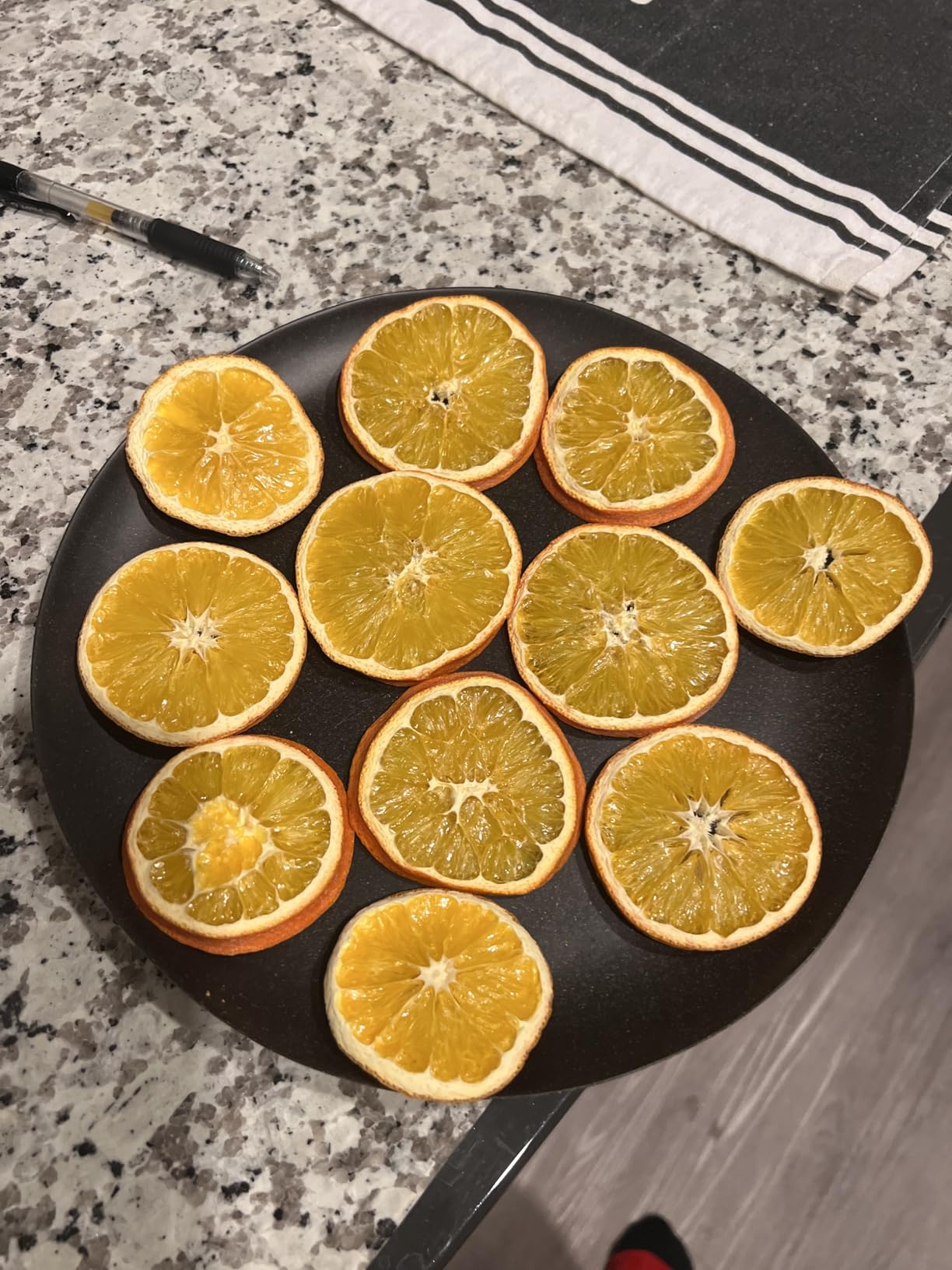
Digital control covers 95-167F, so the ceiling is high enough for meat, and the runtime goes up to 48 hours. The panel is simple buttons with a clear temperature and timer readout, which in a category full of overly sensitive touch controls is a quiet relief.
Owners consistently mention the adjustable spacing and the stainless trays in the same breath, which tells you those two things are what the machine actually delivers. The 240W element is the honest limitation, and it shows up directly in cycle time.
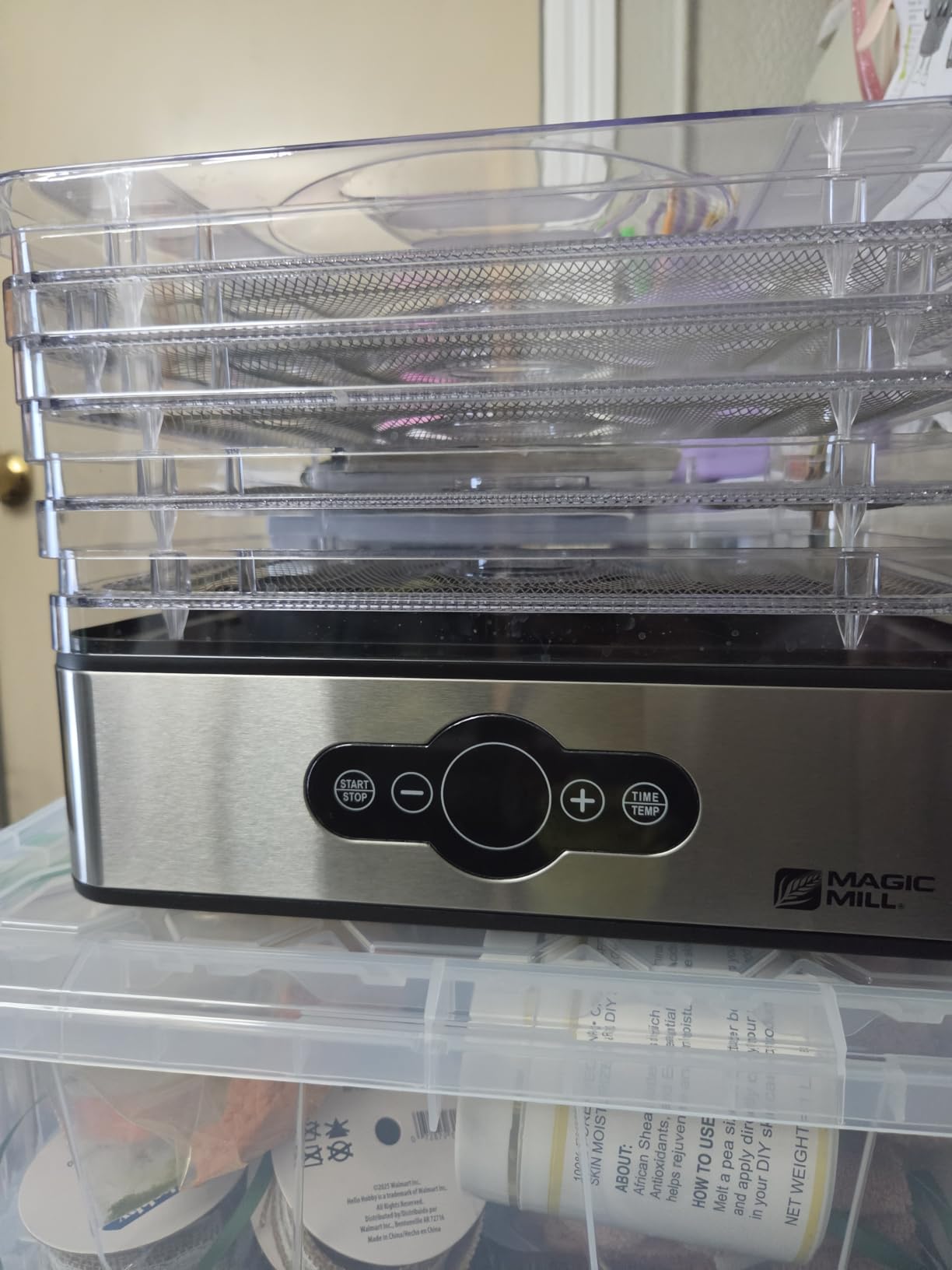
Who the MFD-5000 suits best
It suits someone who wants metal trays on a limited budget, and it suits households drying a mixed load. Fruit, herbs, vegetables, and dog treats all work, and the adjustable spacing means you do not need a second machine for thin and thick foods.
At 8.5 by 11.8 by 11 inches and 2.75 kg, it is also one of the lighter machines here, so it works for people who want stainless without a heavy lift.
Where it falls short
240W is the lowest wattage in the stainless-tray group, and it means longer drying times than the 500W and 600W machines. Plan a longer block for a full load of fruit, especially in humid air, and start earlier than the recipe suggests.
The body is BPA-free plastic even though the trays are steel, and that plastic is less durable across years of repeated heat cycles than an all-metal cabinet. It is a reasonable trade at this price, but if you want the metal to last a decade, the Magic Mill Pro further down the list is the same idea taken seriously.
7. Commercial Chef CCD100W6 – Low-Cost Way to Start Drying Fruit
Commercial Chef Food Dehydrator, Five 9.25” BPA-Free Trays, CCD100W6, White
5 round trays at 9.25 in
280W
104-158F dial
3.3 lb body
Pros
- Very low cost
- Lightweight 3.3 lb body stores in a cupboard
- Clear trays for progress monitoring
- Quiet for normal kitchen use
- Instruction booklet includes a drying chart
Cons
- No built-in timer
- Dial thermostat runs cooler than the mark
- Flimsy trays that can crack if dropped
Sometimes the right answer is that you do not need a dehydrator yet. The Commercial Chef is one of the least expensive ways into dehydrating, and for dried fruit, herbs, and dog treats it genuinely does the job. Five circular BPA-free trays at 9.25 inches, a dial thermostat from 104 to 158F, and a 280W element is a simple machine with one job.
The round trays are clear, so you watch the slices curl and the colour deepen without opening anything. At 3.3 pounds and under 10 inches in every direction, it lives in a pantry or a cupboard between uses better than any other machine here, and it is quiet enough for normal kitchen use.
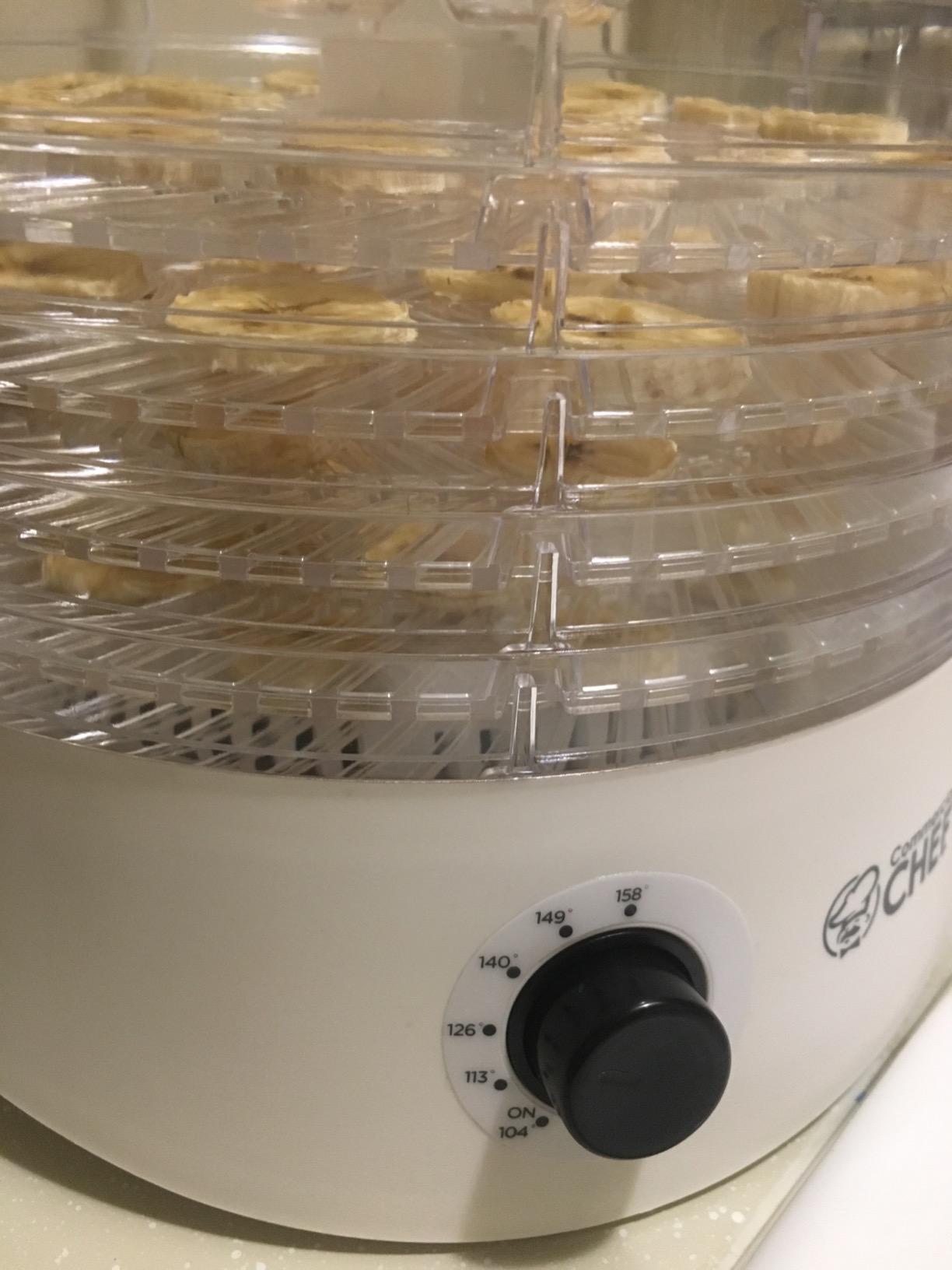
The instruction booklet includes a food dehydration chart, which for a first-timer is the difference between a successful batch and a batch of chewy apple slices you eat out of politeness. Reviewers consistently treat this as a basic, inexpensive unit that works when kept simple, and the one-year warranty covers the early years.
It is also a good machine to learn on. A dial thermostat teaches you to actually look at the food and judge by texture and colour, which is the skill that transfers to any machine you upgrade to later.
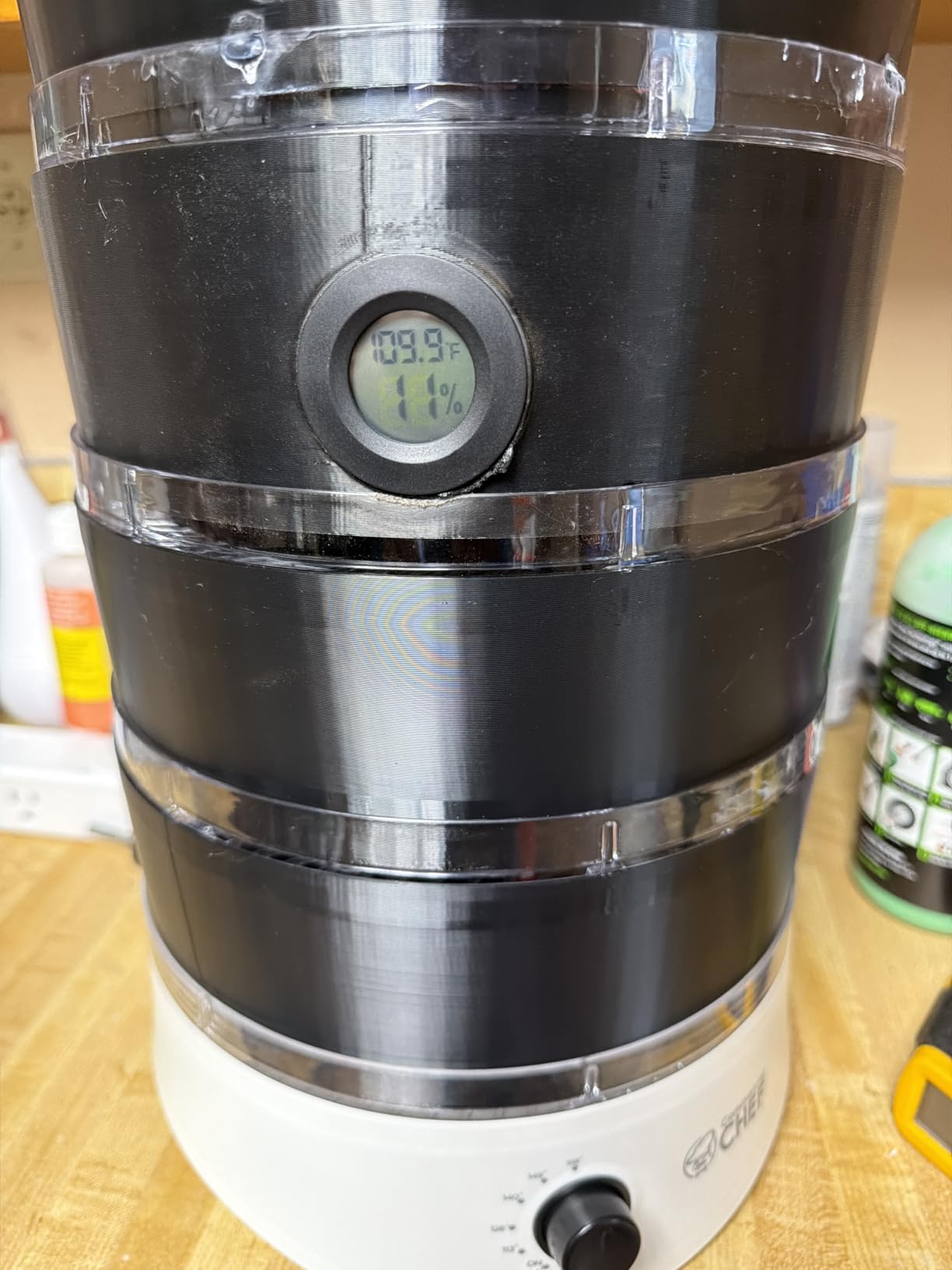
Who the Commercial Chef suits best
It suits a complete beginner, a renter, and anyone drying a small volume of fruit, herbs, or pet treats a few times a month. If you are not sure whether you will use a dehydrator regularly, this is the smallest sensible commitment.
It also suits anyone with genuinely limited storage. Nothing else in this list disappears into a cupboard as easily, and a machine that stores away gets used more than one that lives permanently on the counter.
Where it falls short
There is no timer, so you need a kitchen timer and you need to be there. Combined with a dial thermostat that runs cooler than the mark, a batch takes longer than the chart suggests, and both facts can turn a first experience into a frustrating one.
Trays feel flimsy and can crack if dropped, fine pieces fall through the gaps without added liners, and drying is slow for thick or moist items. The 158F ceiling is below what we would want for a dedicated meat machine, so treat this as a fruit and herb dehydrator rather than a jerky one.
8. Magic Mill MFD-7100 10-Tray 700W – Best for Large Harvests
Magic Mill Premium Food Dehydrator Machine (10 Extra-Large Stainless Steel Trays) 700W Dryer for Beef Jerky, Fruits, Vegetables, Dog Treats, 48 Hour Digital Timer – 95°-167° Temperature Control
10 extra-large trays
700W rear fan
95-167F
Keep Warm mode
Pros
- Largest batch capacity in this price range
- Rear fan dries evenly without rotation
- 700W dries meat quickly and quietly
- Keep Warm holds serving temperature
- Auto shutoff plus overheat protection
Cons
- Heaviest at 20.5 lb with a large footprint
- Highest cost in the roundup
This is the end-of-season machine. Ten extra-large stainless steel trays with a rear-mounted fan and 700W of drying power is the largest batch capacity available in this price band, and the rear fan means you do not rotate shelves on a load that takes most of a day to complete.
The Keep Warm function is the feature growers mention with most affection. A jerky or vegetable batch that finishes at midnight does not have to be pulled into a cooler immediately; the chamber holds serving temperature for up to 24 additional hours, so you can finish the run and collect the trays in the morning.
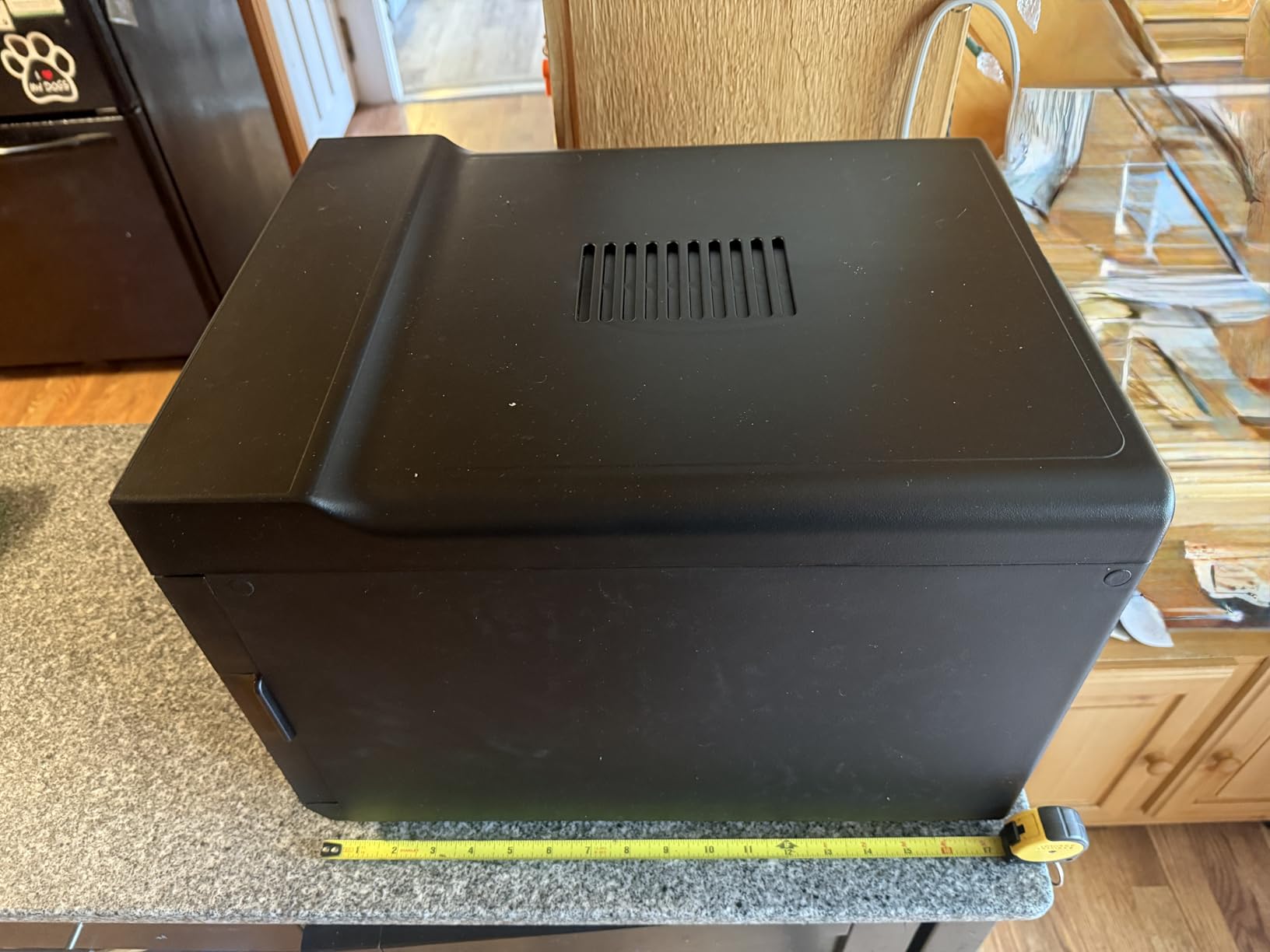
Automatic shutoff and overheat protection make long unattended runs realistic, and the transparent door lets you monitor without opening the cabinet. Dishwasher-safe stainless trays and liners mean cleanup after a sticky marinade is a soak and a load, not an evening of scrubbing.
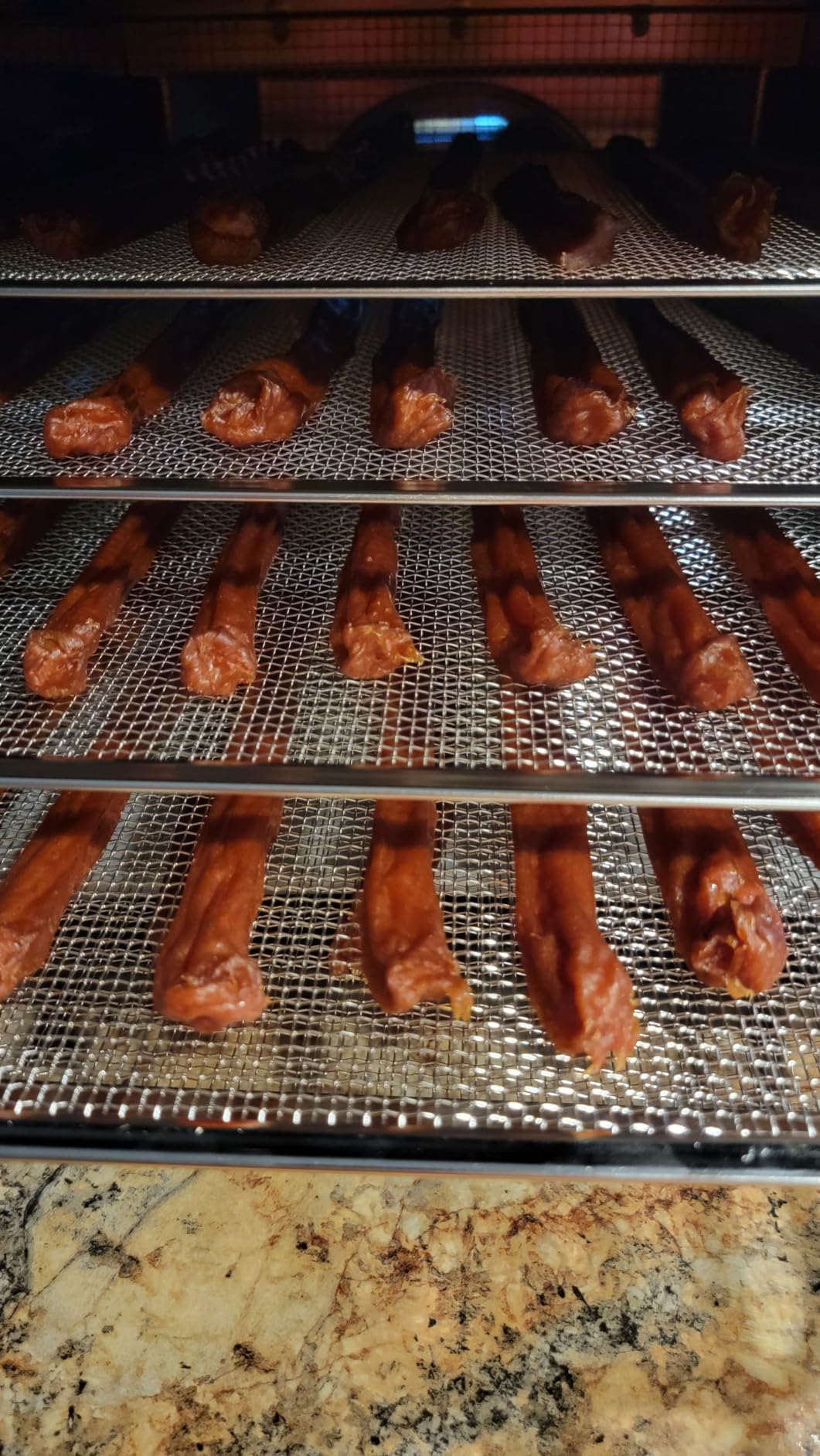
Owners focused on jerky praise the even rear-fan airflow across all ten trays and the quiet 700W performance. The 95-167F ceiling gives real headroom for meat, and the digital panel handles both temperature and a 48-hour countdown in one place.
Who the MFD-7100 suits best
It suits gardeners and small farmers with a real harvest coming in, and it suits households that buy meat in bulk and process it into jerky. A load that would take three runs on a six-tray machine happens in one here, and the Keep Warm mode makes the timing of that long run far less stressful.
It also suits anyone who has decided that tray rotation is not a task they want to own. The rear fan handles airflow, and the large tray count is what you are paying for.
Where it falls short
Size and weight are the honest cost. At 18 by 13 by 14 inches and 20.5 pounds, it needs a real counter position and real storage when it is not in use. In a small kitchen this is the machine that ends up in a garage rather than in daily use.
It is also the most expensive pick here, sitting closest to the top of the band, so a buyer who only plans a few trays a month is spending a lot of money for capacity they will not use. One year of limited warranty is thinner assurance than the OSTBA offers, though the auto shutoff and overheat protection cover the unattended-run risk.
9. Magic Mill Pro MFD-7700 – Best for Jerky
Magic Mill Pro Food Dehydrator Machine | Powerful 600W Rear Fan Even-Drying System | 7 Full-Size Stainless Steel Trays | 95°-176° Temperature Control, 48H Timer, Keep Warm + Auto Shutoff | ETL Listed
7 stainless trays
600W rear fan
95-176F
48-hour timer
Pros
- Full stainless interior and exterior with no plastic walls
- Rear fan gives even drying with no rotation
- 176F ceiling gives a wide meat safety margin
- Seven trays hold roughly 5 lb of meat
- ETL Listed with overheat protection
Cons
- Touch start-stop button is easy to trigger
- Less capacity than ten-tray models so big batches need two runs
If your answer to the drying question is jerky, this is the machine to buy, and the reason is the temperature ceiling. At 176F in one-degree increments, it gives you real margin above the 160F floor we consider the minimum for safe meat drying, which matters more than any other single number on the spec sheet for a meat maker.
The construction is what separates it from the cheaper boxes. It is stainless steel inside and out, with no plastic walls at all, and the 600W rear-mounted fan and rear heat move air consistently from top to bottom so you do not rotate trays halfway through a twelve-hour batch.
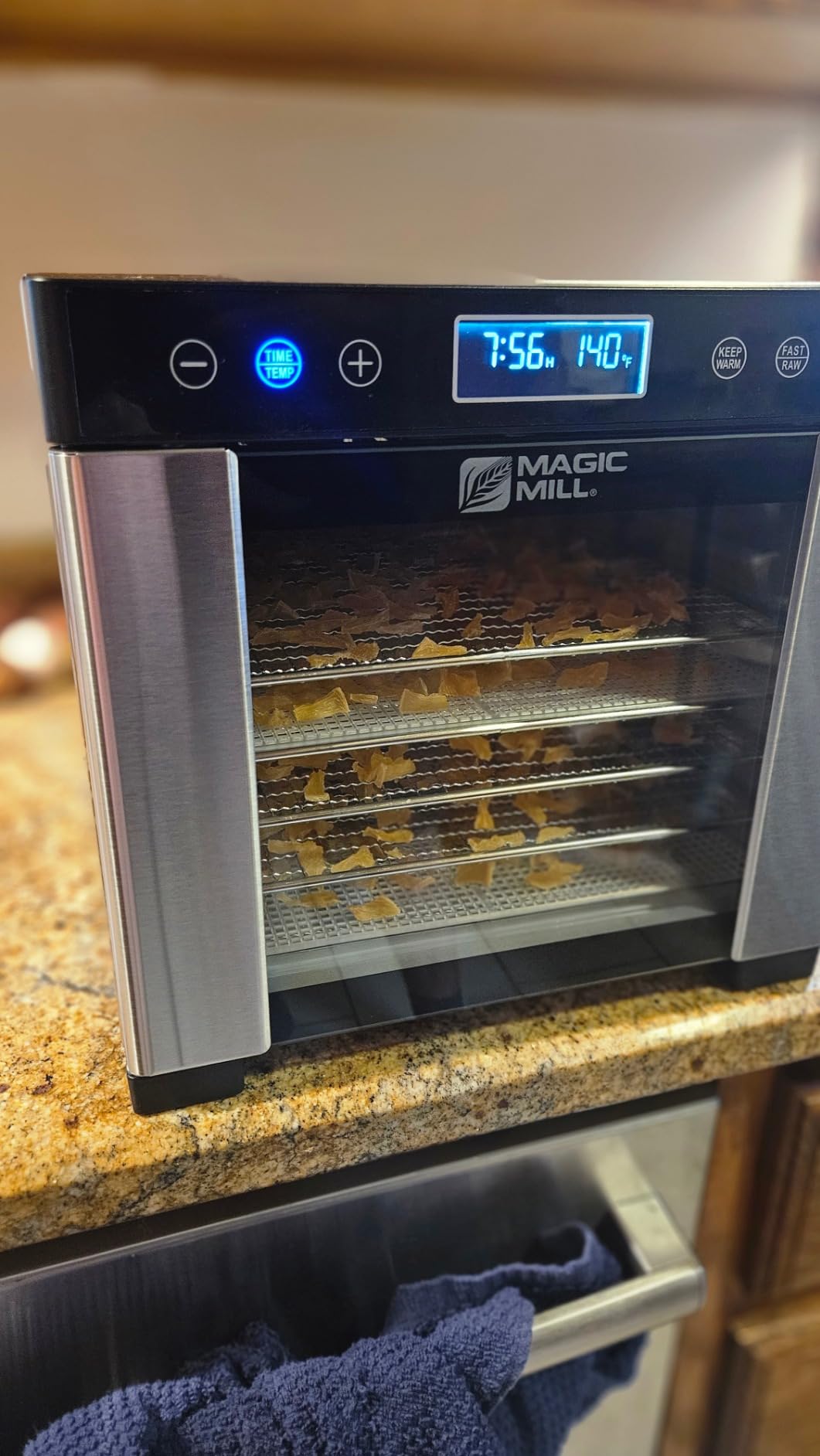
Seven full-size stainless trays hold roughly five pounds of meat per batch, which is a serious weekend of jerky from a single load. The 48-hour timer in half-hour steps with automatic shutoff, plus a Keep Warm hold at 95F for up to 24 hours, means a long run can finish while you sleep.
Two mesh screens and a fruit roll tray are included, which is more than most machines at this level, and the trays are dishwasher safe so a sticky marinade rinses off. It is ETL Listed with overheat protection, and at 15.5 by 11.3 by 10.8 inches it is compact enough to fit under standard cabinets, which is unusual for a machine with a full stainless body.

Who the Magic Mill Pro suits best
It suits backyard jerky makers and hunters who want a wide safety margin and a cabinet that will survive a decade of heat cycles. The all-stainless build means no plastic walls to embrittle, and owners rate it highly for even rear-fan drying, quiet running, and easy cleaning.
It also suits anyone who wants to run loads overnight or away from home. Automatic shutoff, overheat protection, and a Keep Warm mode give you three layers of unattended-run safety that most machines in this bracket lack.
Where it falls short
The start/stop button is touch sensitive and can be triggered accidentally when you open the door to check on food. It is the one design complaint owners raise repeatedly, and it is genuinely annoying mid-batch, so treat the door as sacred and check through it instead.
Seven trays is not ten. If you are processing a whole deer or a very large beef buy, large batches still need two runs, and that is where the MFD-7100 earns its extra footprint.
10. Rosewill RHFD-15001 – Best for Long-Term Ownership
Rosewill Food Dehydrator Machine, 5 BPA-Free 12.6’ Trays, Adjustable Temperature Controls | 95-158°F | 350W, Jerky, Herbs, Fruit, Veggies, Dried Snacks, White
5 stackable trays
350W
95-158F dial
Herb and roll trays included
Pros
- 350W keeps long runs economical to operate
- Quiet and lightweight at 5 lb
- Clear trays and round shape stack easily
- Owners report machines still running after 10 to 20 years
Cons
- No built-in timer so runs must be timed externally
- Chamber runs cool and can take two to four times the recipe time
- Shallow trays limit item height
The Rosewill is the quiet story in this roundup. Several owners report units still running after ten to twenty years, and in an appliance category where people frequently replace a dehydrator every few seasons, that kind of longevity report is worth more than any feature bullet.
It is also one of the most economical machines here to run. At 350W, a twelve-hour cycle pulls less energy than a 600W or 700W box, and if you are drying herbs and fruit regularly rather than running a constant jerky operation, that difference accumulates quietly on the bill.
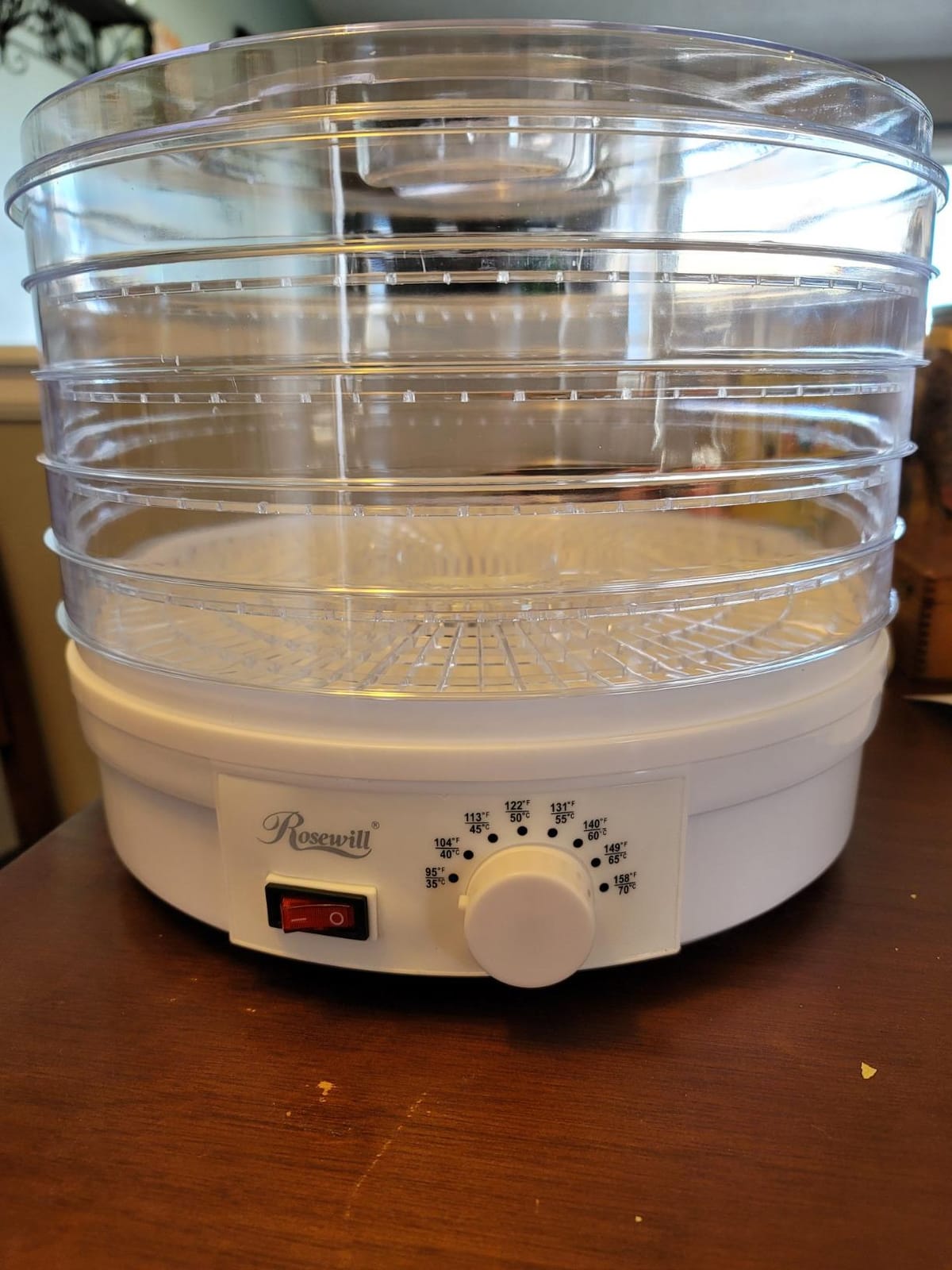
Five BPA-free stackable trays come with an herb tray and a roll tray already in the box, so you can dry fine herbs and fruit leather from the first run. A base-mounted fan and horizontal airflow keep heat moving through the round chamber, and the large viewing window lets you check progress without opening the lid.
Dishwasher-safe removable parts keep cleanup simple, and at 5 pounds with clear trays the machine is easy to handle and easy to stack. This is a round stacked design in the same family as the NESCO, and it carries the same trade-offs.
Who the Rosewill suits best
It suits patient users with modest volume who value a machine that keeps working over one that dries fastest. Herbs, fruit slices, flowers, and pet treats are all natural fits, and the low running cost suits someone who dehydrates in smaller, more frequent batches.
It also suits anyone buying a second machine for a cottage or a workshop. The light weight and small footprint make it easy to move between spaces, and the durability reports suggest it will still be going in a decade.
Where it falls short
There is no built-in timer, so drying schedules have to be tracked externally, and the chamber runs cool. Owners report cycles taking two to four times the recipe time, which is the dominant complaint and the main reason we placed it last despite the durability record.
The trays are shallow and cannot hold anything taller than about an inch, the fan is audible in a quiet room, and tray plastic can yellow or turn brittle over many years. The 158F ceiling is also below what we would want for dedicated jerky work, so this is a fruit, herb, and vegetable machine.
What to Look for When Buying a Food Dehydrator
Look at five things, in this order: a rear-mounted fan, a temperature ceiling that reaches at least 165F if you plan to dry meat, a timer with automatic shutoff, enough square feet of drying space for your real volume, and a frame style that suits how much counter you can give up. Everything else on a spec sheet is secondary. If you read only one section of this guide, read the next two paragraphs.
Box frame versus stacked trays
A box or rigid-frame dehydrator has a fixed square or rectangular cabinet with horizontal shelves, like the Cosori 6-Tray, the Hamilton Beach, and the Magic Mill Pro. A stacked dehydrator is a round column where trays slide in one above the other, like the NESCO FD-75A and the Rosewill. Box designs hold more square footage in a given footprint and mix tray heights more easily, which makes them better for varied loads. Stacked designs are quieter, cheaper, smaller, and expandable one tray at a time, which makes them better for beginners and small kitchens.
Rear fan versus base fan, and why it decides evenness
A base-mounted fan pushes air upward through the column of trays, so the tray nearest the heater runs hotter and the top one runs cooler. A rear-mounted fan and heater move air across the trays horizontally, so the load dries more evenly and you rotate shelves far less often. Only four of the ten picks here use a rear fan, and it is the single biggest reason the Cosori 6-Tray, the Magic Mill 10-Tray, and the Magic Mill Pro outperform their cheaper neighbours. If evenness matters to you, pay for the rear fan before you pay for extra trays.
Temperature ceiling: jerky needs 165F or higher
Meat safety is not a matter of preference. Safe jerky drying needs a sustained temperature of 160F or above, and a machine whose chamber runs cooler than its dial is worse than useless for meat. Four picks here top out at 158F or below, which is fine for fruit, herbs, and vegetables but not for a dedicated jerky setup. Four machines in this roundup reach 165F or higher: the two Cosori units, the Magic Mill 5-Tray at 167F, and the Magic Mill Pro at 176F. Check the ceiling, not the dial markings.
Timer and automatic shutoff for 8 to 12 hour cycles
Real drying runs take eight to twelve hours, sometimes twenty-four for thick cuts in humid air. A machine without a timer means you need a kitchen timer and you need to be awake for the end of it, which is how food gets over-dried and how machines get abandoned. Seven of these ten have a built-in digital timer, and six pair it with automatic shutoff. The three without are the NESCO, the Commercial Chef, and the Rosewill, all of which are still excellent for other reasons.
How much drying space you actually need
Square feet is a better measure than tray count, because round trays and square trays of the same number hold very different areas. Four square feet is enough for a household of one or two or a couple of small beds. Six to seven square feet covers a busy family garden. Ten square feet and up is a harvest machine, and it is the point at which a large body and real storage space become unavoidable. The compact picks here give you four square feet or less, which is fine until you have a surplus to clear.
Dual zone and running a machine half full
A dual-zone machine runs two independent temperature settings at once, so you can dry jerky at a high temperature while fruit dries gently below it. At this price point you are not buying true independent dual-zone control, but the practical lesson from experienced owners still applies: a smaller load dries faster and more evenly than a full cabinet crammed with food. Give trays space between pieces, and do not stack more food than the airflow can move past.
Noise, apartments, and RV living
Brushless and DC motors run quieter than the basic brushed fans in entry machines. The two Cosori units are specified below 48 and 47 dB, the NESCO is repeatedly described as quieter than a household box fan, and the Hamilton Beach is the one most often compared to a box fan. For a bedroom wall or a small RV, the quiet group is a real shortlist, and it costs nothing extra to respect the number.
What to skip in this price band
Skip any machine whose only selling point is tray count. A ten-tray box with a base fan and a 158F ceiling will disappoint you, and you will be left with a large object that dries unevenly and cannot safely hold meat. Also skip machines that advertise a big capacity with no wattage figure listed, because low wattage is the reason the run takes twice as long. Finally, skip anything sold only as a gift set with a large bundle of unrelated accessories, because the bundle does not dry food any faster.
Frequently Asked Questions
What is the best food dehydrator for value for money?
The Cosori Food Dehydrator with 6 Stainless Steel Trays is the best value for money in this price range. It gives you 6.5 square feet of drying space across six stainless steel trays, a 600W rear-mounted fan that dries evenly without rotation, a brushless motor below 48 dB, and digital control from 95 to 165F with a 48-hour timer. The NESCO FD-75A is the cheaper alternative if build quality and quietness matter more than capacity.
What is the best budget food dehydrator?
The Cosori Food Dehydrator with 5 BPA-Free Trays is the best budget choice, and the NESCO FD-75A is the best if you want to spend even less. The 5-Tray Cosori reaches 165F in one-degree increments, which is safe for jerky, runs under 47 dB, and cleans with hot water and a sponge. The NESCO is quieter, lighter, and expands from 5 to 12 trays but has no built-in timer.
What is the best food dehydrator for home use?
For everyday home use the Cosori 6-Tray is the strongest all-round choice, and the Hamilton Beach 32100A is the best when counter space is tight. The Cosori handles a mixed load of fruit, jerky, vegetables, and fruit leather in one batch with even rear-fan airflow. The Hamilton Beach offers 4.2 square feet of drying space, a square shape that stores under cabinets, and a reliable 48-hour timer with automatic shutoff.
What are common mistakes in dehydrating?
The most common mistakes are slicing food unevenly, crowding trays so air cannot move, forgetting to rotate shelves on base-fan machines, and judging doneness by the clock instead of by texture. Low drying temperatures will not kill mold spores, so wipe every tray after use and use soap and water for protein and leafy greens because of salmonella and E. coli risk. Store finished batches in airtight containers with a moisture absorber pack.
What should I look for when buying a dehydrator?
Check five things: a rear-mounted fan for even airflow, a temperature ceiling of 165F or higher if you plan to dry meat, a digital timer with automatic shutoff for 8 to 12 hour runs, enough square feet of drying space for your volume, and a frame style that fits your counter. Tray count alone is a poor guide, because round and square trays of the same number hold very different areas.
The Best Food Dehydrator in This Price Range for 2026
After working through all ten, the best food dehydrators in this price band split cleanly by job. The Cosori 6-Tray is the one we would buy for the most kitchens, because 6.5 square feet, a rear fan, and a sub-48 dB motor cover more real situations than anything else at this money. The Cosori 5-Tray is the best budget dehydrator, and the NESCO FD-75A is the best-built and most trusted name in the category, worth the switch to a manual timer.
For jerky, go with the Magic Mill Pro at 176F. For a garden harvest, the Magic Mill 10-Tray is the batch machine. For a small kitchen or a first experiment, the Hamilton Beach and the Commercial Chef keep the footprint honest. Check your counter dimensions, then use the buttons to confirm current pricing, since these machines move around in price constantly.