
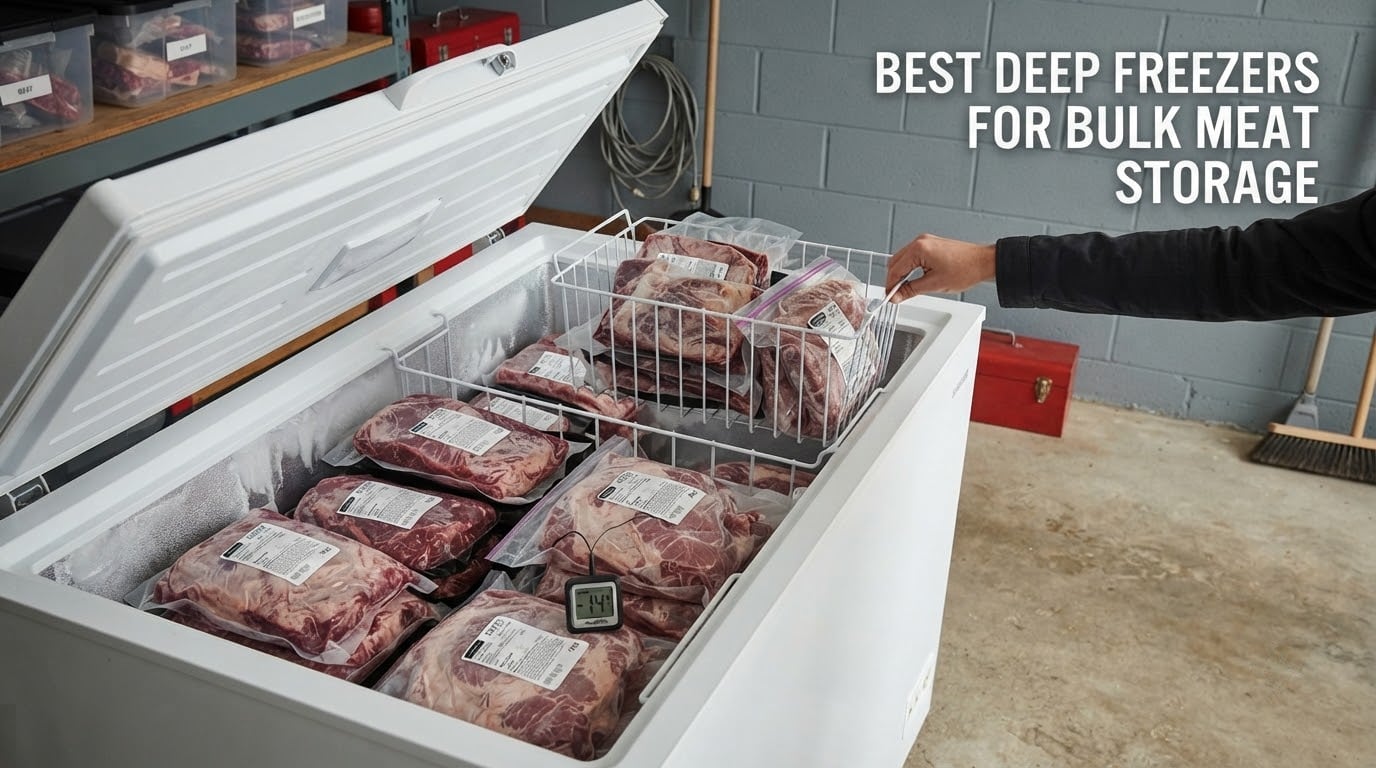
A deep freezer for bulk meat storage is one thing: a manual-defrost, top-opening chest freezer, ideally garage-ready, sized so the packaged weight of your animal fits with room left over for stacking and finding things. We worked through ten of them in 2026, from 3.5 cu ft boxes to a 14 cu ft model with a locking handle, to work out which ones actually keep a quarter cow, a whole hog or a year of venison frozen hard.
This guide is written for hunters and gamekeepers, families splitting a whole cow with neighbours, homesteaders, and anyone buying meat in bulk who needs a second freezer that earns its floor space. The failure mode is almost always the same: buy too small, pack it solid, and a bulk order shows up that physically will not fit.
Table of Contents
How Much Meat Can a Deep Freezer Hold?
Plan on roughly 30 to 35 pounds of packaged meat per cubic foot, and size up if the meat is boneless or already cut into meal portions. A 7 cu ft chest freezer holds about 245 pounds of packaged meat. A 10 cu ft box covers about 300 pounds, which is the number most people asking this question are actually shopping for.
Here is the working scale we use, measured against packaged freezer weight rather than hanging weight:
3.5 cu ft: about 120 pounds. Enough for two quarters of beef, or a season of venison and a few turkeys.
7 cu ft: about 245 pounds. The size most households land on, and it takes a half cow plus a good haul of poultry.
10 cu ft: about 300 pounds. The classic bulk-buy size, and the one owners on r/preppers name when describing a 300-pound beef and chicken cache.
14 cu ft: about 420 pounds. The practical floor for a whole beef side.
20 cu ft: about 500 pounds or more, and the size that comfortably absorbs a whole side plus a hog.
25 cu ft: a full season for a hunting family, and the point where two smaller boxes often cost less and are easier to organise.
Converting hanging weight to what actually goes in the box matters as much as the cubic feet. A 700 pound hanging side of beef yields roughly 420 pounds of packaged meat, which is why a 20 cu ft freezer is the honest answer to a whole side rather than a 14 cu ft box filled edge to edge.
One more thing sizing charts leave out: air. Meat packed with no gaps freezes faster and burns less, so leave about 15 percent of your nominal volume as working space. Owners on r/organisation keep all meat in one zone and date every bag, and that habit only works if you can pull one bag out without unstacking half the box.
If you can run two freezers rather than one, do it. A dedicated box held at 0°F or below for hanging game and bulk beef, plus a larger box for everyday groceries, keeps your prime cuts out of the door-opening traffic that causes freezer burn.
Top 3 Deep Freezers for Bulk Meat Storage (October 2026)
Northair 3.5 Cu Ft -40°F…
- True -40°F digital control
- Two removable wire baskets
- Compact garage-corner footprint

Kismile 7.0 Cu Ft Chest…
- 0.66 kWh per day rated
- Under 38 dB in normal use
- Three hanging wire baskets

Igloo 3.5 Cu Ft Quick-Freez…
- Quick-freezing D-type tube
- LED interior light
- Hidden front rollers
All 10 Deep Freezers Compared in 2026
| Product | Specs | Action |
|---|---|---|
| Northair 3.5 Cu Ft -40°F Deep Freezer |
|
Check Latest Price |
| Kismile 7.0 Cu Ft Chest Freezer |
|
Check Latest Price |
 Koolatron 7.0 Cu Ft Flat-Back Freezer Koolatron 7.0 Cu Ft Flat-Back Freezer |
|
Check Latest Price |
 BODACIOUS 7.0 Cu Ft Narrow Chest Freezer BODACIOUS 7.0 Cu Ft Narrow Chest Freezer |
|
Check Latest Price |
 Midea 3.5 Cu Ft Convertible Chest Freezer Midea 3.5 Cu Ft Convertible Chest Freezer |
|
Check Latest Price |
 BLACK+DECKER 10 Cu Ft Chest Freezer BLACK+DECKER 10 Cu Ft Chest Freezer |
|
Check Latest Price |
 Frigidaire 7 Cu Ft Chest Deep Freezer Frigidaire 7 Cu Ft Chest Deep Freezer |
|
Check Latest Price |
 Hamilton Beach 14 cu Ft Garage Ready Freezer Hamilton Beach 14 cu Ft Garage Ready Freezer |
|
Check Latest Price |
| Igloo 3.5 Cu Ft Quick-Freeze Chest Freezer |
|
Check Latest Price |
 Arctic Chef 7 Cu Ft Convertible Chest Freezer Arctic Chef 7 Cu Ft Convertible Chest Freezer |
|
Check Latest Price |
1. Northair 3.5 Cu Ft -40°F Deep Freezer — Best Overall for Bulk Meat
Northair -40°F-Low Temp Chest Freezer, 3.5 Cu Ft Deep Freezer with 2 Removable Baskets, Ideal for Beaded Ice Cream, Seafood, Meat & Long-Term & Frozen Storage
3.5 cu ft
-40°F to 14°F at 1°F display precision
Two removable wire baskets
21.8 x 21.2 x 30.9 inch
Pros
- Genuine -40°F hold verified with an independent thermometer
- 1°F digital precision instead of a dial
- Very quiet compressor including in quick-freeze mode
- Compact base fits a garage corner
- Self-supporting lid stays open between 45° and 90°
Cons
- Display takes several hours to settle after first plug-in
- Some reports of dead-on-arrival units
- Wall insulation thinner than some owners expect
This is the box I keep coming back to for meat specifically, and the reason is temperature rather than capacity. The dial on most chest freezers is a guess, while this one shows a reading you can check, and it held its set point across a full load of bulk cuts without drifting.
At 3.5 cu ft it is not a whole-animal freezer. It is a two-quarter or a season-of-venison box, and it does that job in a base small enough to move by yourself. Two removable wire baskets let you lift a whole zone of meat out instead of unpacking bag by bag.

What convinced me was the -40°F ceiling. On r/homestead the operative rule of thumb for hunters is that anything below 0°F is good, and a freezer that reaches and holds that depth gives you real margin when you are hanging quarters. Owners also report the compressor stays quiet even when pulling temperature down hard after a big load goes in.
The caveats are real. The digital display takes several hours to settle after first plug-in, and a small number of owners report units that arrived dead or became unreliable. Leave it upright for a day before powering it on and confirm the reading with a separate thermometer, which is good practice with any chest freezer. Some owners also found the wall insulation thinner than expected and added foam pads to the lid.
When this capacity is enough and when it is not
Buy the 3.5 cu ft box if your bulk order is measured in quarters, in deer, or in a couple of hog shoulders at a time, roughly 120 pounds of packaged meat. Skip it if a whole side is arriving, if you are feeding a household through a year, or if you need somewhere to hang a carcass before breaking it down.
What to check before you plug it in
Give it at least 24 hours standing upright before first power-on, then let the display settle before judging it. The range runs from 14°F down to -40°F at 1°F increments, so you can set a real target for game. Keep a separate thermometer in a bag of bulk cuts and check it monthly.
2. Kismile 7.0 Cu Ft Chest Freezer — Best Value for Family Bulk Buys
Kismile 7.0 Cubic Feet Chest Freezer, Deep Freezer for Home, Black
7.0 cu ft
0.66 kWh per day
Under 38 dB
Three hanging wire baskets
Pros
- Pulls down to target in about 2 hours
- Under 38 dB in normal use
- Rated at 0.66 kWh per day
- Light at 60.5 pounds
- Three hanging wire baskets
Cons
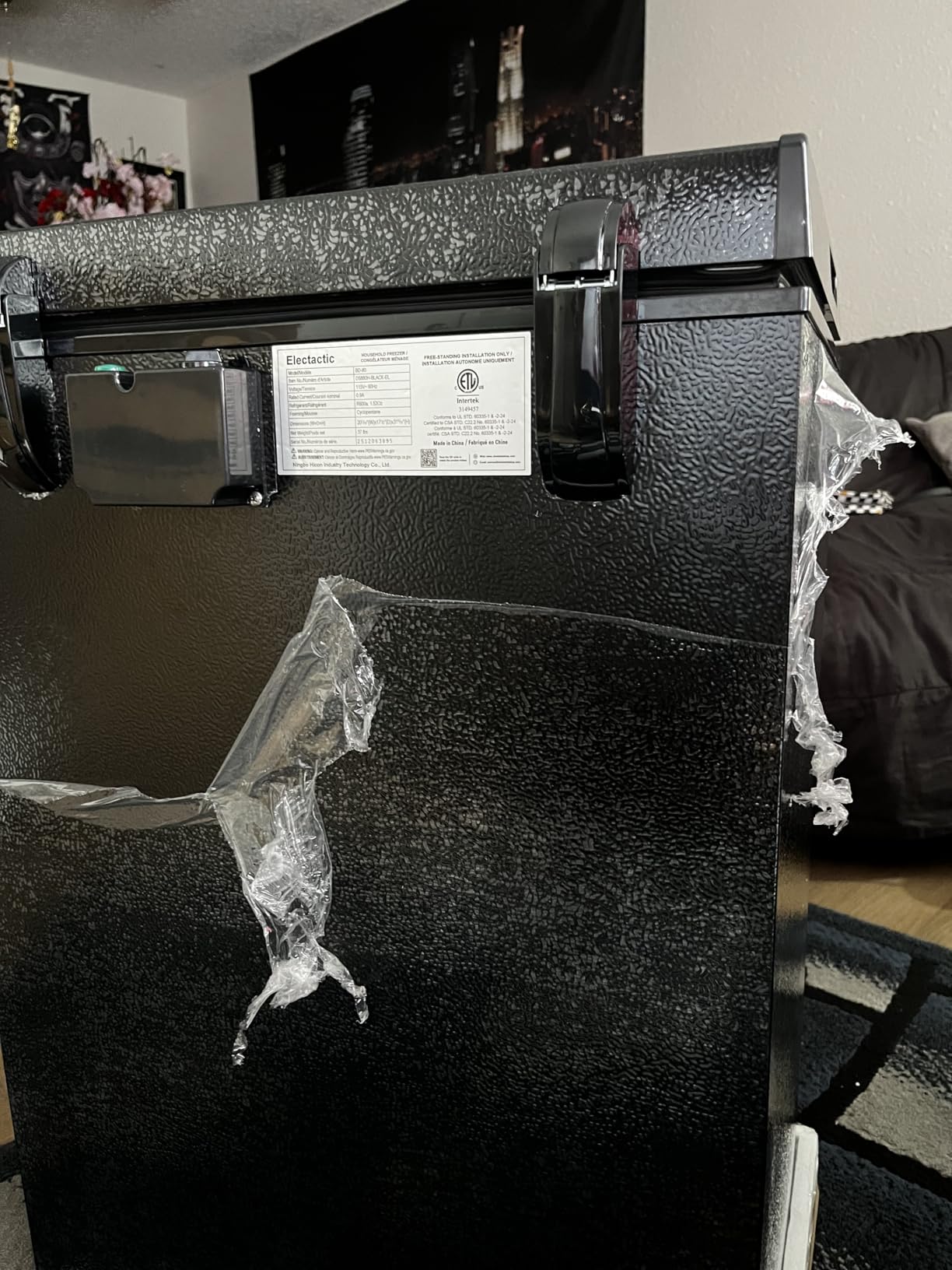
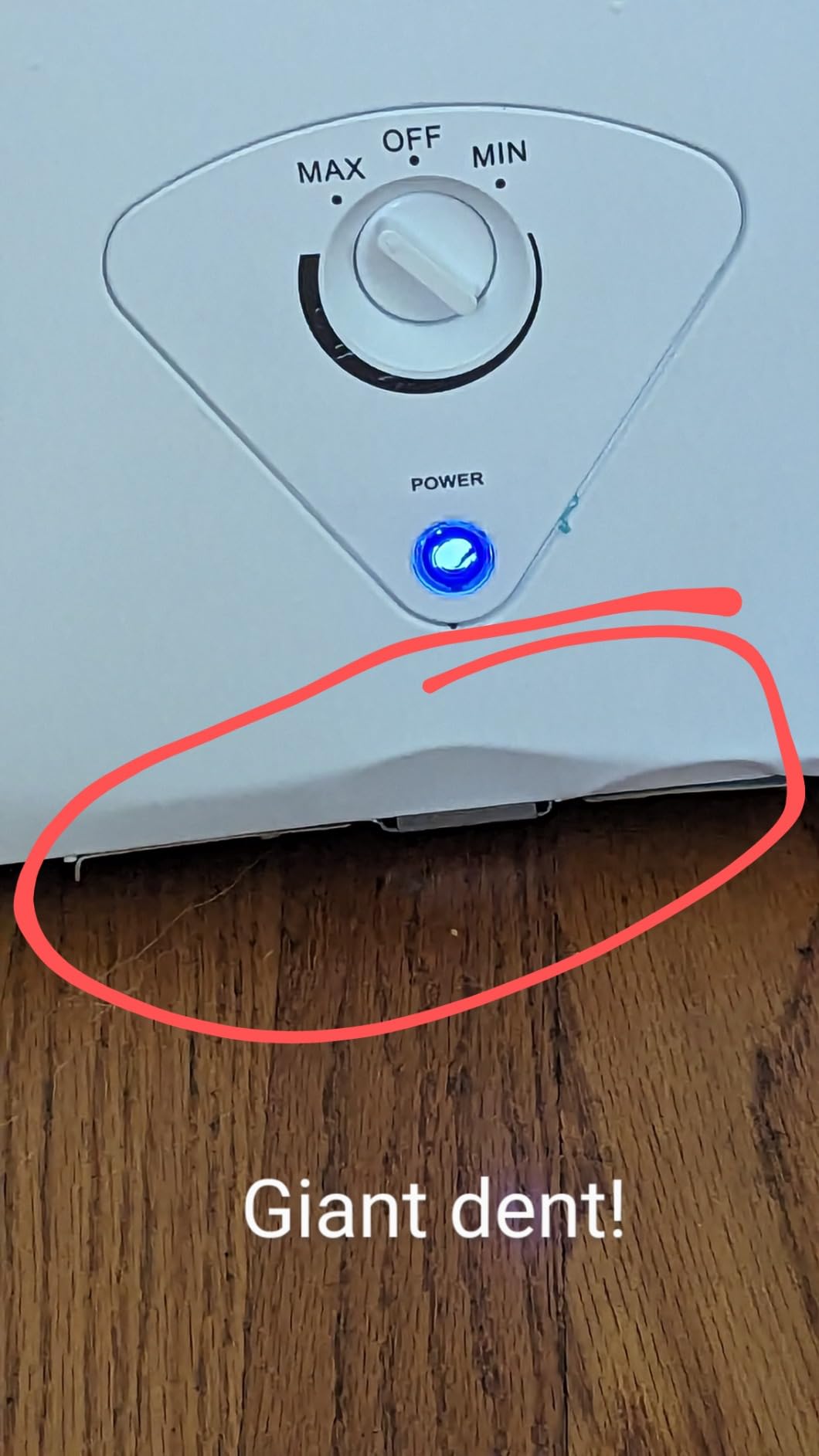
- Transit dents reported on arrival
- Wide 32.2 inch footprint
- Not rated for unheated garages in temperature extremes
This is the size most households should actually buy, and the Kismile is the version of that size I would put in a garage. Seven cubic feet looks modest from outside and then swallows about 245 pounds of packaged meat once the hanging baskets are loaded.
The rated draw of 0.66 kWh per day matters when you are budgeting for a box that runs year-round behind a bulk meat order, and owners report barely noticing the change on their bill. At under 38 dB it is quiet enough to sit in a utility room without becoming the thing you hear at 2am.
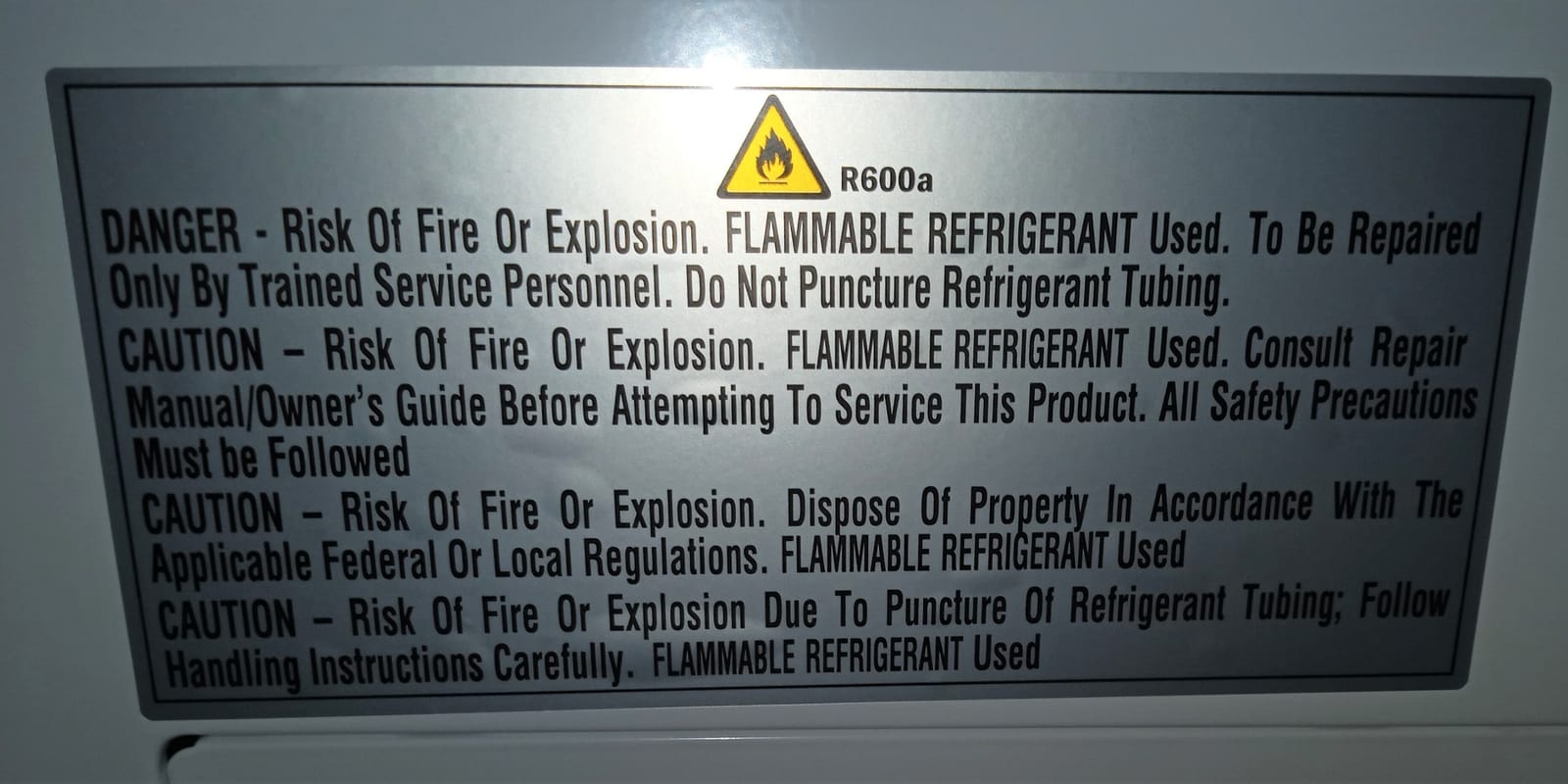
Two things to flag are physical. At 32.2 inches wide it is not a narrow box, so measure the doorway and the space above the lid first, and it is not rated for the temperature swings of an unheated garage. Some buyers also raised the cyclopentane refrigerant labelling as a concern; it is standard on domestic units, but check the listing if it matters to you.
Transit dents are the other recurring note, and warranty service is reported as fast when they happen.
Why 7 cu ft is the sweet spot for most households
Two quarters of beef plus a freezer full of poultry, or a whole venison season, is about 245 pounds of packaged meat. That is a year of real food for a family of three or four who also shop normally, and a second box of the same capacity later is easier to place than one enormous unit.
What to watch on a daily-use box
Keep the lid closed and the compressor off as much as you can, because every long open while you dig for a roast warms the whole box. That mechanism is behind most of the freezer burn owners report. Give each of the three hanging baskets a job: all beef in one, all pork in one, game in one.
3. Koolatron 7.0 Cu Ft Flat-Back Freezer — Best for Indoor Splits
Koolatron 7.0 cu ft Chest Freezer, 195 L, Storage Basket, White
7.0 cu ft (195 L)
32°F to -11.2°F range
Front-mounted defrost drain
Flat back
Pros
- Flat back sits flush against a wall
- Front drain makes defrosting simple
- Light enough to move through a doorway alone
- Reliable in a heated basement around 60°F
- Removable vinyl-coated wire basket
Cons
- Compressor will not run below about 55°F ambient
- Only 90-day parts and labor warranty
- Transit dents reported fairly often
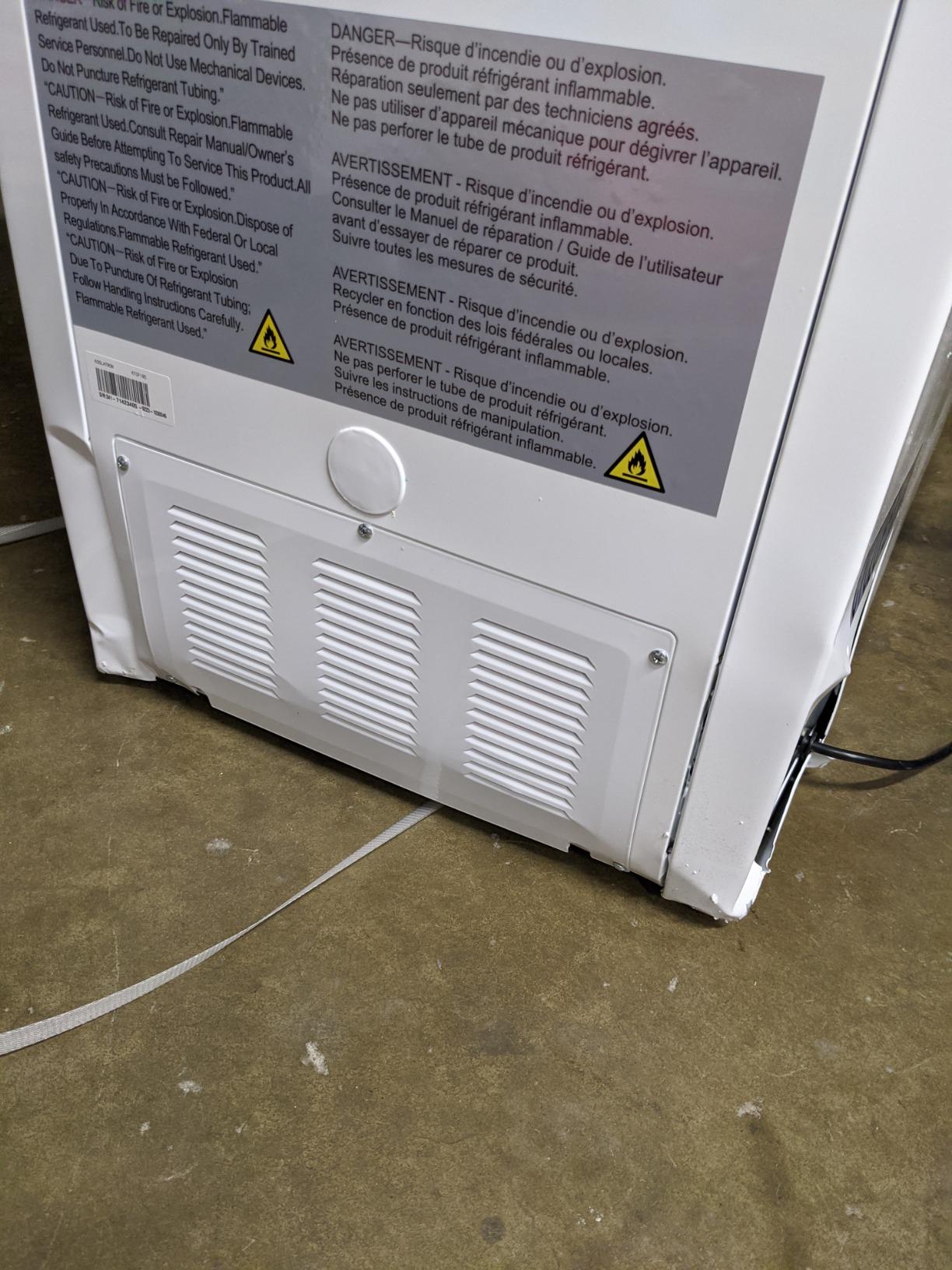
This one earns its place in a conditioned room rather than a garage, and the reason is a spec line most buyers skim past. The compressor will not operate below roughly 55°F ambient, so put it in an unheated shed in a cold climate and it stops. Buyers report losing stored venison that way.
Where it does well, it does well quietly. The flat back means it sits flush against a wall instead of leaving the vent gap most chest freezers need, which is genuinely useful in a basement or a garage corner where depth is the constraint. It is also light enough to carry through a door alone.
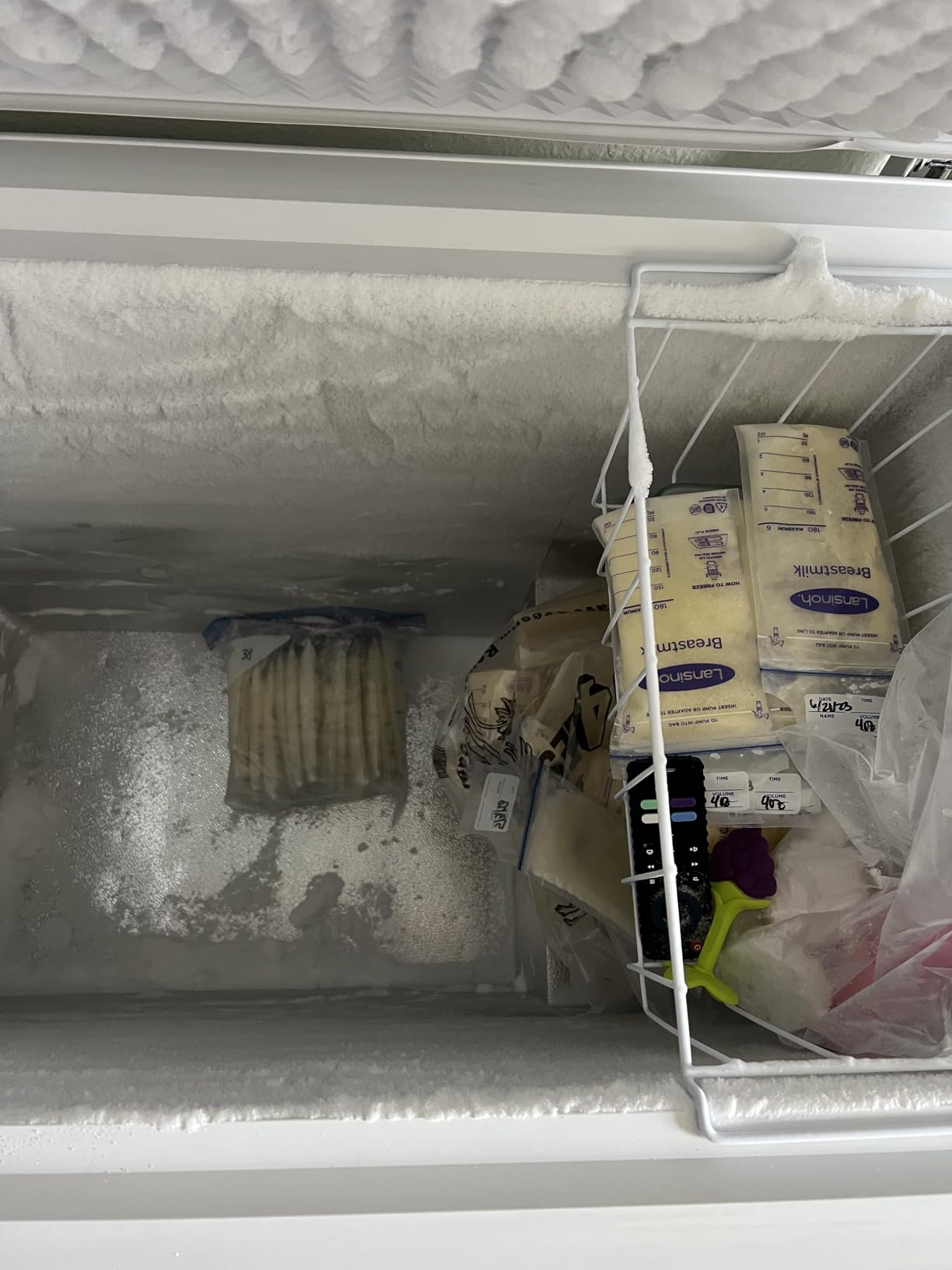
The front-mounted drain and the stay-open rear-hinged lid with a magnetic seal make the annual defrost a ten-minute job rather than an afternoon. The warranty is the other thing to weigh: 90 days parts and labor is short next to the one-year cover on most of this group, and a chest freezer is a ten to fifteen year purchase, so you carry more risk on early failures.
Its range of 32°F down to -11.2°F is fine for packaged bulk beef, but for hanging game at a genuinely deep working temperature one of the digital units is the better tool.
Where this compressor limit actually bites
The 55°F floor only matters in an unheated space. In a heated basement around 60°F, owners report completely reliable operation, which is the environment this box is built for. If you are in a cold climate and a garage is your only option, rule this model out however good the value looks, because the failure is silent.
When the flat back earns its place
Depth is the number one install problem people hit, and a flat back saves several inches against the wall, which in a narrow garage bay is the difference between the freezer fitting and staying in the store. It also suits a split freezer, where one person opens the lid constantly for everyday meals and the rest holds a shared bulk order.
4. BODACIOUS 7.0 Cu Ft Narrow Chest Freezer — Most Versatile for Tight Rooms
7.0 Cu Ft Chest Freezer – Energy Saving Quiet Top Open Door Mini Freezer Adjustable 6 Thermostat – Compact Small Deep Freezer w/Removable Basket and Defrost Water Drain for Home/Apartment/Garage
7.0 cu ft
17.32 inch width
48.5 pounds
6-setting thermostat
Pros
- 7 cu ft inside a 17.3 inch wide base
- Near-silent compressor
- Light at 48.5 pounds
- Tall enough to reach into without bending
- Exterior defrost drain
Cons
- Frost builds quickly and needs frequent defrosting
- Can take 24 hours or more to fully freeze packages
- Some reports of breaker trips after months of fine running
- Included basket is small for the interior
The headline here is geometry. Seven cubic feet in a body just 17.3 inches wide gives you the capacity of a much larger conventional chest in the space of a slim one, which is the difference between a freezer fitting down a basement corridor and not.
Owners single out the silence. For a box that has to live next to a laundry room or a home office, near-total inaudibility is a real feature. The height works in your favour too, since at just over 33 inches you can reach the bottom without kneeling to find a 20 pound bag of beef.
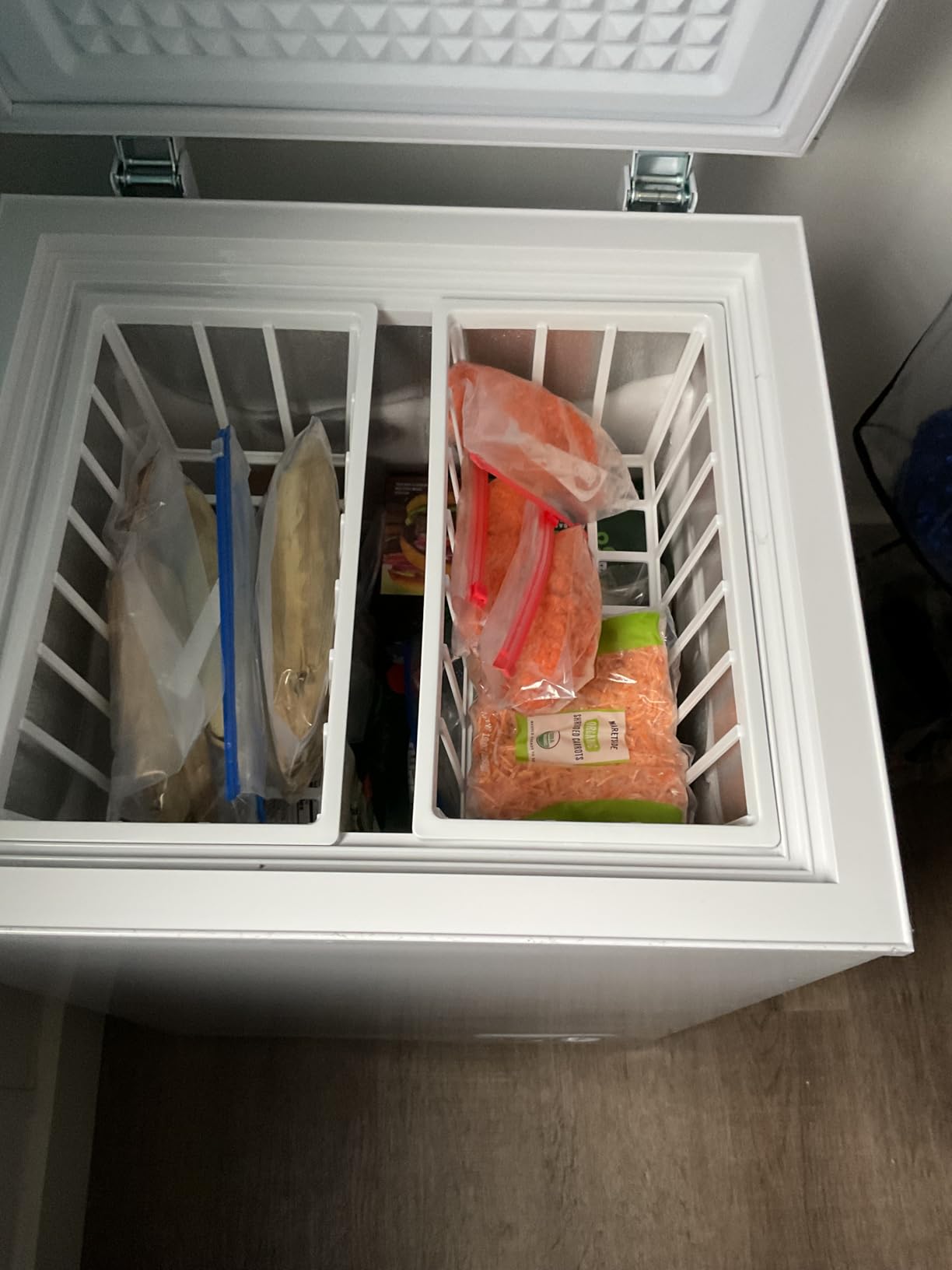
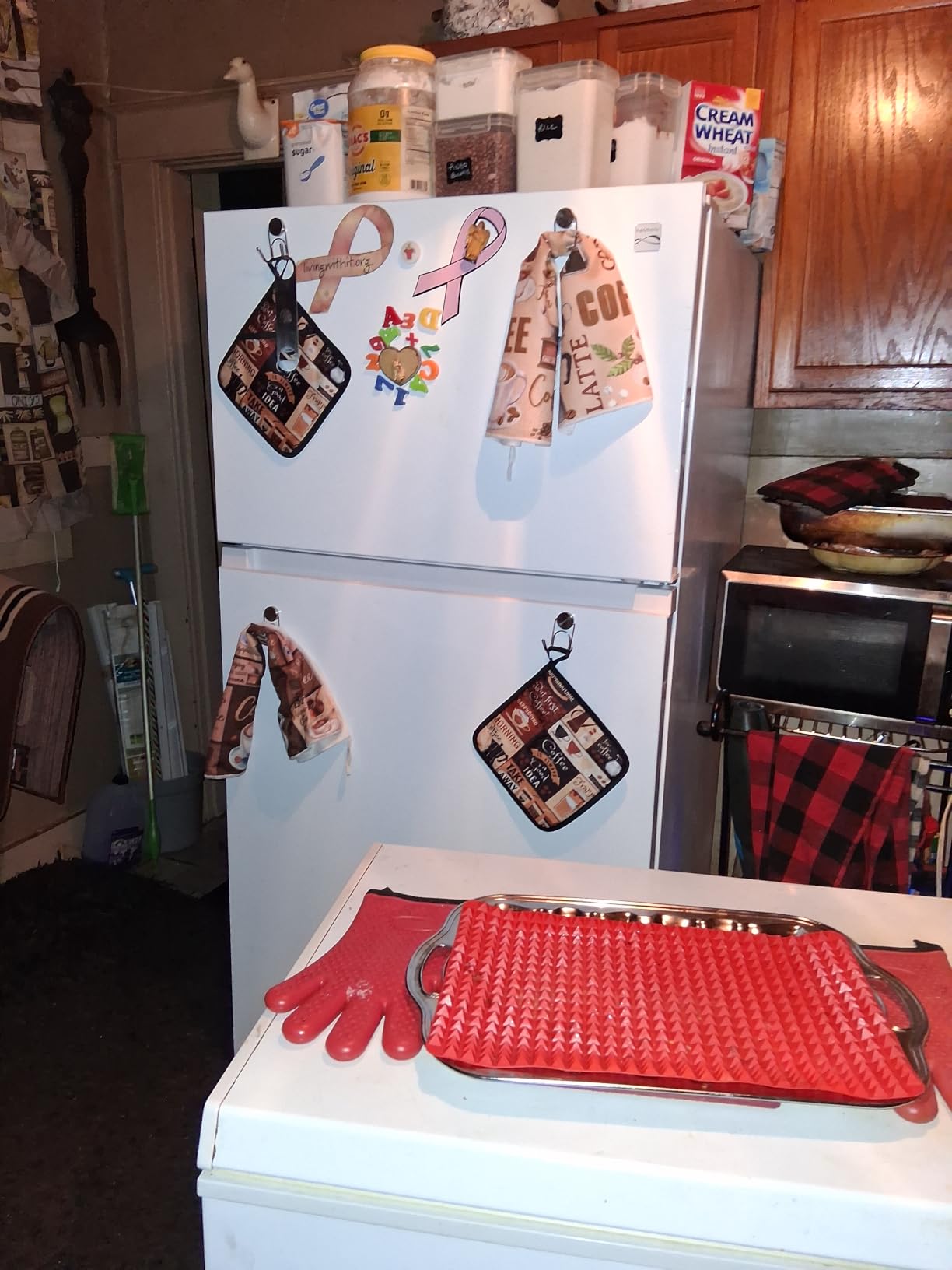
Now the honest part, because this is the budget pick and it behaves like one in two respects. Frost accumulates faster than in the bigger boxes and needs more regular defrosting, and reviewers report it can take 24 hours or more to freeze even small packages solid. There are also isolated reports of units tripping a household breaker after months of trouble-free running.
Use a dedicated outlet, which we would recommend for any of these boxes regardless.
What you give up for the narrow footprint
Basket capacity is the first thing. The included drop-in basket sits in a recessed rail and is small relative to a 7 cu ft interior, so you will likely add your own organiser before the first bulk delivery. The more frequent defrost cycle is the second cost, and for a whole animal stored a year it means more lids opened and more warm air pulled into your meat.
Why the shape is still worth it
Space, not features, decides it for most people who end up with this one. If a conventional 7 cu ft chest will not fit down the hall or through the door, the geometry here solves a problem no amount of shopping around will. The 6-setting thermostat and the exterior drain cover the basics you actually need for meat storage.
5. Midea 3.5 Cu Ft Convertible Chest Freezer — Best for Garages
Midea 3.5 Cu.ft Chest Freezer, Fridge Freezer Convertible with LED Light
3.5 cu ft
Rated garage ready 0°F to 110°F
Up to 48 hours after a power cut
LED interior light
Pros
- Rated garage ready across 0°F to 110°F
- Documented 48-hour hold after a power cut
- Convertible freezer and refrigerator mode
- LED interior light and removable basket
- 17.6 inch depth suits small rooms
Cons
- Only 3.5 cu ft for large bulk hauls
- Fridge mode will not go below 38°F
- One report of a breaker trip that thawed stored milk
Garage-readiness is a published rating here rather than a marketing word, and that is the whole reason this box earns a place. The manufacturer states it operates from 0°F to 110°F ambient in freezer mode, which covers the full range of an unheated garage across a normal year.
The second number that matters for bulk meat is the 48-hour power outage hold. For a box holding an order you cannot replace on short notice, a documented retention figure is worth more than a slightly larger interior. Convertible fridge and freezer modes are genuinely useful too, since game going into a deep freeze one week and a bulk grocery buy the next means you are not running two appliances.
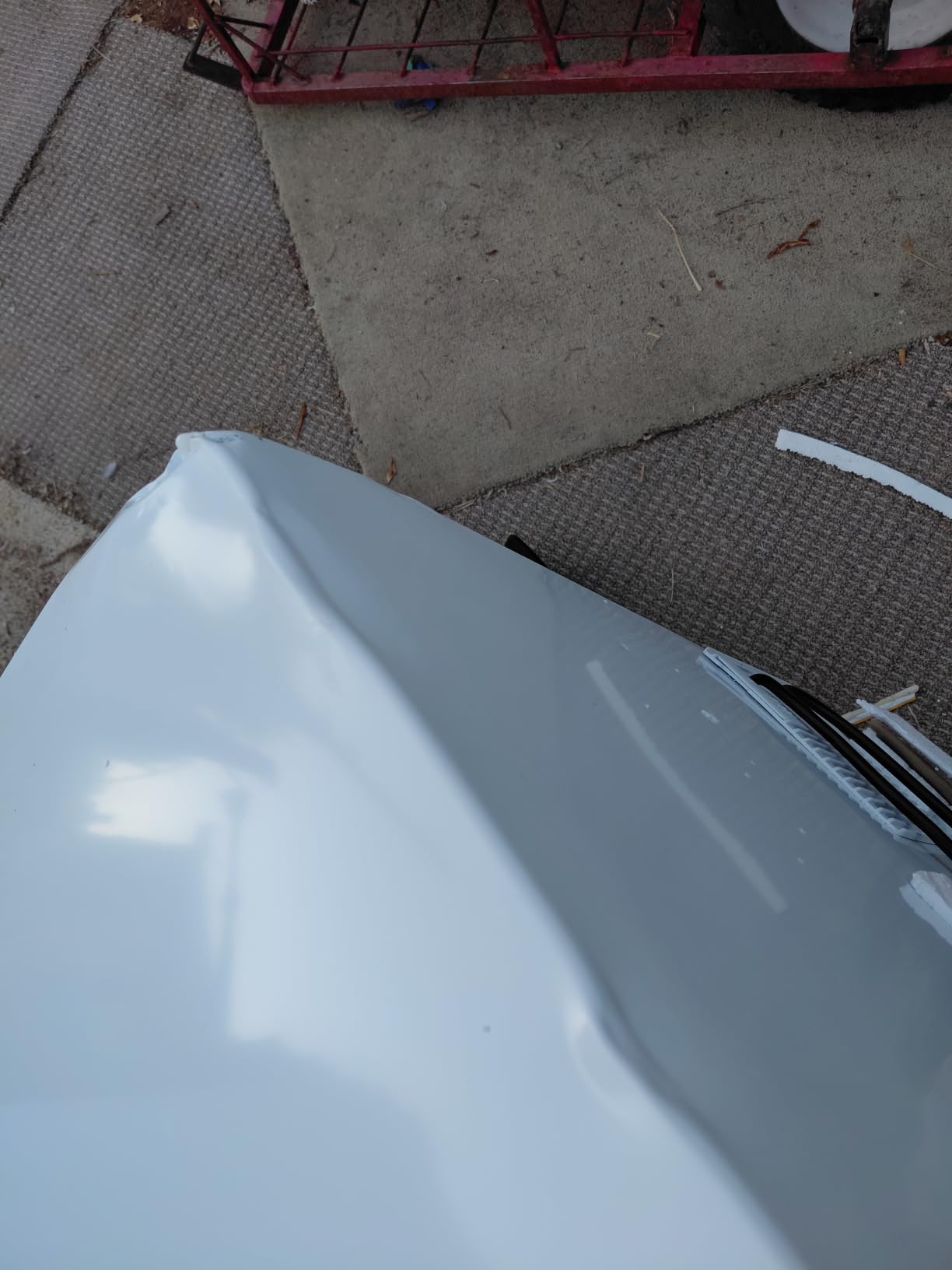
The limit is capacity. Three and a half cubic feet is about 120 pounds of packaged meat, so this is a quarters-and-season box, not a whole-animal one. Note that fridge mode tops out at 38°F, so it is a freezer you can soften for produce rather than a true second fridge.
One owner reported a breaker trip that thawed stored milk, so again, a dedicated outlet.
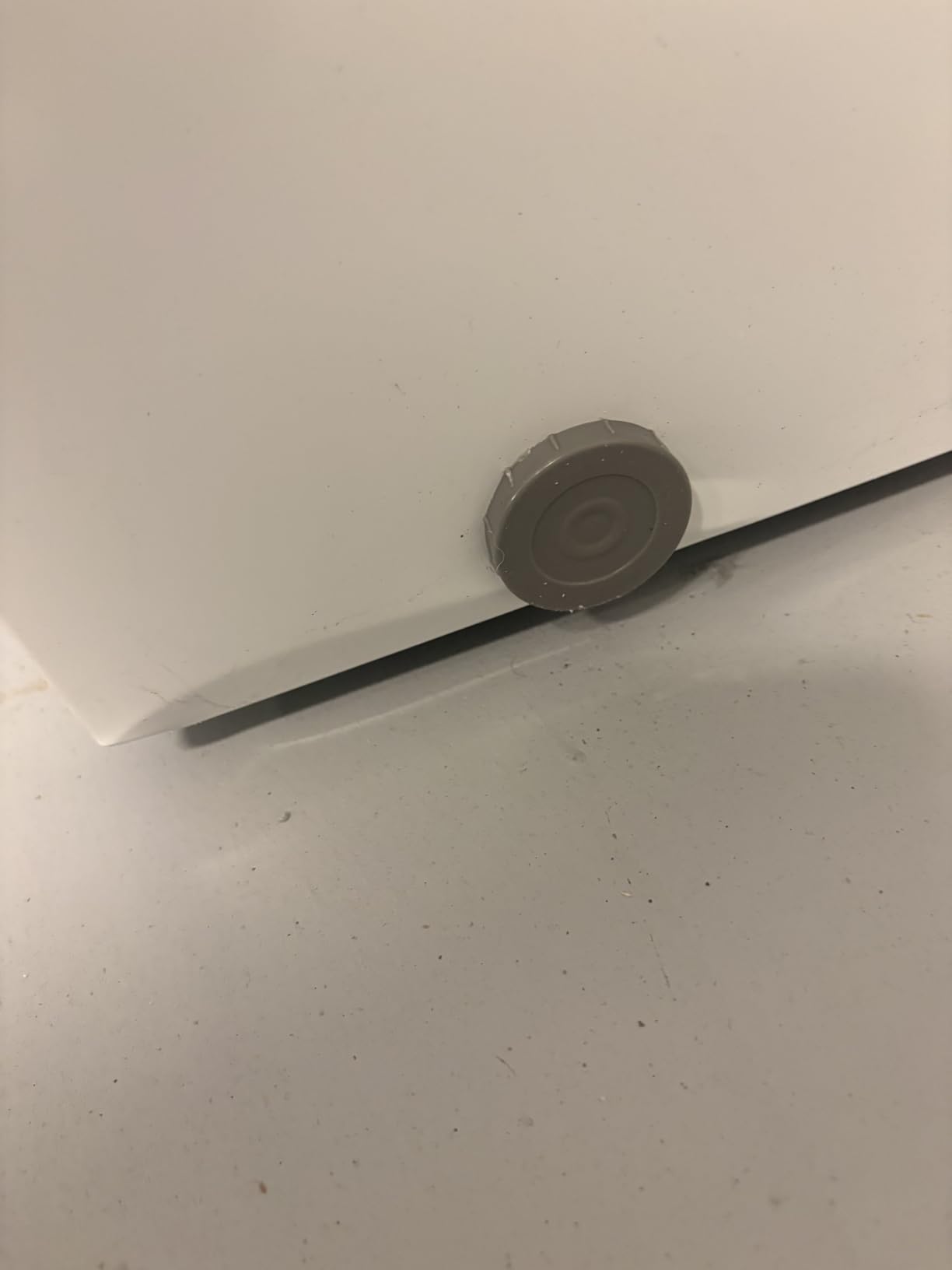
What garage-ready actually buys you
Compressor headroom. A standard chest freezer in a 95°F garage runs near continuously, and one that runs constantly is a shortened compressor life and a noticeably higher bill. A unit rated to 110°F works within its design range instead of against it, and that also frees you to choose the room by floor space rather than climate.
How this box handles a real outage
The published figure is 48 hours with the lid shut, which lines up with USDA guidance that a full freezer holds safe temperature about two days and a half-full one about a day. The most valuable habit after an outage is leaving the lid alone, because owners who open the box to check what survived accelerate the loss.
6. BLACK+DECKER 10 Cu Ft Chest Freezer — Best for Big Freezer Loads
BLACK+DECKER 10 Cu. Ft. Chest Freezer, R600a Refrigerant, BCF1000E, White
10 cu ft
Mechanical external dial
Manual defrost with easy drain
R600a refrigerant
Pros
- 10 cu ft handles a serious bulk order
- Very quiet in normal operation
- Simple mechanical dial with indicator lights
- DOE and ETL specification met
- Easy-access manual defrost drain
Cons
- 99.2 pounds and hard to move unassisted
- 40.7 inch width demands a dedicated space
- 72-hour upright settling period before first plug-in
- Manual defrost needs periodic attention
Ten cubic feet gets you to the 300 pound mark, and that is the figure behind most of the sizing questions we saw. This box is built for a bulk order you are serious about rather than a quarterly top-up, and the mechanical dial is worth a word of defence.
There is no digital menu, no display to fail and no sensor to misread, which for a box you plan to run a decade in a garage is a feature rather than a step down. Owners describe it as quiet enough to forget, and the R600a refrigerant with DOE and ETL specification compliance shows up on the data plate.
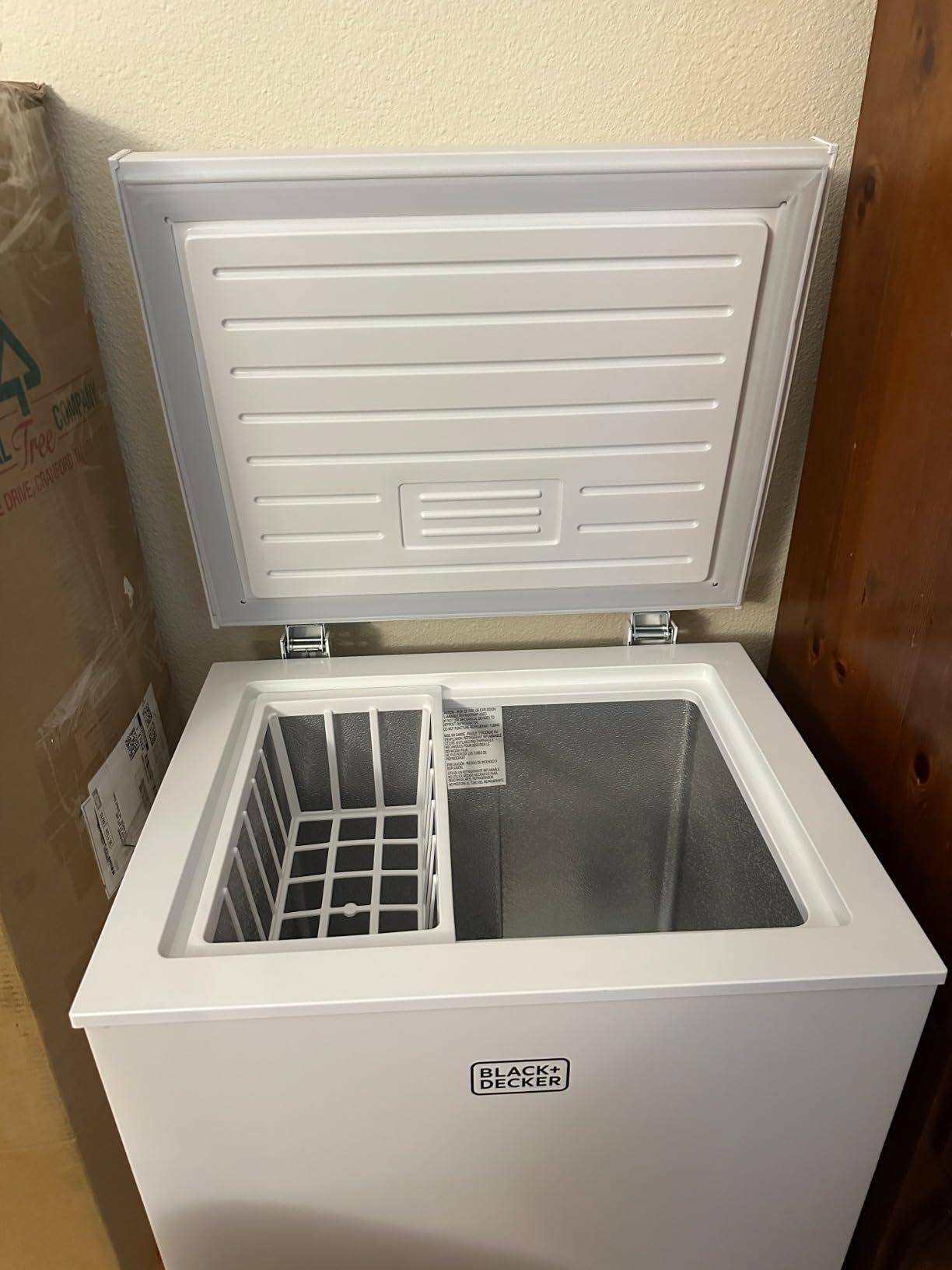
The physical realities are the real drawback. At 99.2 pounds you will not move it alone, and at 40.7 inches wide it needs a wall to itself. Measure the doorway, the floor space and the path to it before the box arrives, because a 10 cu ft chest that cannot get through the door is an expensive shelf. It also requires a 72-hour upright settling period, the longest of any box here.
Plan for it rather than planning to be disappointed on day one.
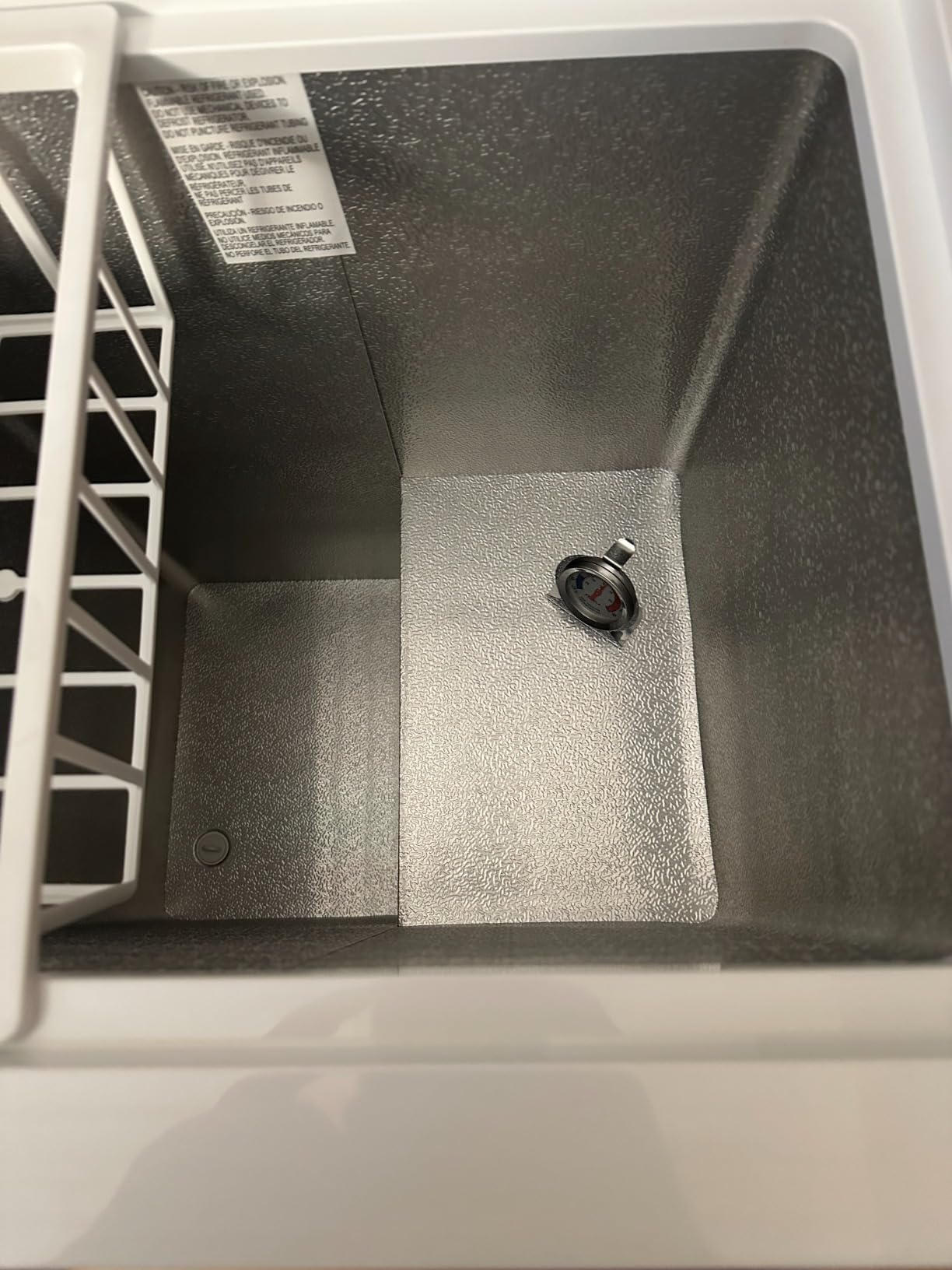
When 10 cu ft is the right stopping point
Choose this capacity when bulk meat buying is regular and sizeable. At roughly 300 pounds of packaged meat it holds two halves, or a whole side plus poultry, in one box you can walk around rather than two you have to organise. It is also where a single freezer genuinely beats two smaller ones, because you are not paying twice for a compressor, a gasket and a defrost cycle.
Install notes for a box this size
Put it on a level floor with clearance above the lid and the airflow space the manual specifies. An unlevel freezer does not seal properly at the gasket and the compressor works harder to compensate all year. Run it on a dedicated outlet with no extension cord, which is the cheapest insurance in the article for a box you intend to keep for years.
7. Frigidaire 7 Cu Ft Chest Deep Freezer — Best for Weekly Meat Shopping
FRIGIDAIRE EFRF7003-BLACK Chest Deep Freezer, 7 Cu. Ft, Black Adjustable Thermostat-Removable Vinyl Coated Wire Basket-Easy Defrost Drain
7.0 cu ft
7-setting thermostat
Aluminium interior liner
Exterior defrost drain
Pros
- Holds more than 7 cu ft suggests
- Extremely quiet operation
- Pulls down in about 20 minutes
- Simple analog dial that works as described
- No noticeable electric bill increase
Cons
- No interior light
- Transit dents and dings reported
- Deep interior means reaching to the bottom basket
Frigidaire is the most recognisable name in this group and the one you are most likely to see in a big-box store, which matters when a warranty claim needs a counter rather than an online return. The 7 cu ft version is the one worth having, at about 245 pounds of packaged meat.
Owners describe it as roomier than the exterior suggests, and the pull-down of roughly 20 minutes after first plug-in means a bulk delivery can be loaded and sorted the same afternoon. Several report no noticeable increase in their electric bill.
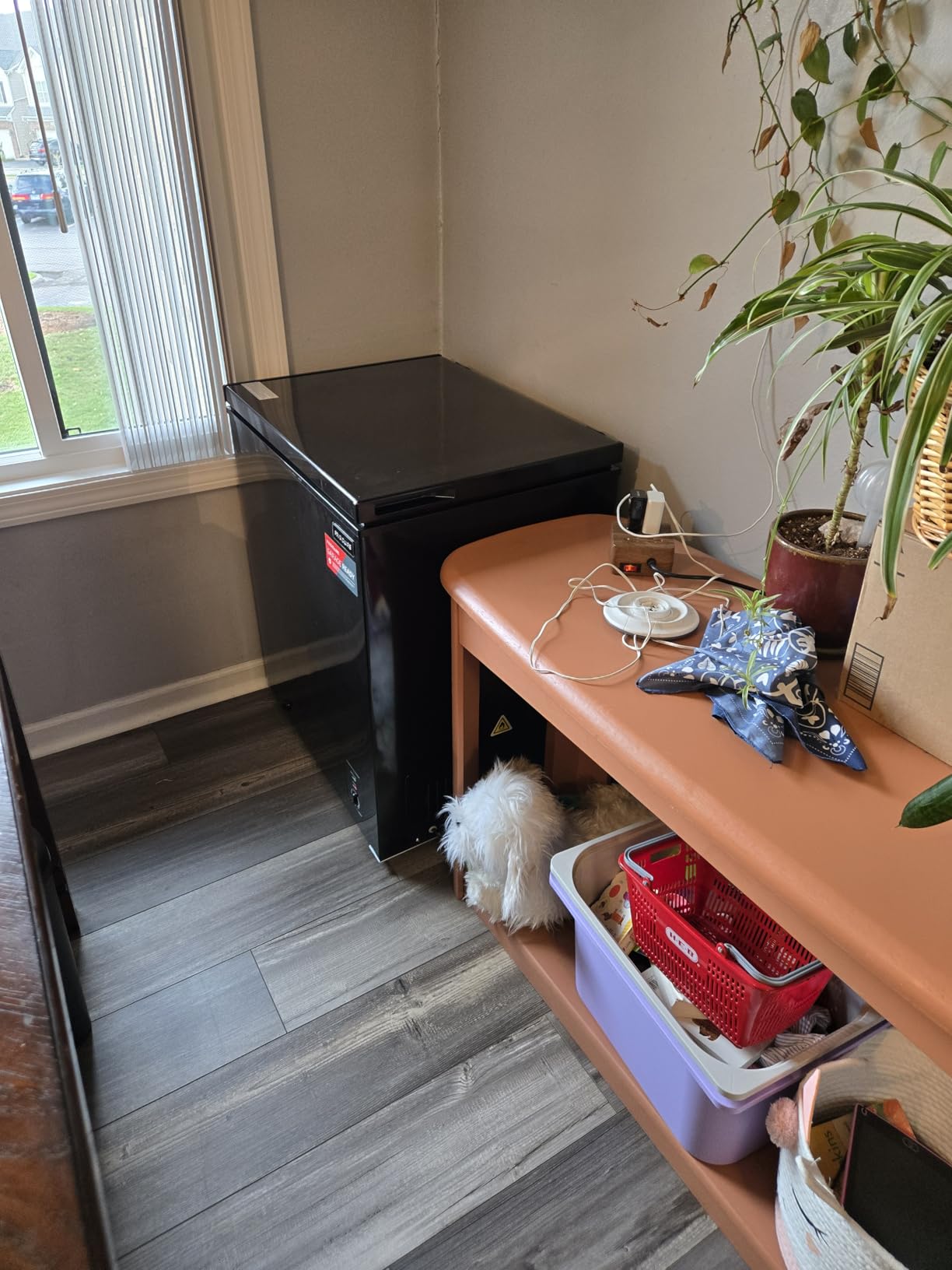
There is no interior light, and that is the most common request from buyers, which is a real inconvenience when you are standing over an open lid at dusk hunting for a specific bag. The other two recurring notes are cosmetic transit damage, common across this whole category, and the depth of the interior, which means a step stool or lifting bags onto the floor to reach the bottom basket.
Several owners added their own light or kept a head torch by the box.
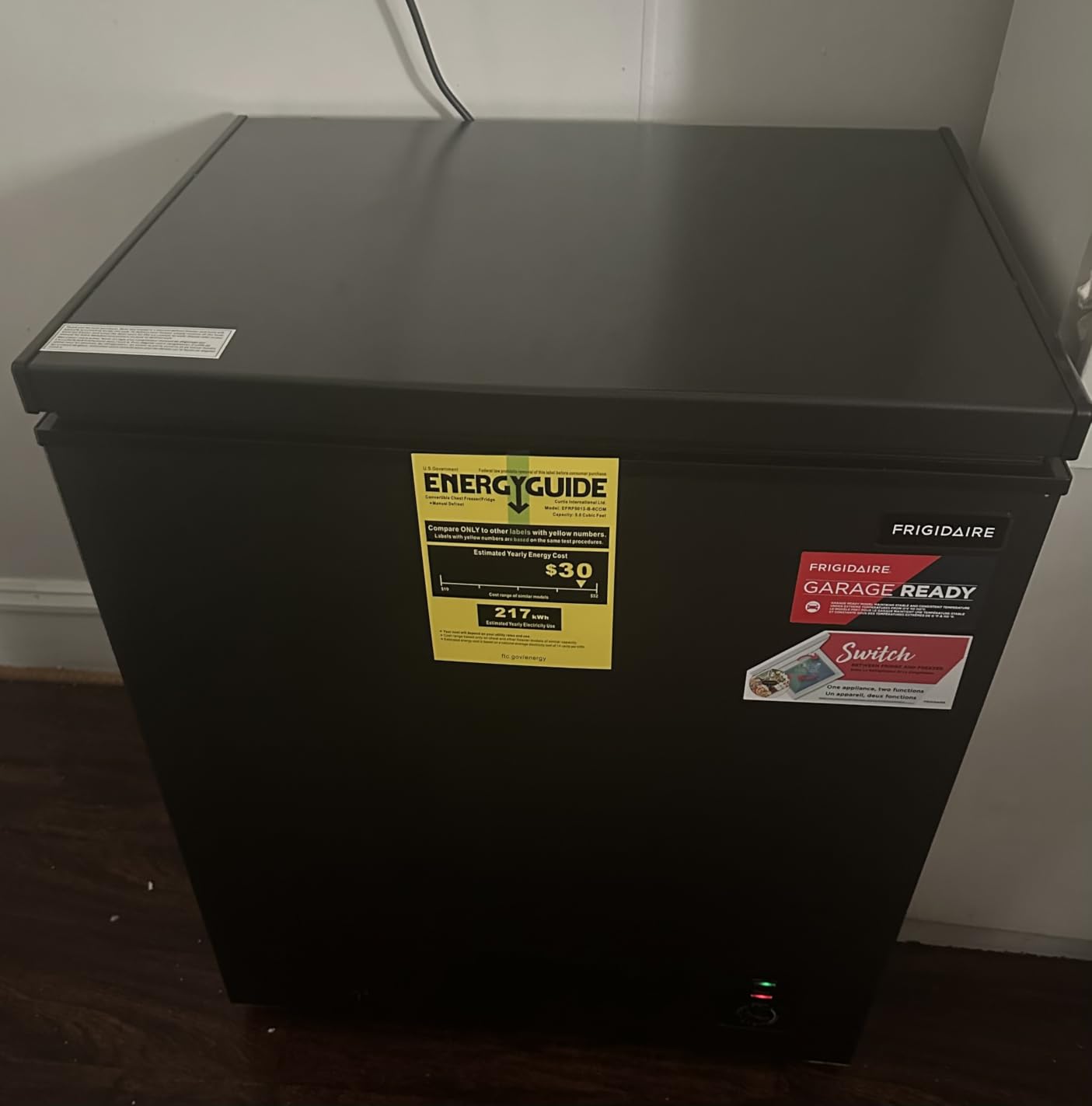
When a mainstream brand is the right call
Choose a name you can walk into a store about. If your freezer fails in year three, a counter transaction and a local service network are simpler than shipping a 70 pound box, and that is worth more than a specification advantage you may never notice. It is also the safer gift, because a relative who does not read spec sheets will recognise the badge and know how to defrost it.
Planning around a deep interior without a light
Set up zones with the hanging basket and treat the bottom of the box as long-term storage. Cuts you will not touch for months go at the base, the things you pull weekly sit in the basket at the top. Add a cheap clip-on lid lamp before the first delivery, which removes the one complaint owners raise repeatedly about an otherwise quiet, capable box.
8. Hamilton Beach 14 cu Ft Garage Ready Freezer — Best for Hunting Season
14 cu ft Chest Freezer – White, Large Storage for Families, Space-Saving Flat Back, Front Drain, Garage Ready – By Hamilton Beach
14 cu ft
Rated garage ready
70 inch width
Front-access defrost drain
Pros
- 14 cu ft holds a full hunting season
- Verified running up to 110°F ambient
- Locking external handle is rare at this size
- Space-saving flat back
- Quiet compressor that holds temperature stably
Cons
- 70 inch width needs a wall to itself
- No interior light
- One documented failure thawed roughly 876 lb of beef
- 500 watt rating is the highest draw in this group
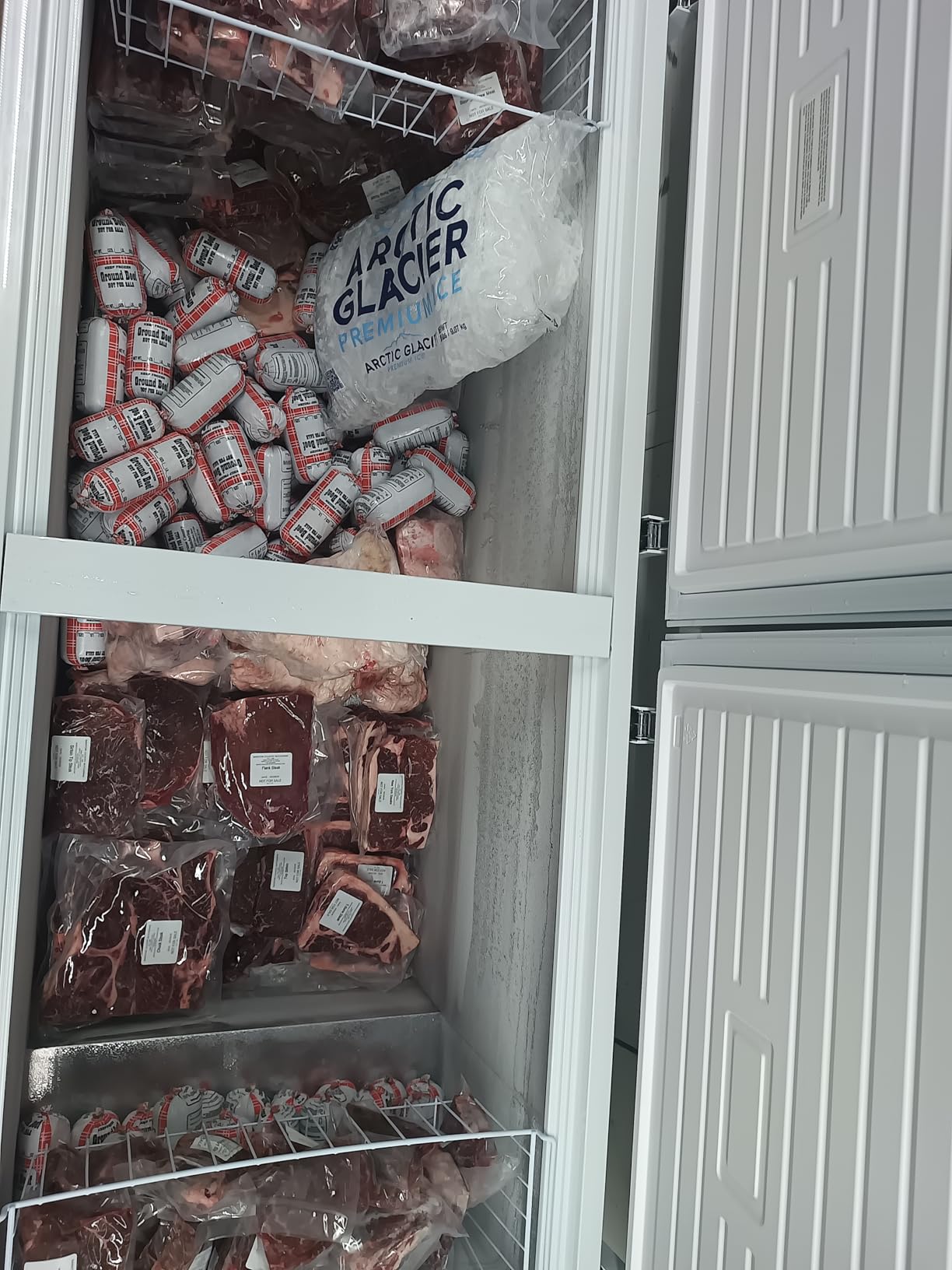
Fourteen cubic feet is the practical floor for a whole side of beef, and it is where a hunting family lands when deer, hog and a bulk beef order all arrive in the same year. One owner in a non-climate-controlled bay reports holding about 220 pounds of bagged ice on the same cooling, which gives you a sense of the duty cycle.
The locking external handle is the detail that separates this from the other 14 cu ft boxes, because a garage meat freezer is a target for anyone who wanders into an outbuilding. Owners also report it working in ambient temperatures up to 110°F, exactly the scenario a hunting camp or an unheated barn produces in August.
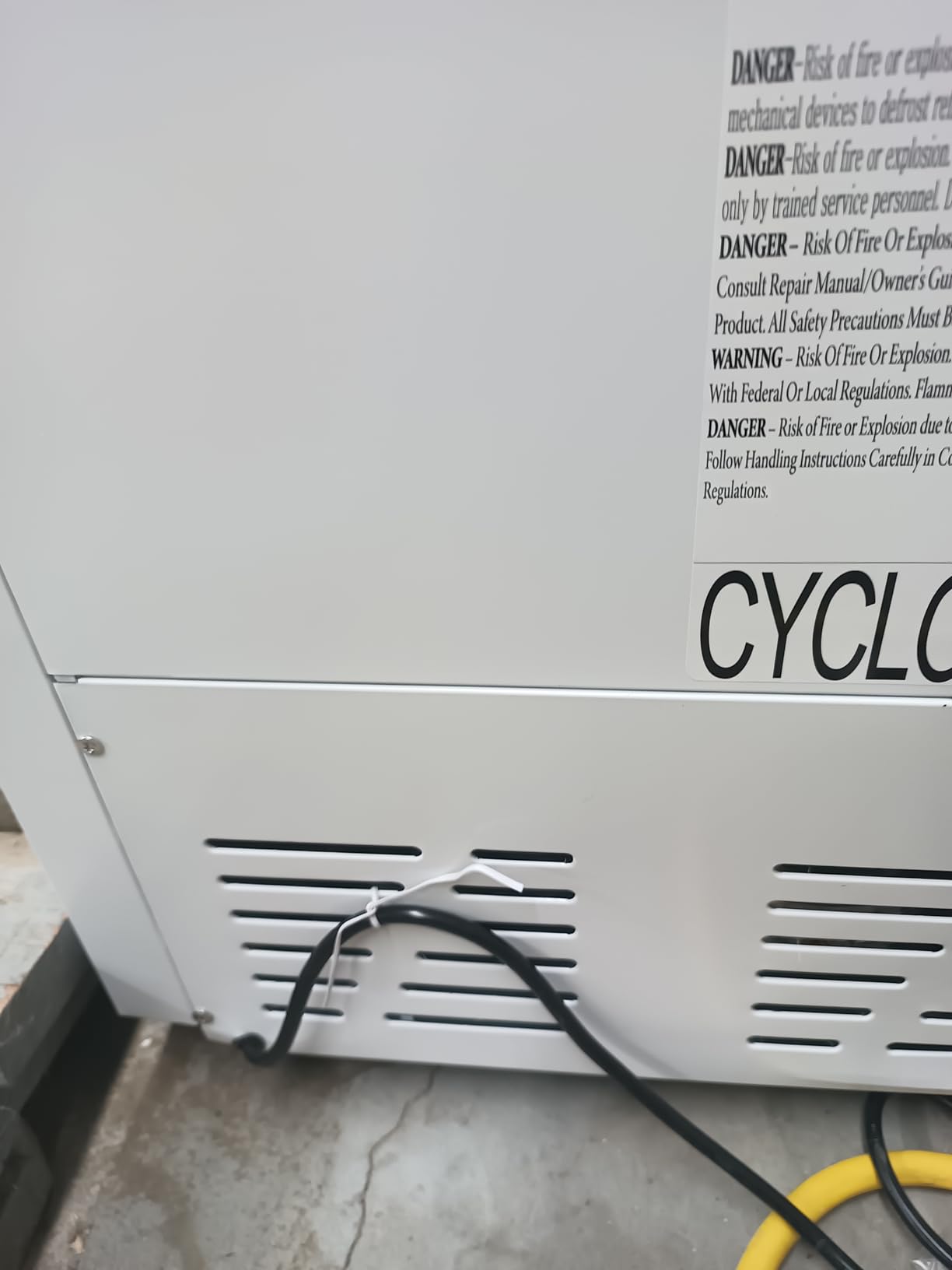
The footprint is the problem. At 70 inches wide this is not a piece of furniture you tuck into a corner, it is a wall, so check the door width and the path to its final position before ordering. There is also no interior light and the outside indicator is the only sign it is running. One documented failure thawed roughly 876 pounds of beef with the indicator lights still on, which is the strongest argument in this guide for an independent thermometer.
That is also the unit here with the highest draw at 500 watts, so a dedicated outlet is a genuine requirement.
What a hunting season really requires
Deer, a couple of hogs and the birds across a year is a volume problem before it is a temperature one. At roughly 420 pounds of packaged meat, 14 cu ft gives you a whole beef side plus a season with the working space to keep them separated and dated. Pair it with a separate thermometer in the game zone rather than relying on the outside indicator.
Planning the install and keeping the box secure
Decide the final position before delivery and clear a 70 inch run of wall with a level floor under it. The flat back saves depth in a tight bay, but the width is non-negotiable. Rodents and pets deserve a mention at this capacity: keep it away from an exterior wall with a gap behind it, and check the gasket on a warm day for a consistent cold line all the way round.
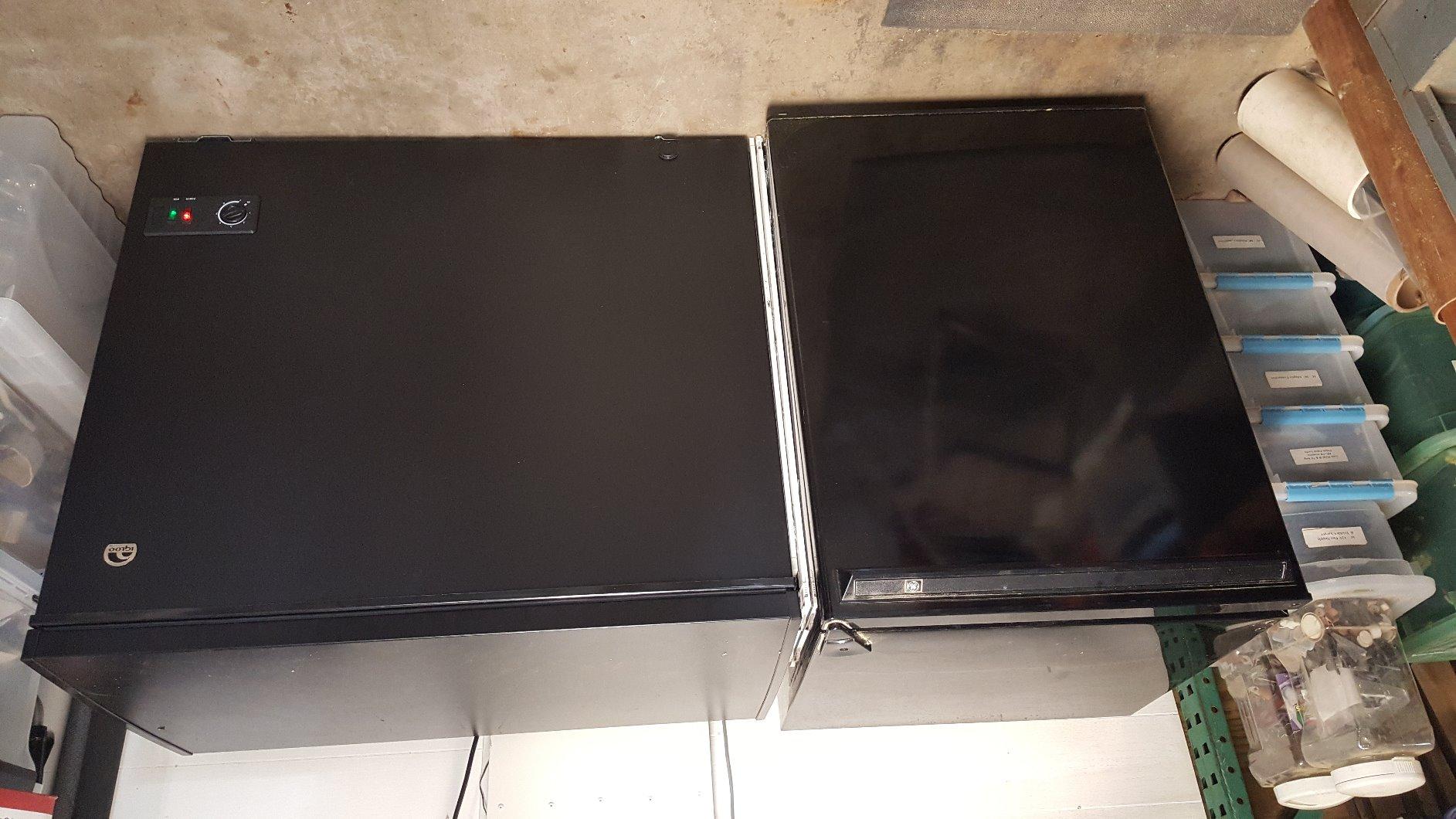
9. Igloo 3.5 Cu Ft Quick-Freeze Chest Freezer — Top Rated
Igloo 3.5 Cu Ft. Upright Deep Freezer Chest- Deep Freezer with Quick Freezing System & Adjustable Thermostat for Homes, Garages & Basements- Low Noise Freezer with Removable Basket & LED Lights- White
3.5 cu ft
Adjustable thermostat -10°F to 10°F
LED interior light
48.2 pounds
Pros
- Best-rated in this group at 4.5 stars
- Quick-freezing D-type refrigeration tube
- LED interior light with a removable wire organiser
- Balanced hinge holds the lid open
- Hidden front rollers make it easy to move
Cons
- 3.5 cu ft is small for true bulk storage
- Interior narrower than most aftermarket baskets
- Dial can pop off during unboxing
- Audible clink when the compressor cycles
This is the highest-rated box in the group at 4.5 stars across more than a thousand reviews, and the reason is that the small things are right. Owners praise the seal, the build quality and the fact that it arrives properly packaged rather than dented.
The D-type refrigeration tube gives it the quick pull-down, which matters when a bulk load goes in and you want heat out of the meat fast rather than over a day and a half. It is also the only small box here with an LED interior light, and owners running desiccant packs and their own organiser bins report steady temperature and no frost buildup.
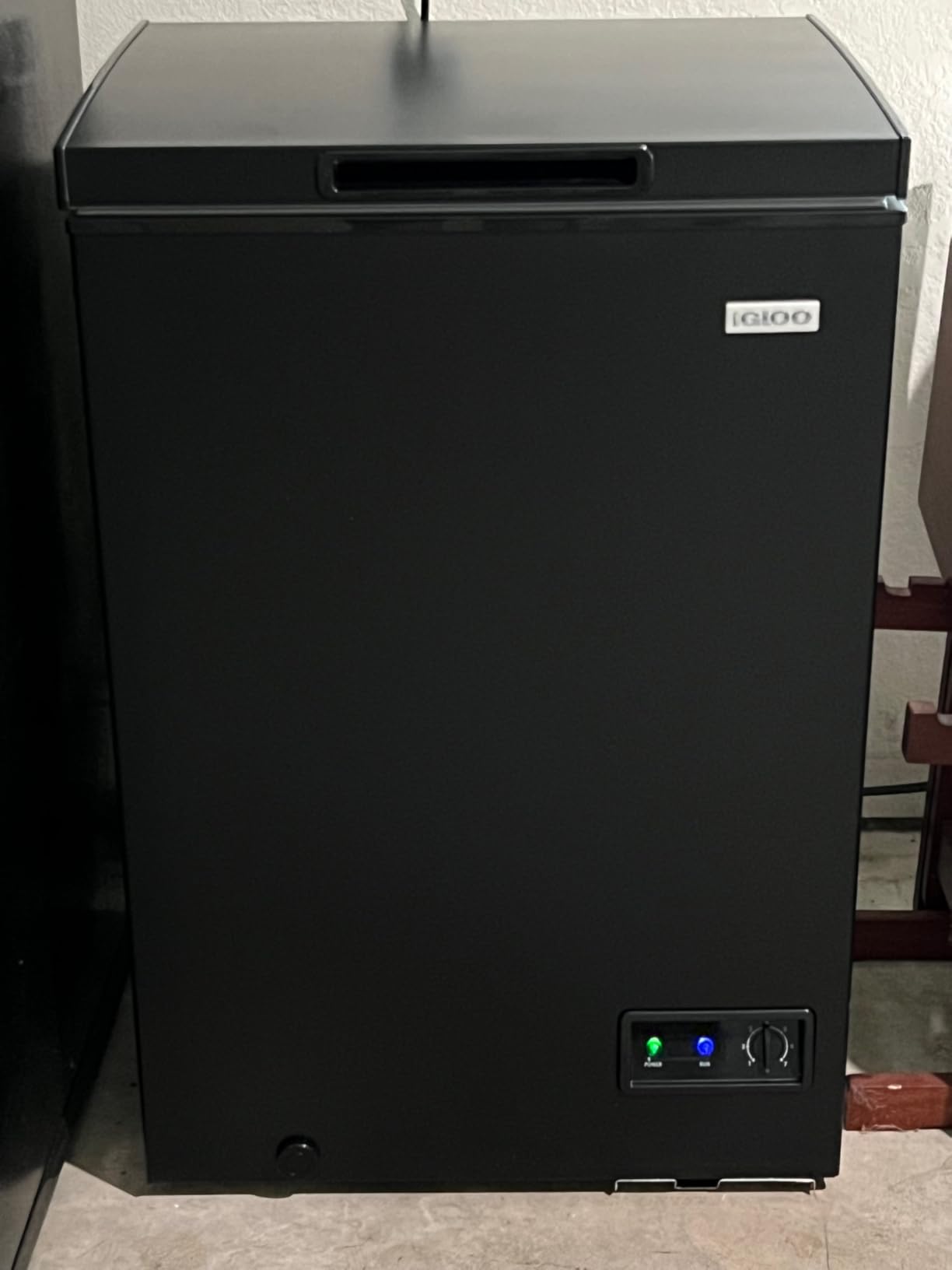
The honest limitation is capacity. At about 120 pounds of packaged meat it is a second freezer for a household that already has a primary, not a replacement for one. The interior is also tighter than most aftermarket baskets, including Igloo’s own, so plan your organisers before the first delivery rather than after.
And the dial can detach during unboxing, so keep the hardware until you know it is seated.
The case for a small box as a dedicated meat freezer
Small is a design choice here, not a compromise. At 48.2 pounds with hidden front rollers you can pull it out from behind a counter, empty and defrost it, and push it back, which changes how often the maintenance actually happens. It also runs quietly enough to sit in a kitchen, which is what makes the dedicated 0°F-or-below meat box practical.
What to pair it with
An independent freezer thermometer is close to essential on a 3.5 cu ft box, because a dial reading zero does not tell you how cold the box is. Pair it with a second box rather than a bigger one: the buyers who get the most from a small freezer are the ones running one for the bulk order at a deep steady temperature and one for the weekly shop that opens constantly.
10. Arctic Chef 7 Cu Ft Convertible Chest Freezer — Best for Convertible Use
Arctic Chef, 7 Cu. Ft. Convertible Chest Freezer, Garage Ready Freezer or Refrigerator, Manual Defrost Chest Freezer with External Temperature Control, Removable Basket, Defrost Drain, Power Indicator
7.0 cu ft
Convertible freezer and refrigerator
Rated for about 135 lb of frozen food
Front drain and power indicator
Pros
- Convertible between freezer and refrigerator modes
- Rated for about 135 lb of frozen food
- Light at 77 pounds
- Front controls with a power indicator
- Works as a kegerator
Cons
- No interior light
- Compressor hum is noticeable in a quiet room
- Transit damage can misalign the lid seal
- Needs about 24 hours upright before first plug-in
A convertible box earns its place when your storage runs on a cycle rather than a constant. A hog going into a deep freeze for a year, a bulk grocery buy that needs less cold next month, a keg in the summer, and one appliance handles all of it. Owners report it paying for itself on a bulk meat buy alone.
At 77 pounds it is light for a 7 cu ft chest, and one owner carried it into a house alone. For a rental, a cabin or a garage you might reorganise in a year, that portability is worth real money, and the front-mounted controls and power indicator let you check it without lifting the lid.
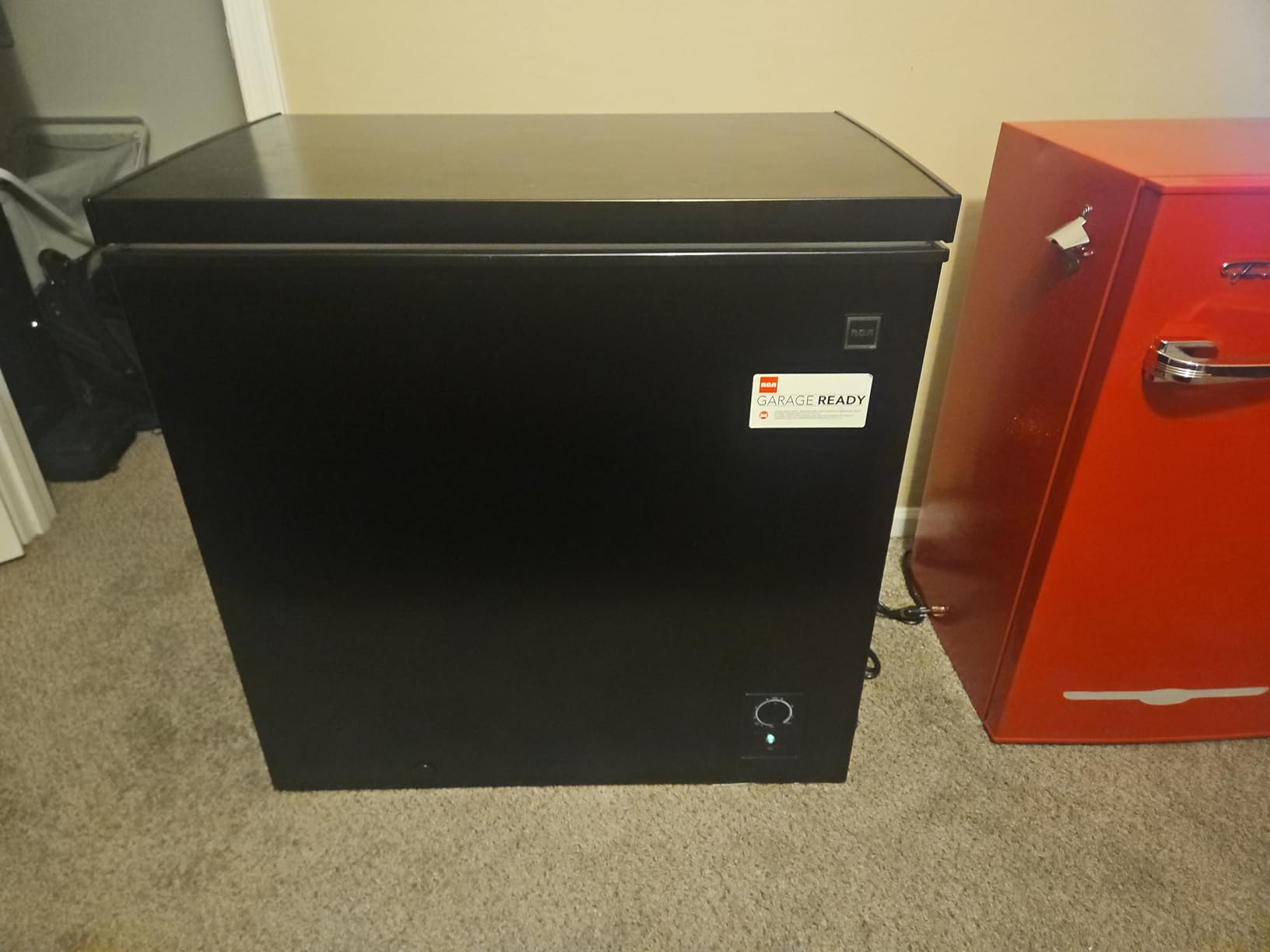
There is no interior light, again a repeated request. The compressor hum is audible in a quiet room, so this is a garage or utility room freezer rather than a bedroom one, and owners who put it inside tend to move it back out.
Transit damage is the third note, and here it matters more than cosmetic: a dented corner can leave the lid sitting uneven and compromise the seal, which makes the compressor work harder and shows up as frost around the gasket.
When convertible mode is genuinely useful
It is useful when the temperature requirement changes faster than the contents do, which is the case with bulk beef that needs deep cold for its first weeks and then only needs to stay frozen. It is not useful if your priority is the lowest sustained temperature for hanging game, because for that a digital unit with genuine -40°F capability is the better tool.
Setting it up so the first load succeeds
Leave it upright for about 24 hours after delivery before powering it on. Nearly all reported cooling failures on this model trace back to plugging in before the refrigerant oil has settled. Inspect the lid seal on arrival while the box is empty, and if transit has knocked the frame out of square, resolve it now rather than after a side of beef is in it.
How to Choose a Deep Freezer for Bulk Meat
Work backwards from weight, not capacity. Get the packaged weight of what you are buying, divide by 30 to 35 pounds per cubic foot, then add 15 percent for working space. A 300 pound order lands at roughly 10 to 11 cu ft, which is the most common sizing mistake people make.
Second, decide where it lives before you shop. Measure the doorway, the floor area and the clearance above the lid, because the widest boxes here need a wall to themselves. An install you cannot complete is the expensive failure and the one people hit most often.
Third, treat the thermostat dial as an indication rather than a control. Owners repeatedly add an independent freezer thermometer because the factory dial is uncalibrated, and for a year of bulk meat that third product is not optional. Run it on a dedicated outlet with no extension cord.
Garage-Ready vs Standard Units and Ambient Temperature Limits
Garage-ready means the compressor is rated for a wider ambient range, typically from around 0°F up to 110°F. A standard chest freezer is designed for a conditioned room, so putting one in an unheated garage means it runs near continuously in the heat and can stop entirely in the cold.
The failure is worth stating plainly. The compressor in one of these boxes will not operate below roughly 55°F ambient, and buyers report losing stored venison to it. Cold does not just make a freezer work harder, it takes it offline. Check three things before a garage install: the published ambient range, the minimum operating temperature, and the airflow clearance behind the unit.
Manual Defrost vs Frost-Free for Long Bulk Holds
For long bulk meat holds, manual defrost is the right answer, and it is not close. Every box in this roundup is manual defrost, and the reason is cost combined with the temperature story.
A frost-free freezer defrosts by warming the interior periodically, which is the core of the objection raised on the Rokslide forum, where owners point out the periodic warm-up is not good for long-term meat storage. A manual-defrost box is defrosted once or twice a year, usually in a week where you have eaten down the contents, and the front drain on most of these models makes that a short job.
Chest vs Upright Freezer for Bulk Meat
A chest freezer holds more usable volume for the money, runs cheaper, and holds its temperature longer through a power cut because cold air sinks and stays put when the lid opens. That is the core of the case, and it is why people on r/preppers keep choosing a manual-defrost chest for a bulk meat cache.
The upright wins on organisation, because shelves and bins mean you can find a bag of mince without unstacking forty pounds of beef. It is also a climbing risk for children and pets, and it costs more to buy and run. For a year of bulk meat, use the chest; if you also need a general grocery freezer, run both rather than asking one box to do two jobs badly.
How to Pack a Meat Freezer to Stop Freezer Burn
Freezer burn happens when air reaches the surface of the meat and the moisture in it sublimates out. Vacuum-sealing every package is the single most effective fix, and it costs very little against what a bulk order represents.
Leave air gaps between packages rather than packing solid, because air conducts cold and a box packed with no channels develops more frost on the walls. Do not stack weight on top of bulk cuts, since a 20 pound bag on a 20 pound bag over a year compresses the lower one and creates exactly the dry, pale surface you are trying to avoid.
Date and label everything and keep like meat in like zones. Owners on r/organisation settle on the same system every time: one area for beef, one for pork, one for game, everything dated before it goes in. Two smaller boxes beat one large one for exactly this reason, keeping your prime cuts out of the door-opening traffic that causes the damage.
Frequently Asked Questions
What size freezer holds 300 pounds of meat?
Plan on 30 to 35 pounds of packaged meat per cubic foot, plus about 15 percent working space. At 300 pounds of packaged meat you need a 10 to 11 cu ft chest freezer. A 7 cu ft box holds roughly 245 pounds, which covers two quarters of beef or a season of venison plus poultry, and a 14 cu ft box covers about 420 pounds and will take a whole side.
How much meat will a 20 cu ft freezer hold?
At 30 to 35 pounds of packaged meat per cubic foot, a 20 cu ft chest freezer holds about 600 pounds packaged. The useful conversion is hanging weight: a 700 pound side of beef yields roughly 420 pounds of packaged meat, which is why 20 cu ft is the honest answer for a whole side plus a hog rather than filling a 14 cu ft box edge to edge.
What is the best freezer for storing meat?
A manual-defrost, top-opening chest freezer is the best format for bulk meat because cold air stays put when the lid opens, it costs less to run than an upright, and it holds temperature longer through a power cut. In our 2026 roundup the Northair 3.5 cu ft unit was the top pick for its verified -40F hold, and the Kismile 7.0 cu ft is the best size for most households.
Which brand is the most reliable chest freezer?
Reliability is better judged by review count and ownership longevity than by brand. The units here with the deepest owner histories are the Northair 3.5 cu ft and the Kismile 7.0 cu ft, both above 2000 reviews. Frigidaire and BLACK+DECKER are worth considering because a warranty claim can be handled at a physical store counter rather than a shipping return.
How long can meat stay in a chest freezer?
Beef, pork, lamb and venison keep indefinitely at 0F or below, provided they stay frozen solid, and USDA guidance is that frozen food is safe indefinitely at that temperature. Quality declines slowly. A whole side stored at 0F with air gaps and good packaging will still be usable a year later, provided the lid gasket has held and the compressor has not failed.
How long does food stay frozen without power?
USDA guidance is about 48 hours for a full freezer and about 24 hours for a half-full one, assuming the lid stays shut. A chest freezer holds noticeably longer than an upright because the cold air stays at the bottom. Do not open the lid to check what survived, and put an independent thermometer in a bag of bulk cuts so you can read it without opening the box.
Is it OK to put a freezer in the garage?
Only with a garage-ready unit. A standard chest freezer is designed for a conditioned room, runs near continuously in a hot garage, and some compressors stop below roughly 55F ambient, which can thaw a full load. Check the published ambient range, keep it on a level floor with airflow clearance, and run it on a dedicated outlet with no extension cord.
Do chest freezers use less energy than upright freezers?
Yes, generally. A chest freezer holds its cold air more efficiently because cold sinks and is not lost each time the door opens, and there is no fan or defrost heater cycle. A 7 cu ft model rated at 0.66 kWh per day is typical, and owners of several units here report no noticeable change in their electric bill.
Which Deep Freezer Should You Buy?
For the best deep freezers for bulk meat storage, the Northair 3.5 Cu Ft -40°F Deep Freezer is our top pick in 2026, because verified deep-freezing performance matters more than raw capacity when a bulk order is on the line. Buy the Kismile 7.0 cu ft if a quarter cow plus a normal grocery shop is the plan, and the BODACIOUS 7.0 cu ft instead if the space is narrow.
Buy the Midea 3.5 cu ft if the freezer lives in a garage that swings from freezing to very hot, the BLACK+DECKER 10 cu ft for a 300 pound order, and the Hamilton Beach 14 cu ft if a whole side or a hunting season is the plan. Whichever you choose, add an independent freezer thermometer before the delivery arrives, give it a dedicated outlet, and leave 15 percent of the volume as working space. Those three habits do more for a year of bulk meat than any feature on the spec sheet.