
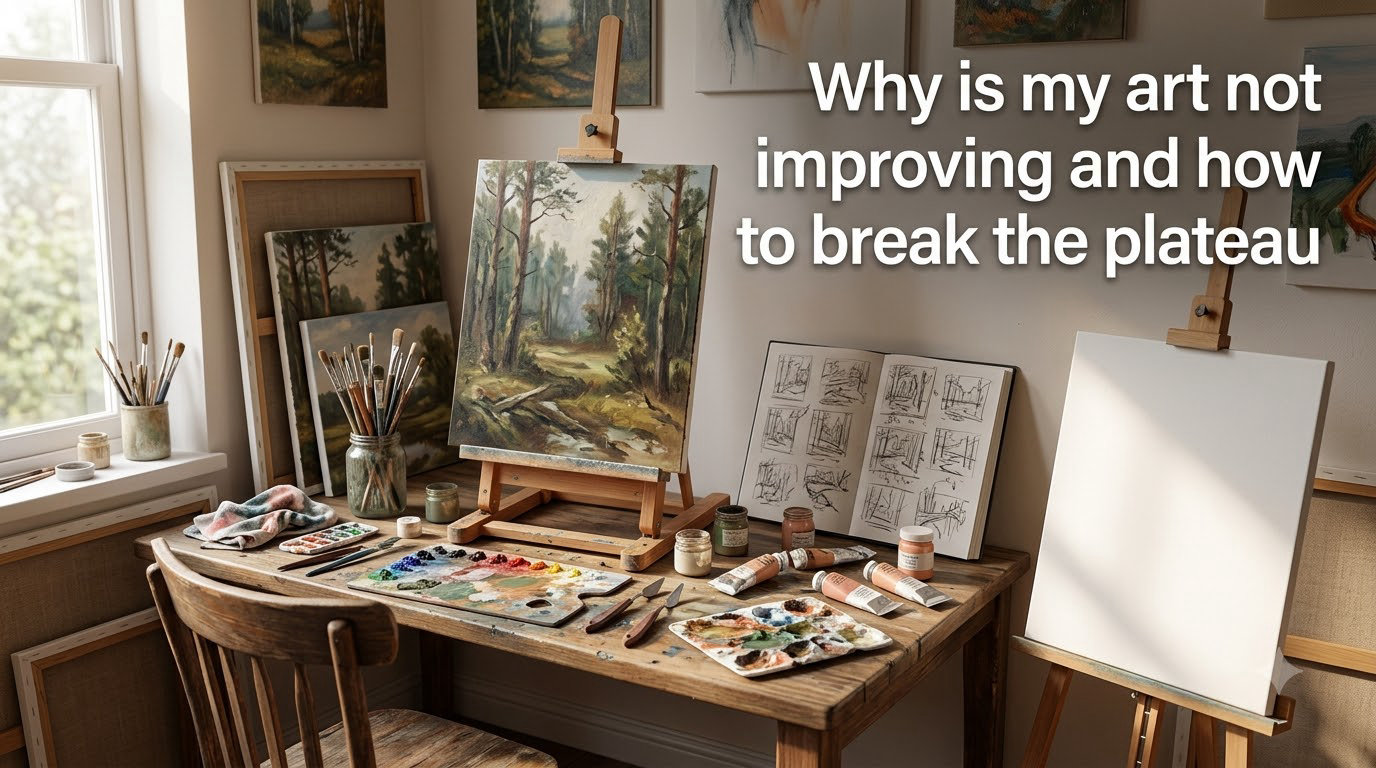
You’ve been practicing for months — maybe years — and your art looks the same as it did when you started. You’re not alone, and you’re not broken. An art plateau happens when you shift from “learning mode” into “performance mode,” repeating what you already know instead of practicing at the edge of your ability. The good news? It’s completely fixable, and in this guide I’ll show you exactly why your art isn’t improving and give you a concrete 4-week plan to break through.
Table of Contents
What Is an Art Plateau (and Why It’s Not a Bad Sign)
An art plateau is a period where you practice consistently but stop seeing noticeable improvement. Your drawings look roughly the same as they did weeks or months ago, even though you’re putting in the time. It’s the artistic equivalent of a runner who jogs the same route every day — technically active, but not getting faster.
Here’s the thing most artists don’t realize: a plateau is actually a sign of progress. It means you’ve mastered the basics well enough that your current practice routine no longer challenges you. Your brain has automated what it can, and now it needs something harder to keep growing.
A plateau is different from burnout. Burnout is emotional exhaustion — you dread picking up the pencil, feel resentful toward your work, or lose all desire to create. A plateau is more like boredom mixed with confusion: you still want to improve, you just don’t know how. If you’re feeling burned out, you need rest first, not more practice.
The Dunning-Kruger effect helps explain why plateaus feel so discouraging. Early in your art journey, you’re in the “peak of naive optimism” — you don’t know what you don’t know, so everything feels exciting. As your skills grow, your critical eye grows faster, and you enter the “valley of despair” where you can see all the flaws in your work but can’t yet fix them. This valley is where most artists quit. The ones who push through eventually reach the “slope of enlightenment,” where improvement becomes visible again.
Why Your Art Isn’t Improving: 7 Root Causes
Every art plateau has at least one — usually two or three — of these root causes. Diagnose yours, and you’ll know exactly what to fix.
1. You’re Repeating What You Already Know
This is the most common cause of stagnation. You draw the same subjects, use the same techniques, and stay in your comfort zone. Psychologist Anders Ericsson — the researcher behind the “10,000 hours” concept — called this “naive practice.” It’s the difference between practicing and performing. If every drawing session feels easy, you’re not learning. You’re just reinforcing existing habits.
The fix: Apply the 50% rule. If you’re not failing at least half the time during practice, you’re not practicing hard enough. Deliberately choose subjects and techniques that make you uncomfortable. If portraits are easy, try hands. If digital is comfortable, switch to ink for a week.
2. You Don’t Have Specific Goals
“I want to get better at art” is not a goal — it’s a wish. Without a specific target, you can’t measure progress, and without measurable progress, you can’t tell the difference between a plateau and normal development. Many artists practice aimlessly for years because they never defined what “better” actually means to them.
The fix: Set one focused goal for the next four weeks. Not “improve anatomy” but “draw 20 hands from reference with correct proportions.” Not “get better at color” but “complete 5 studies focusing on warm/cool temperature shifts.” Specificity creates direction.
3. You’re Not Getting Feedback
Self-critique has a ceiling. You can only catch mistakes you’re aware of, and by definition, your blind spots are invisible to you. Research consistently shows that external feedback is one of the strongest predictors of skill improvement. Yet many artists — especially self-taught ones — go months or years without showing their work to anyone who can offer constructive critique.
The fix: Find one reliable feedback source. This could be a mentor, a critique community like r/learnart, an online course with instructor feedback, or even a structured self-critique method like flipping your canvas or using a grid overlay. The key is getting eyes on your work that see things you can’t.
4. You Skipped the Fundamentals
If you jumped straight into rendering and finished pieces without building a solid foundation in construction, proportion, perspective, and value, you’ll hit a wall eventually. It’s like painting a beautiful design on a crooked wall — eventually the structure fails. Many artists who plateau describe the frustration of knowing what their art should look like but being unable to execute it.
The fix: Dedicate 70% of your practice time to fundamentals (construction, anatomy, perspective, light and shadow) and 30% to finished pieces. This is the 70/30 rule, and it’s the single most impactful ratio shift for stuck artists. It feels backward, but building the foundation faster actually accelerates everything above it.
5. Your Eye Is Outpacing Your Hand
This one frustrates artists more than any other. You look at your recent work and think, “This is worse than what I made six months ago.” But here’s what’s actually happening: your ability to see errors has improved faster than your ability to fix them. Your old work looks better because you couldn’t see its flaws back then. You’re not getting worse — you’re getting more discerning, which is a prerequisite for getting better.
The fix: Keep a dated portfolio and review it monthly. You’ll notice that while individual pieces may feel worse, the trajectory is upward. Also, reframe the frustration: every flaw you can now identify is proof that your eye has improved. That’s progress, even when it doesn’t feel like it.
6. You’re Practicing Without Focus
There’s a difference between “drawing for two hours” and “spending two hours working specifically on foreshortening.” Time spent without intentional focus produces minimal improvement. Ericsson’s research showed that quality of attention during practice matters far more than quantity of hours. Many artists confuse duration with effectiveness.
The fix: Use focused practice sessions of 20-45 minutes. Before each session, write down exactly what skill you’re targeting. During the session, concentrate solely on that skill — no music, no multitasking, no scrolling for reference mid-draw. After the session, do a quick self-assessment: what improved, what didn’t, and what you’ll adjust next time.
7. You’re Comparing Yourself to the Wrong People
Social media creates a distorted view of where you “should” be. You’re comparing your work-in-progress to someone else’s curated portfolio. You’re measuring yourself against professionals with 10+ years of experience or art school graduates who had structured training. This comparison isn’t motivating — it’s paralyzing. It makes you feel like you’re failing when you’re actually on track.
The fix: Compare your current work to your own work from three months ago, six months ago, and a year ago. That’s the only comparison that matters for your growth. If you must look at other artists, study their process, not just their polished final pieces. Behind every stunning artwork are hundreds of messy sketches you’ll never see.
How to Break Through Your Art Plateau: A 4-Week Plan
This protocol is designed to address the root causes above in a structured, sequential way. Each week has a specific focus and actionable tasks.
Week 1: Diagnose and Baseline
Start by honestly assessing where you are. Draw a self-portrait, a hand, a still life, and a figure from reference — no rushing, no shortcuts. Date and save these as your baseline. Then go through the 7 root causes above and check off which ones apply to you. Be brutally honest. Most artists will find three or four that resonate.
Your task this week: Complete your baseline drawings and write down your top three root causes. Nothing else — no fixes yet, just diagnosis.
Week 2: Deliberate Practice Reset
Now that you know your weak points, restructure your practice. Pick your biggest root cause and design three focused drills around it. For example, if you skipped fundamentals, spend this week on construction studies. If you lack feedback, post your baseline drawings in a critique community and study the responses.
Your task this week: Complete at least three focused practice sessions of 30-45 minutes each, targeting your primary root cause. Apply the 50% rule — if the drills feel easy, make them harder.
Week 3: Feedback and Challenge
By now you have new practice habits forming. This week, introduce external feedback and a creative challenge. Share your week 2 work and ask for specific critique on your target skill. Then try something that genuinely scares you — a new medium, a subject you’ve avoided, a style outside your comfort zone. Growth happens at the edge of discomfort.
Your task this week: Get feedback from at least one outside source and complete one piece that pushes you well beyond your comfort zone.
Week 4: Review and Integrate
Redraw your baseline subjects from week 1 using everything you’ve learned. Compare them side-by-side. You might be surprised by the improvement — or you might see subtle progress that confirms you’re on the right track. Either way, the exercise gives you concrete evidence that deliberate practice works.
Your task this week: Complete your comparison redraws, document what changed, and plan your next four weeks based on which root causes still need attention.
Frequently Asked Questions
What to do if your art is not improving?
Start with a self-diagnostic: identify which of the seven root causes apply to your situation (repetition without challenge, vague goals, no feedback, weak fundamentals, eye outpacing hand, unfocused practice, or harmful comparison). Then set one specific goal, switch to deliberate practice, and seek outside feedback. A structured 4-week plan targeting your biggest weakness is the fastest path out of a plateau.
What is the 70/30 rule in art?
The 70/30 rule recommends spending 70% of your practice time on fundamentals — construction, anatomy, perspective, and value — and 30% on finished pieces or stylistic experiments. Most stuck artists have this ratio reversed, spending most of their time rendering without building the underlying skills that make rendering effective.
What is the 50% rule in art?
The 50% rule is a practice benchmark: if you are not failing at least half the time during your practice sessions, you are not challenging yourself enough. Comfortable practice reinforces existing habits but does not produce growth. Deliberate discomfort is the engine of improvement.
How long does an art plateau typically last?
Art plateaus typically last 3 to 6 months for beginners, 6 to 12 months for intermediate artists, and 1 to 2 years or longer for advanced artists. Duration depends on how actively you address the root causes — targeted deliberate practice shortens plateaus significantly, while repeating the same routine extends them indefinitely.
Is it normal to feel like my art is getting worse?
Yes, and it is actually a sign of progress. Your critical eye improves faster than your technical hand, which means you can now see flaws in your work that were invisible to you before. This mismatch creates the illusion of regression. Keeping a dated portfolio helps you see the overall upward trajectory despite the frustration.
Should I take a break or push through an art plateau?
It depends on the cause. If you feel emotionally exhausted and resentful toward your art, take a one to two week break — that is burnout, not a plateau. If you are bored and confused but still want to improve, you do not need rest. You need a more challenging practice routine. The distinction matters because the remedy for each is opposite.
Conclusion
If you’re wondering why your art isn’t improving, the answer is almost certainly in the seven root causes above — not in a lack of talent. Plateaus are a documented phase of skill acquisition, and every artist who reaches mastery has pushed through multiple ones. The difference between artists who keep growing and those who stay stuck isn’t natural ability. It’s the willingness to diagnose what’s actually wrong and practice differently. Start with the 4-week plan this week, and you’ll have proof that you can break through.