
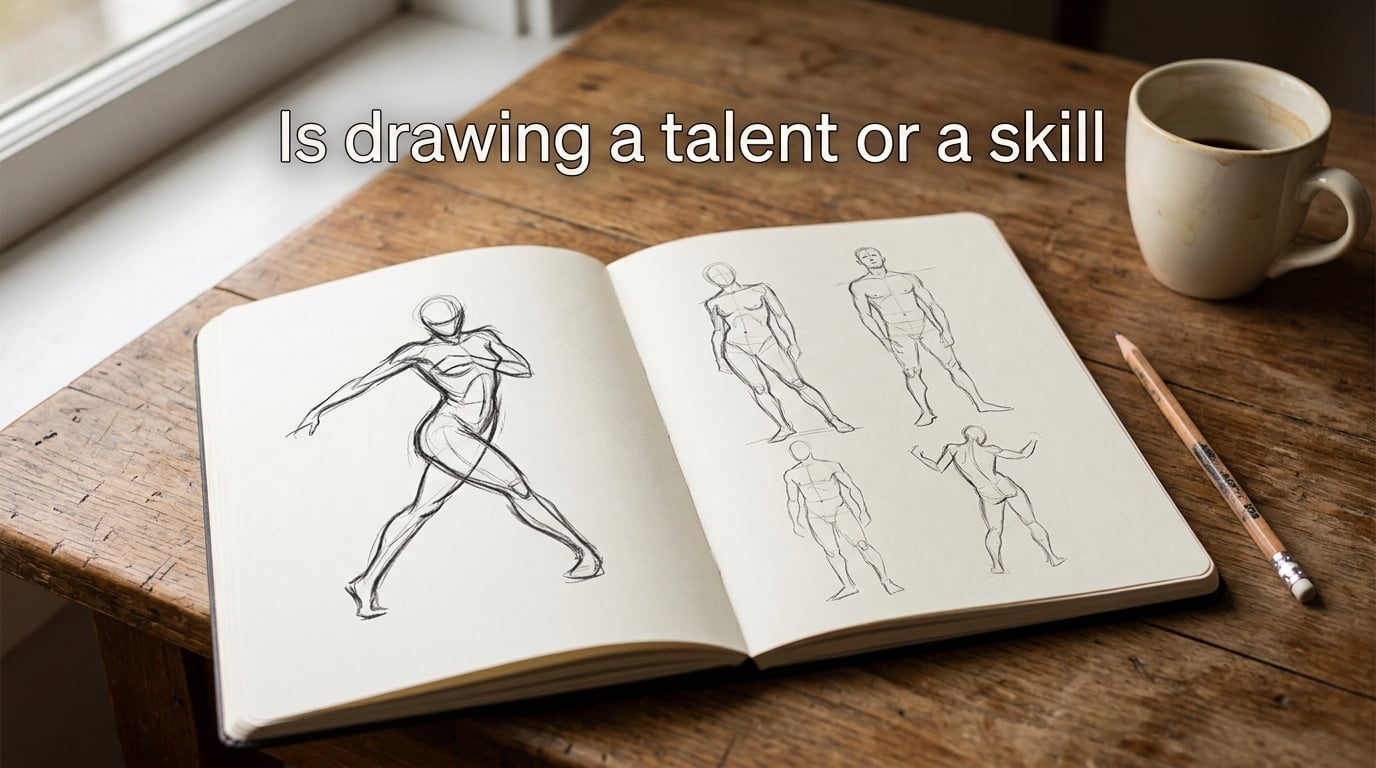
Is drawing a talent or a skill? Drawing is primarily a learned skill. Almost anyone can develop it through deliberate practice and study of fundamentals, even if they were told as a child that they “had no talent.” Natural aptitude may give some people an early head start, but it does not decide how far you can go. Consistent practice does.
I know how it feels to sit down with a pencil, scratch out something awful, and quietly conclude you were simply not born with the gift. I have been there. So have most of the working artists I know. The honest answer to whether drawing is a talent or a skill matters because the wrong answer has chased millions of adults away from a craft they would genuinely enjoy.
In this guide I will walk you through what talent and skill actually mean, why drawing sits firmly on the “skill” side of the line, where natural aptitude does and does not matter, and how long it really takes to get good as an adult. You will also get a comparison table covering music, dance, sports, singing, and guitar (since those are the exact questions people ask about drawing), plus a realistic timeline and a fundamentals list you can start using today.
Table of Contents
Quick Answer: Drawing Is Primarily a Skill
Drawing is primarily a learned skill, not an inborn talent. Anyone with functional vision and motor control can learn to draw well through deliberate practice. Natural aptitude can shorten the early learning curve, but it does not set the ceiling. Here is the short version:
- Drawing is teachable. Every fundamental (perspective, proportion, anatomy, light, shadow, color) can be learned through study and practice.
- Natural aptitude exists, but it is a head start, not a guarantee. Talented artists who never practice tend to plateau. Practicing artists with modest aptitude often surpass them.
- Skill compounds. Hours invested in fundamentals build muscle memory, observation, and visual judgment that raw talent cannot shortcut.
- The brain is plastic at any age. Neuroplasticity research shows adults can build new visual and motor skills well into their 70s and beyond.
Talent vs Skill: What the Words Actually Mean
Before we argue about whether drawing is a talent or a skill, it helps to pin down what each word means in practice. Most of the confusion comes from using the two terms as if they were interchangeable. They are not.
Talent is an innate, natural aptitude you are born with. You did nothing to earn it, and it tends to show up early in life. A child who instinctively picks up accurate proportions without being taught has a talent for visual perception. A toddler who never misses a football kick has a talent for spatial awareness. Talent sets your starting position on the field.
Skill is an ability that is acquired and refined through study, practice, and experience. You build it on purpose. A surgeon has surgical skill. A pianist has pianistic skill. A draftsman has drafting skill. Skill determines how far you travel from where you started.
Predisposition is the middle ground most people miss. It is a soft head start: better-than-average visual memory, an eye for proportion, a tendency to doodle as a child, or a family environment where drawing was normal. Predisposition feels like talent, but it usually has a strong “practice-rich childhood” component hiding inside it.
Here is the clean side-by-side:
- Talent: Innate, inborn, present without practice, uneven across individuals, cannot be acquired.
- Skill: Learned, acquired through deliberate practice, available to anyone willing to put in the work, builds steadily over time.
- Predisposition: A natural leaning toward something, often amplified by early exposure, easily mistaken for talent.
The reason drawing feels like a talent to so many people is that children who draw a lot tend to be children whose parents drew, or whose art was encouraged, or who had access to art supplies and time. By the time they are teenagers, those “talented” kids have thousands of hours of practice that nobody counted. They are not more talented than you. They just started earlier and practiced more, often without realizing it.
Why Drawing Is a Skill (the Evidence)
Five lines of evidence show that drawing is a skill, not a gift reserved for the chosen few. Together they are hard to argue with.
1. Drawing Breaks Down Into Teachable Mechanics
Every drawing skill can be broken into smaller components you can practice in isolation. Perspective is geometry. Proportion is measurement and comparison. Anatomy is structural landmarks. Light and shadow follow predictable rules. Color theory has principles anyone can learn. None of these require talent. They require attention and repetition.
Christopher Volpe of Streamline Publishing put it well when he wrote that drawing is not “an elite inborn superpower.” It is a craft with rules you can study. The same is true of writing: nobody would argue that writing well is a talent you either have or do not have. It is a craft with grammar, structure, and technique. Drawing works the same way.
2. Self-Taught Adults Regularly Reach High Levels of Skill
Look at the r/learnart and r/learntodraw communities on Reddit. New threads appear every week from adults who started drawing in their 30s, 40s, or 60s and are now producing work that would have been unthinkable to them a few years earlier. One widely shared Guardian piece by Josh Nicholas documents exactly this: a journalist who spent years teaching himself through YouTube tutorials and library books, going from flat, preconception-driven sketches to recognizable faces.
Self-taught artists are not exceptions. They are the norm, once you account for time invested.
3. Even “Talented” Children Start From Ugly Drawings
Ask any professional artist about their earliest drawings. They will laugh, then show you a notebook full of stiff figures and weirdly proportioned pets. Every working artist drew badly before they drew well. The talent myth survives only because we never see the ugly early work of the people we admire.
4. Neuroscience Supports Skill Acquisition at Any Age
Brain imaging studies on visual artists show differences in brain activity compared to non-artists, but those differences correlate with years of training rather than with talent per se. In other words, the brain changes because of drawing, not the other way around. Neuroplasticity is real, and it works in adults. The window for building new visual and motor skills does not close when you finish high school.
5. Drawing Fundamentals Are a Finite, Well-Mapped Curriculum
Art schools have taught the same fundamentals for centuries: perspective, proportion, anatomy, light, shadow, color, composition, line quality. If drawing were a talent, there would be no curriculum to teach. There is. You can enroll in it.
The Real Role of Natural Talent
So far I have argued that drawing is a skill. Now I owe you the honest counterpoint. Talent does exist. Pretending it does not is just as misleading as overstating it.
Some people genuinely see the world differently from childhood. They notice how shadows fall, how a face is constructed, how a foreshortened arm looks from an unusual angle. This kind of visual sensitivity is partly heritable and partly environmental. It is also not unique to artists. Athletes, surgeons, navigators, and mechanics all have analogous perceptual gifts in their own domains.
Clara Lieu, a professor at the Rhode Island School of Design, has written that natural talent exists but “all of the talent in the world won’t get you anywhere if you aren’t willing to work hard.” She uses Albrecht Dürer, who painted a famous self-portrait at age 13, as a historical example of a prodigy. But she balances that example with stories of naturally talented students who stagnate because they coast on early advantages, while less gifted classmates outpace them through sheer effort.
The honest summary is this. Talent can give you a faster start and a more pleasant early experience. It can also lull you into believing you do not need to practice, which is exactly when growth stalls. The role of natural talent in drawing is real, but it is also smaller than most people think, and it is dwarfed by the role of practice over years.
One more nuance worth raising. Some commenters in Clara Lieu’s discussion section cite brain studies showing different activity patterns in artists and non-artists. The right reading of that research is not “some brains are wired for art.” It is “brains change in response to sustained visual training.” The chicken-and-egg problem still favors skill.
Is Drawing a Talent or Skill Compared to Other Activities?
A lot of people arrive at this question by wondering whether the same logic applies to other crafts they care about. The short answer is yes. Drawing is a skill in the same way that music, dance, sports, singing, and guitar are skills. Talent plays a similar (modest, supportive) role in each one.
Here is the comparison the search engines are clearly hungry for:
- Drawing: Primarily a skill. Learnable through fundamentals and practice. Talent gives an early edge but does not set the ceiling.
- Music (general): Primarily a skill. Most musicians are made through years of practice, not born.
- Playing guitar: Primarily a skill. Talent helps with finger dexterity or rhythm sense, but millions of average-talent people play beautifully.
- Singing: Closer to a 50/50 split. Vocal cords are physical and partly heritable, but pitch, breath control, and style are all trainable skills.
- Dancing: Primarily a skill. Natural rhythm and flexibility help, but trained dancers with average talent consistently outperform untrained “natural movers.”
- Sports: Primarily a skill. Genetics matter for elite competition (height for basketball, lung capacity for swimming), but recreational skill is learnable for almost everyone.
If someone tells you they were born with the talent to dance, ask how many years of classes they took as a child. If someone tells you they were born to play guitar, ask how old they were when they started. The pattern is almost always the same: childhood exposure plus practice creates the illusion of innate talent.
How Long Does It Actually Take to Get Good at Drawing?
This is the question real beginners ask, and it is also the question most articles dodge. Here is an honest timeline for an adult who starts from scratch and practices consistently. By “consistently” I mean something like 20 to 45 minutes most days, or 3 to 5 focused hours a week.
- Month 1: Holding a pencil feels more natural. You start noticing shapes, negative space, and light direction in the world around you. Your drawings still look stiff, but you can see why.
- Months 3 to 6: You can sketch recognizable subjects: a face that looks like a specific person, a coffee mug with believable volume, a simple room in one-point perspective.
- Year 1: You understand the fundamentals well enough to debug your own work. You can plan a drawing before you start. Mistakes are obvious to you, even when you still make them.
- Years 2 to 3: Consistent practice shows. You can tackle portraits, figures, and complex scenes with confidence. Style begins to emerge.
- Years 5 to 10: Genuine competence. You have enough hours in to handle unfamiliar subjects, experiment with mediums, and develop a personal voice.
The 10,000-hour rule gets cited a lot, and it is roughly the right order of magnitude for advanced mastery. The good news is that you do not need 10,000 hours to enjoy drawing or to produce work you love. Most adults who practice regularly for a year describe their drawing life as transformed, even at modest technical levels.
A few factors speed this up. Focused, deliberate practice (where you set a small target, attempt it, and critique the result) is worth several times more than equivalent hours of unfocused doodling. Getting feedback from a teacher or a peer who draws better than you do is another multiplier. And staying with one medium and one set of fundamentals until you have built a foundation is far more effective than bouncing between pencil, charcoal, watercolor, and digital every few weeks.
Fundamentals Every Adult Beginner Should Learn
You do not need to learn everything at once. If you focus on these six fundamentals in roughly this order, you will build a solid foundation.
- Observation and negative space. Train your eye to see shapes, angles, and the spaces around objects rather than the objects themselves. This is the single biggest unlock for most adult beginners.
- Proportion and measurement. Use your pencil as a measuring tool. Compare heights, widths, and alignments across your subject before you commit to lines.
- Perspective. Learn one-point, two-point, and basic three-point perspective. Even if you mainly want to draw portraits and figures, perspective makes everything else sit believably in space.
- Anatomy and gesture. Start with gesture drawing (30-second to 2-minute captures of pose and movement) before you try detailed anatomy. Gesture prevents the stiff “mannequin” look.
- Light, shadow, and rendering. Understand how light creates form. Practice simple spheres, cubes, and cylinders before tackling complex subjects.
- Composition and color theory. Once the technical basics feel natural, learn how to arrange a drawing and how to use color with intent rather than instinct.
For drills, start with these three and rotate them through your week.
- Gesture drawing (5 to 10 minutes): Quick figure captures from photo reference or a life-drawing class. Trains fluidity and observation.
- Contour drawing (10 to 15 minutes): Slow, careful line drawings where you look at the subject more than the page. Trains hand-eye coordination.
- Negative space study (10 minutes): Pick an object and draw only the spaces around it, not the object itself. Trains you to see what is actually there.
Common Myths That Hold Adult Beginners Back
Most adults who say “I can’t draw” are stuck behind one of these five myths. Recognizing them is half the cure.
- “I can’t even draw a straight line.” Straight lines are a tool, not a skill gate. Even professional draftsmen use rulers when they need true straightness. Curved, expressive marks are what drawing actually rewards.
- “I was told I had no talent as a child.” Most teachers say this to 8-year-olds who drew a sad horse. It says almost nothing about your adult capacity to learn.
- “You have to start as a kid.” Childhood helps because of free time and fewer inhibitions, not because of some lost neural window. Plenty of great artists started in their 30s, 40s, or later.
- “Either you have it or you don’t.” Drawing is a spectrum, not a binary. You can be somewhere on the spectrum and still get better every year.
- “Real artists don’t need to study.” Every working artist studies. Master copies, life drawing, and reading about art are all forms of practice.
Frequently Asked Questions
What counts as a talent or a skill?
A talent is an innate, inborn aptitude you did nothing to acquire. A skill is an ability built through study, practice, and experience. Talent sets where you start; skill determines where you can go. Most of what people call u0022talentu0022 in drawing is actually skill built during a practice-rich childhood.
Can someone with no talent learn to draw?
Yes. Talent is not required to learn to draw. Fundamentals like observation, proportion, perspective, and shading can be taught and practiced by almost anyone. Adults who believe they have no talent often simply missed out on encouragement or instruction as children. With consistent practice, they reach recognizable, even impressive, levels of skill.
Is dancing a talent or a skill?
Dancing is primarily a skill. Natural rhythm, flexibility, and body awareness help, but trained dancers with average natural ability consistently outperform untrained u0022naturals.u0022 Most professional dancers spend years in classes before they perform. The same logic applies to drawing.
Is singing a talent or a skill?
Singing is closer to a 50/50 split. Vocal cords are partly physical and heritable, which sets real limits on tone and range. Pitch accuracy, breath control, vibrato, and style, however, are trainable skills. Most singers improve dramatically with lessons, regardless of starting voice.
Is playing guitar a talent or a skill?
Playing guitar is primarily a skill. Finger dexterity, a sense of rhythm, and ear training help, but millions of average-talent players reach advanced levels through years of practice. Like drawing, guitar rewards consistency and focused fundamentals over raw gift.
Are artists born or made?
Artists are primarily made. Childhood exposure, encouragement, and practice explain most u0022born artistsu0022 more than genetics. Neuroscience shows that visual training physically changes the brain, and adult learners can build the same neural pathways as people who started young.
The Honest Answer, One More Time
Is drawing a talent or a skill? Drawing is primarily a learned skill. Almost anyone who is willing to put in focused, patient practice can become a competent draftsman, illustrator, or artist. Natural talent is real and can give some people a head start, but it does not decide the ceiling, and it is rarely the reason someone “cannot draw.” The reason is usually a combination of childhood discouragement, lack of fundamentals, and not enough deliberate practice.
If you have been waiting for permission to start drawing, consider this your permission. Pick up a pencil, set a small goal (one gesture drawing, one contour drawing, one negative space study), and protect 20 minutes a day for the next month. By Christmas you will be a different artist than you are today. And yes, that applies even if you were the kid in third grade who was told they had no talent.