
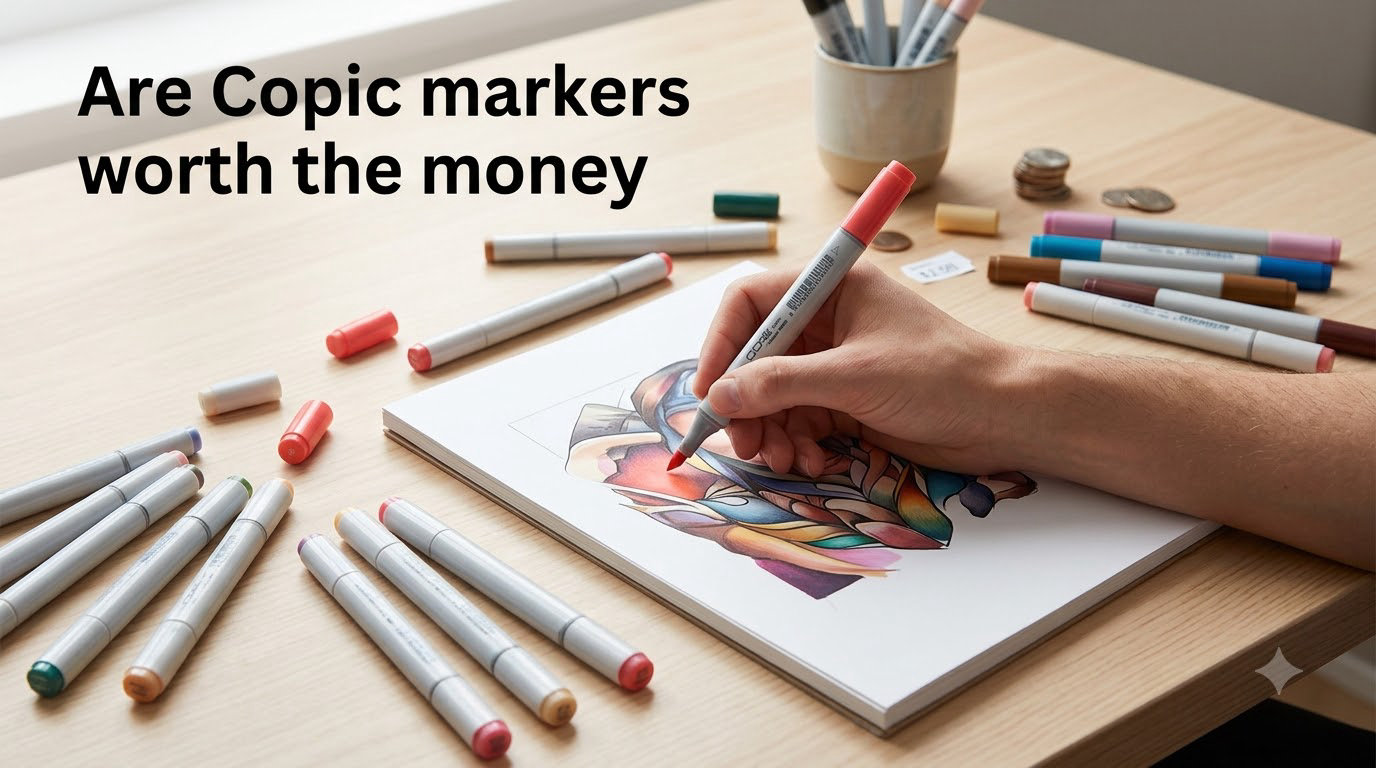
Yes, Copic markers are worth the money, but only if you draw with alcohol-based markers often enough to justify the upfront cost. Their refillable ink reservoirs and replaceable nibs drop the long-term cost dramatically compared to disposable alternatives. If you are a beginner still deciding whether you enjoy alcohol markers, start with Ohuhu or Blick Studio, then graduate to Copic once you know the medium fits your workflow.
That is the short version. Our team has used Copic markers in client work, manga commissions, and personal illustration for years, and the verdict changes depending on who you ask. Below, we break down what makes them special, what makes them frustrating, who they actually fit, and whether the 2026 pricing still justifies the investment.
Table of Contents
What Are Copic Markers?
Copic markers are professional-grade, alcohol-based art markers developed in Japan in the late 1980s by Too Corporation. They are widely considered the industry standard for marker illustration, used by manga artists, fashion designers, and commercial illustrators around the world.
There are three Copic lines you will see on shelves and authorized retailer sites:
- Copic Original – The classic, with a round barrel and two nibs (broad chisel + fine bullet). Available in all 358 colors. Heavier feel, preferred by manga artists who want durability.
- Copic Sketch – Oval body that prevents rolling off desks, with a flexible brush nib and a medium broad nib. 358 colors. Most popular among Western illustrators.
- Copic Ciao – Smaller, lighter, student-friendly version. Available in 180 colors. Same refill system and nib compatibility as the bigger lines, just shorter barrel and lower per-marker cost.
All three lines use the same alcohol-based ink, the same nib sizes, and the same ink refills. That compatibility is the backbone of the entire Copic ecosystem. If you own Sketch markers and want to add a Ciao because it is the only one available in a specific shade, the ink bottle refills both. That kind of interchangeability is rare in the marker world.
Why Are Copic Markers So Expensive?
Copics cost more than most alcohol markers because of three things: Japanese manufacturing, alcohol-based ink chemistry, and the refillable design. Each marker is built to be refilled and re-tipped over years, not discarded.
Per-marker MSRP in 2026 roughly tracks the following:
- Copic Ciao: the most affordable line, priced lowest per marker
- Copic Sketch: mid-range pricing per marker, the most popular line
- Copic Original: the highest price per marker, built for heavy use
- Pre-curated sets (Ciao 12-pack, Sketch 72-set) typically work out cheaper per marker than open stock
The high per-marker price is what shocks new buyers. Reddit threads in r/copic and r/ArtistLounge are full of posts from people who hesitate for years before pulling the trigger on a set. Once they start using them, most say the sticker shock fades when they refill their first marker instead of replacing it.
That is the core answer to why Copic markers are so expensive: you pay for a system, not a single-use pen. Budget markers like Ohuhu and Arteza are cheaper up front because they are designed to be replaced, not maintained.
Refillable Ink and Replaceable Nibs: The Real Value
The refill system is the single biggest reason Copic markers justify their cost. A single 12 ml bottle of Copic ink refills a marker approximately 15 times, depending on how empty it was. At typical bottle pricing, that works out to just a few cents of ink per refill, no matter which line you use.
Do the math on a 24-marker Sketch collection:
- Initial setup: 24 markers purchased individually or as two 12-packs
- Refill cost per top-up cycle: one bottle covers roughly 15 markers, so you need about two bottles per cycle
- Over 5 years of regular use, most artists refill each marker 6 to 10 times
Compare that to budget alcohol markers. Once an Ohuhu marker runs dry, you toss it and buy a new one. Over five years, the math starts to favor Copic for anyone who actually uses their markers regularly. Reddit user breakdowns in r/copic confirm the same conclusion: even heavy users spend less per year on Copic refills than they would on equivalent replacement Ohuhu markers.
The nibs are the other half of the value equation. Copic sells replacement nibs in every shape: bullet, broad chisel, medium broad, and the famous super brush. A pack of replacement nibs typically costs less than one new marker. Worn nibs, bent nibs, dried-out nibs – all replaceable in seconds.
Our team has replaced maybe a dozen nibs across five years of professional illustration work. None of our Copics have died. A well-maintained Copic can outlive its owner.
Color Range and Blending Performance
Copic offers 358 colors across the Sketch and Original lines and 180 colors in the Ciao line. Every color has a unique alphanumeric code (like YR04 or B29) printed on the cap and barrel. That coding system lets you match colors across multiple markers from any set, even years apart.
Blending is where Copic earns its reputation. The alcohol-based ink dries slowly enough to allow smooth gradients and layering, but fast enough to keep your workflow moving. When you blend two Copic colors on marker paper, you get a near-seamless transition with no streaks, no banding, and no pigment shift.
Budget alternatives have improved a lot since 2020. Ohuhu and Blick Studio markers blend well for the price. Prismacolor Premier markers also perform respectably. The difference shows up in three places:
- Color consistency – Copic colors look the same marker to marker, year to year. Cheaper brands sometimes have batch variation where two markers from the same set produce slightly different tones.
- Streak-free coverage – Large flat areas lay down smoothly with Copic. Some budget markers leave visible streaks, especially on non-coated paper.
- Re-wetting – You can go back to a Copic layer hours later and it will still blend. Budget markers often dry too hard to rework.
The Copic colorless blender (0 number) is a separate tool that pushes existing ink around the page without adding new pigment. It is a small thing until you use one. Then nothing else compares.
How Long Do Copic Markers Last?
Real-world Copic longevity is one of the strongest arguments in their favor. Users in r/copic and r/AdultColoring regularly report 10 to 14 years with their original Copic collections, often with only a handful of nib replacements and no ink replacements beyond refills.
A widely cited 14-year ownership story on kiriska.com describes a small set of 11 Copic markers that survived daily professional use, with only one nib replacement over the entire period. That kind of lifespan is not unusual.
The main failure modes are cap-related, not ink-related. Copic caps can crack over time, especially if the marker is stored nib-up or nib-down against gravity. A cracked cap lets air into the barrel and dries out the nib. The fix is simple – replace the cap and the nib – but it is the one maintenance issue users consistently flag.
Budget markers rarely last two years of regular use. Nibs wear out faster, caps loosen, and the ink reservoir is not designed to be refilled, so once it dries, the marker is dead. The Copic longevity gap is real, and it compounds over time.
If you treat your Copics well – store them horizontally, keep caps clicked all the way, refill before they run bone-dry – they will outlast most of your other art supplies.
Copic Markers vs Budget Alternatives
Direct comparison is the question most readers actually want answered. Here is how Copic stacks up against the three most common alternatives in 2026.
Copic vs Ohuhu
Ohuhu brush markers are the most popular budget alternative, available in 120- and 168-color sets. They cost roughly 70-80% less per marker than Copic Sketch. Blending quality is decent for the price, but reviewers report three persistent issues: faster nib wear, looser cap fit, and inconsistent color matching between sets.
Our team tested Ohuhu markers for a 30-day side-by-side project. Performance landed at roughly 85-90% of what a Copic Sketch delivers on the same paper. That gap matters for professional work. For hobby use and learning, it is honestly fine.
The Reddit consensus in r/Ohuhu and r/ArtistLounge is consistent: Ohuhu is a great way to find out if you like alcohol markers before committing to Copic. Many artists use Ohuhu for sketch layers and Copic for final layers on the same piece.
Copic vs Prismacolor
Prismacolor Premier brush-tip markers sit between Ohuhu and Copic in price. They blend smoothly and feel closer to Copic in hand than Ohuhu does. The big limitation is the color range – 156 colors – and the lack of a refill system. Once a Prismacolor marker dries out, it is done.
For fashion illustration and design school students, Prismacolor is a solid middle ground. For long-term use, the lack of refills makes it more expensive over five years than Copic despite the lower upfront cost.
Copic vs Blick Studio
Blick Studio brush markers are made by the retailer Blick and manufactured in the same factories as several other alcohol marker brands. They cost less than Copic and refills are available, though the refill nibs are not as standardized as Copic replacements.
Performance is close to Prismacolor Premier. The main appeal is the price – about 50-60% less than Copic for the initial setup. If you want refillable alcohol markers but cannot afford Copic, Blick Studio is the most direct budget alternative with a real refill system.
Copic Sketch vs Ciao vs Original: Which Line Should You Pick?
Choosing between the three Copic lines is easier than it looks. All three share the same ink, the same nibs, and the same color system. The differences are body shape, weight, and price.
- Copic Ciao – Best for beginners and students. Cheapest per marker. 180 colors. Round body, lighter weight, slightly smaller grip. Smaller ink reservoir means more frequent refills.
- Copic Sketch – Best for most illustrators. Mid-tier price. 358 colors. Oval body that does not roll off the desk. Flexible brush nib is the industry favorite.
- Copic Original – Best for manga artists and heavy users. Highest price per marker. 358 colors. Round body, heavier weight, slightly longer ink reservoir.
Our recommendation for most readers in 2026: start with Copic Ciao if you are undecided about the medium. Buy a 12-pack or 18-pack in the basic color range, use them for two or three months, and see if you keep reaching for them. If you do, sell or gift the Ciao set and upgrade to Copic Sketch. The Ciao marker bodies will not be wasted – the refills and nibs work in every line.
Who Should Buy Copic Markers?
The honest answer depends entirely on who is asking. Here is the verdict by user type.
For Professional Illustrators
If you earn money from marker illustration, Copics are worth the money. The combination of refillable ink, replaceable nibs, and color consistency saves you money over a professional career. Client work demands predictable results, and Copic delivers them marker after marker.
The break-even point compared to budget markers typically lands around year two of professional use. After that, the refill system makes Copics cheaper to maintain than replacements of any other brand.
For Hobbyists and Adult Colorists
For hobbyists who color or illustrate a few times a week, Copics are worth it if you want them, not because you need them. Ohuhu and Blick Studio deliver 85-90% of the experience at a fraction of the cost. If money is tight, start there.
If budget is not a concern and you want the best blending, the most consistent colors, and a marker that will last 10+ years, Copic is the right call. Many hobbyists treat Copics as a long-term art investment rather than a consumable.
For Beginners and Students
Beginners should not start with Copic. The upfront cost is high enough to create anxiety around using them, which is the worst possible mindset for learning. Buy Ohuhu or Prismacolor first, learn whether alcohol markers fit your style, then graduate to Copic once you are committed.
If you are an art student with a materials budget and a clear interest in marker illustration, Copic Ciao is a defensible first purchase. The lower per-marker cost reduces the financial risk while still giving you the Copic refill system.
Common Mistakes When Buying Copic Markers
Even experienced artists make these errors. Avoid them and you will save hundreds of dollars.
- Buying a 72-marker set before you know what you need – Pre-curated sets include colors you will rarely use. Buy 12-18 markers in colors you actually reach for, then expand over time.
- Skipping the refill bottle – Buying markers without buying at least one refill bottle defeats the entire value proposition. Order an ink bottle with your first set.
- Ignoring the super brush nib – The flexible brush nib is what makes Copic blending famous. If you only own the bullet and chisel nibs, you are missing the main feature.
- Storing markers vertically – Storing Copics nib-up or nib-down causes ink to pool in one end, which speeds up drying at the other end. Lay them flat.
- Letting caps click without testing the seal – A cap that looks closed may not be fully sealed. Press until you hear the click, then gently tug to confirm.
None of these mistakes will ruin your markers, but they will shorten their lifespan and reduce your daily experience. Fix the small habits early and your Copics will run beautifully for years.
5-Year Cost of Ownership: Copic vs Ohuhu
Here is the calculation no competitor article shows. Assume you buy 24 markers and use them moderately – three to four illustration sessions per week, refilling or replacing as needed. Here is the five-year cost comparison.
- Copic Sketch setup (24 markers) – Initial markers purchased as two 12-packs. Add one ink bottle for refills and one super brush nib pack. Five-year cost includes 8 to 10 refill cycles.
- Ohuhu setup (24 markers) – Initial markers purchased as a single 24-set or two 12-packs. No refill system. Five-year cost assumes 2 to 3 full replacements as markers dry out or nibs wear down.
Even with Copic’s higher sticker price, the refill math closes the gap by year two. By year five, Copic users who refill consistently spend less than Ohuhu users who replace. The advantage grows every year after that.
The catch is discipline. Copic only wins this comparison if you actually refill. Owners who treat Copics like disposables and never buy ink lose the financial argument entirely. Buy the refill bottle with your first set, and the math works in your favor.
Frequently Asked Questions
Are Copic markers really the best?
Copic markers are widely considered the industry standard for professional marker illustration in 2026. Their refillable ink, replaceable nibs, and 358-color range put them at the top of the category. That said, ‘best’ depends on your use case. For occasional hobby use, Ohuhu and Blick Studio deliver 85-90% of the performance at a fraction of the cost. For professional or daily use, Copic is the best option available.
Which one is better, Ohuhu or Copic?
Copic is the better marker for professional work, archival quality, and long-term cost if you refill regularly. Ohuhu is the better marker for beginners, hobbyists, and anyone who wants to try alcohol markers without a major upfront investment. The blending quality gap is real but smaller than most people expect – reviewers report Ohuhu at 85-90% of Copic performance.
What is the lifespan of a Copic marker?
A well-maintained Copic marker can last 10 to 14 years or longer. Real-world ownership reports from r/copic and r/AdultColoring confirm markers surviving more than a decade with only occasional nib replacements. The main failure mode is cap cracking, not ink exhaustion. Replace the cap and nib and the marker keeps going.
Are Copic markers good for beginners?
Copic markers are not ideal for absolute beginners because the high upfront cost creates anxiety around using them. Beginners who want to learn alcohol markers should start with Ohuhu, Blick Studio, or Prismacolor. Once you know the medium fits your style, Copic Ciao is a defensible first Copic purchase for students and committed learners.
Why are Copic markers so expensive?
Copic markers are expensive because they are refillable and designed to last decades. Each marker is built in Japan from high-grade alcohol-based ink with a refillable reservoir and replaceable nibs. The cost reflects a long-term system, not a single-use pen. Budget markers are cheaper because they are designed to be replaced, not maintained.
What markers are like Copic but cheaper?
The closest cheaper alternatives to Copic are Ohuhu brush markers, Blick Studio brush markers, and Prismacolor Premier brush-tip markers. All three use alcohol-based ink with similar blending characteristics. Ohuhu is the most affordable. Blick Studio offers a refill system at a lower price point. Prismacolor sits between the two for quality and price.
Do markers dry out if not used?
Alcohol markers can dry out if not used for extended periods, especially if the caps are not fully sealed. Copic caps can crack over time, which accelerates drying. To prevent dryout, store markers horizontally, confirm caps are fully clicked, and refill markers before they run completely dry. Properly stored Copics can sit for months without issue.
How can I revive dried Copic markers?
Revive a dried Copic marker by adding a few drops of Copic ink refill directly to the nib or into the barrel. Let the marker rest nib-down for 10 to 15 minutes so the ink saturates the nib. If the nib itself is dried out, replace it with a new Copic replacement nib – they are inexpensive and snap in place. A dried marker that still has ink in the barrel usually revives fully.
Where is the cheapest place to buy Copic markers?
Authorized Copic retailers include Blick Art Materials, Jerry’s Artarama, and the Copic official website. Prices vary by set and line. Buying pre-curated sets is usually cheaper per marker than open-stock singles. Watch for sales around back-to-school season and Black Friday. Avoid unauthorized Amazon third-party sellers, which sometimes list old or grey-market stock.
Final Verdict: Are Copic Markers Worth the Money?
Yes, Copic markers are worth the money for artists who use alcohol markers regularly and commit to refilling instead of replacing. For professional illustrators, manga artists, and serious hobbyists, the combination of refillable ink, replaceable nibs, 358 colors, and a multi-decade lifespan makes Copic the clear choice in 2026.
For beginners and casual colorists, start with Ohuhu or Blick Studio first. Learn whether alcohol markers fit your workflow. Once you know you will reach for them weekly, graduate to Copic Ciao, then Copic Sketch, and let the refill system pay back the upfront cost over time.
The honest answer is the conditional one: Copics are worth it if you are. If you are still figuring out your medium, save the money until you know.