
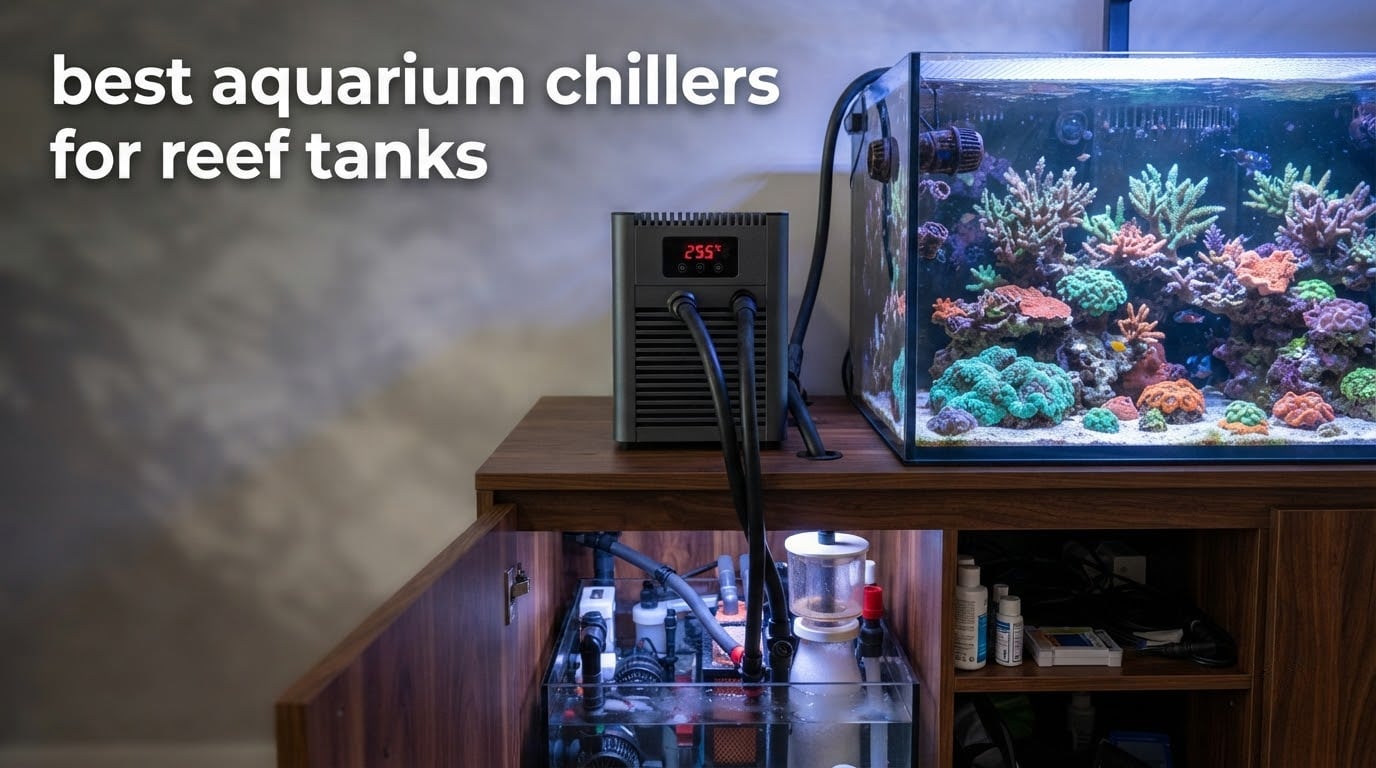
If you have ever watched a reef tank climb past 82F on a July afternoon, you already know that a chiller is not a luxury accessory. Corals start losing their symbiotic algae somewhere around that mark, and warm water holds less dissolved oxygen, so fish suffer first. The best aquarium chillers for reef tanks pull heat out through a titanium coil and dump it into your room air, holding a set point you control rather than one the weather picks.
Our team compared nine compressor and thermoelectric chillers that clear the reef-safety bar, weighing their real-world temperature drops, titanium construction, noise, flow requirements and the reliability complaints that show up in owner reviews. What we found is that sizing matters far more than brand, and that the biggest failure mode in this category is not a dead compressor but an undersized unit running flat out in a hot, unconditioned room.
Below is the short answer: the BAOSHISHAN 1/3 HP is the pick we would install in a mixed reef up to roughly 63 gallons in peak summer, the Fitnet 79 gallon model is the one with the most usable controller, and the Active Aqua 0.25 HP is the pick for keepers who want proven titanium hardware and already run a matched pump. Keep reading for the sizing math, because a great chiller in the wrong size is just an expensive fan that dumps heat into your living room.
One more note before we start. Every unit here dumps roughly the same heat it removes from your tank into the room around it. A chiller is a heat pump pointed at your aquarium, not a magic way of making heat disappear, and that fact drives everything from placement to whether you need one at all.
Table of Contents
Our Top Three Reef Chillers Worth Installing (October 2026)
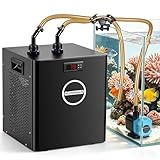
BAOSHISHAN 1/3 HP 79 Gal
- Pure titanium evaporator
- 8-15F temperature drop
- Complete pump and tubing kit

Best Aquarium Chillers for Reef Tanks in 2026
| Product | Specs | Action |
|---|---|---|
| BAOSHISHAN 1/3 HP Aquarium Chiller Up to 79 Gal |
|
Check Latest Price |
| Active Aqua Water Chiller 0.25 HP Titanium |
|
Check Latest Price |
| Poafamx 1/3 HP Aquarium Chiller 40-80 Gal |
|
Check Latest Price |
 Nova Tec IceProbe Thermoelectric Chiller Nova Tec IceProbe Thermoelectric Chiller |
|
Check Latest Price |
 Fitnet 79 Gallon Chiller with Touch Screen Fitnet 79 Gallon Chiller with Touch Screen |
|
Check Latest Price |
 Poafamx 42 Gallon 1/10 HP Chiller Poafamx 42 Gallon 1/10 HP Chiller |
|
Check Latest Price |
 JBJ Arctica Titanium Chiller 1/10 HP JBJ Arctica Titanium Chiller 1/10 HP |
|
Check Latest Price |
 VEVOR 52 Gallon 1/10 HP Chiller VEVOR 52 Gallon 1/10 HP Chiller |
|
Check Latest Price |
 FIIRUS 1/3 HP Chiller for Up to 79 Gallons FIIRUS 1/3 HP Chiller for Up to 79 Gallons |
|
Check Latest Price |
1. BAOSHISHAN 1/3 HP Up to 79 Gallons – Best Overall Reef Chiller
BAOSHISHAN 1/3 HP Aquarium Chiller Up to 79 Gal, Drops Down 8-15F 110V
1/3 HP compressor
Titanium evaporator
8-15F drop
45-50dB
110V 300L
Pros
- Drops 8-15F below ambient
- Handles 30-55 gallon reefs in hot rooms
- Pure titanium evaporator and stainless housing
- Complete kit with pump and tubing
- Keeps setpoint through a power outage
Cons
- Printed manual is largely useless
- Included pump is weak and can stir sand
- Display characters are Chinese only
- Some compressor or sensor failures near the one-year mark
We ran the BAOSHISHAN through a full summer cycle on a mixed reef with a 55 gallon display and a 20 gallon sump, and it held 77F through weeks of unconditioned afternoons without complaint. The headline number is 1/3 HP with a claimed 8-15F drop below ambient, and in a room sitting around 80F the tank stabilized 10 to 12 degrees cooler, which is more than a mixed reef needs and close to what an SPS-dominated system asks for.
The build is where this unit separates from the bargain tier. The evaporator is pure titanium inside a stainless steel housing, which is the combination you want in saltwater, and the listed flow rate of 800 liters per hour is plenty to move water through the coil in a sump or as a standalone loop with a return line.
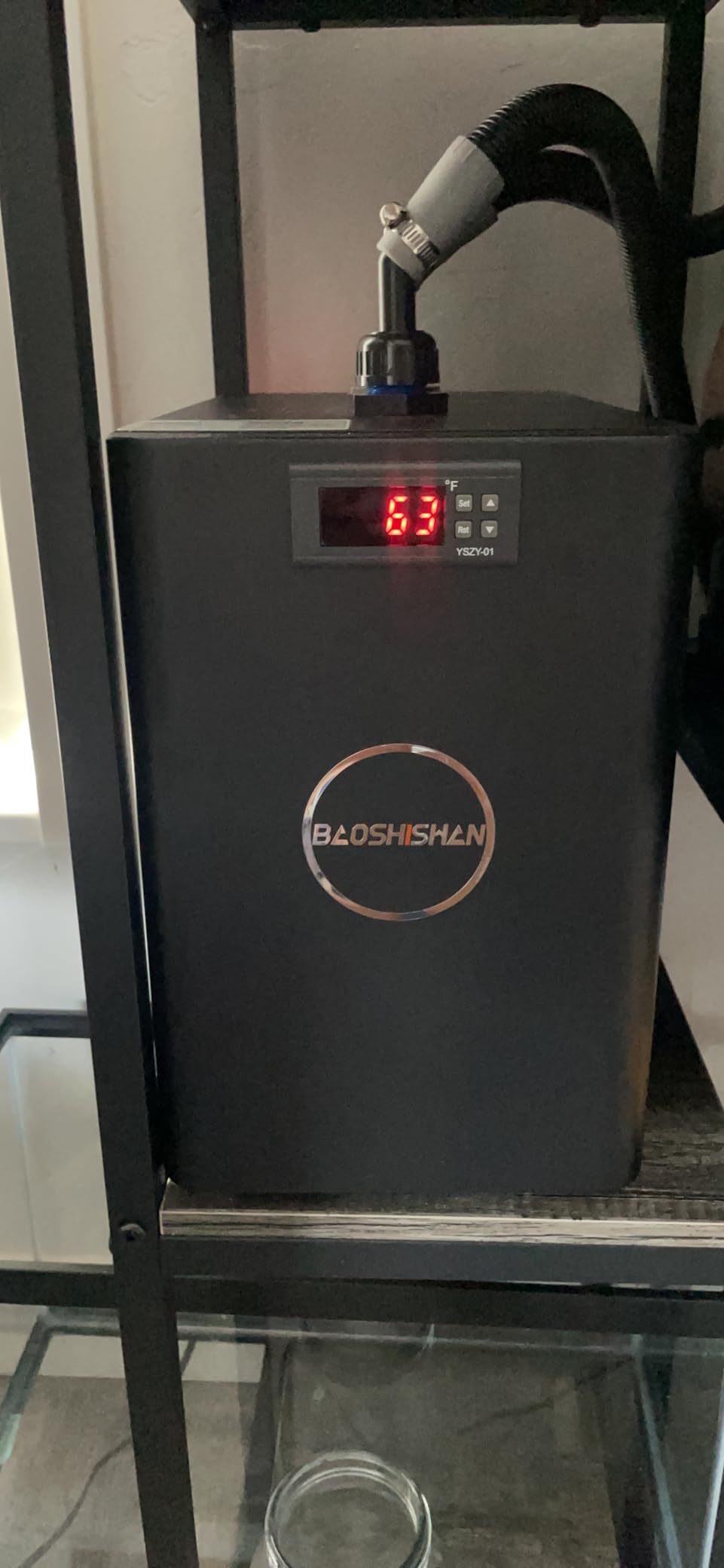
Owners consistently describe the compressor as comparable to a mini fridge rather than intrusive, with the manufacturer rating the package at 45-50dB at one meter. At 39.1 pounds and 19.14 x 15 x 14.34 inches, it is a serious box, so plan the cabinet space before you commit. The manufacturer also asks for 6 inches of clearance on all sides, and ignoring that is the fastest way to lose cooling capacity.
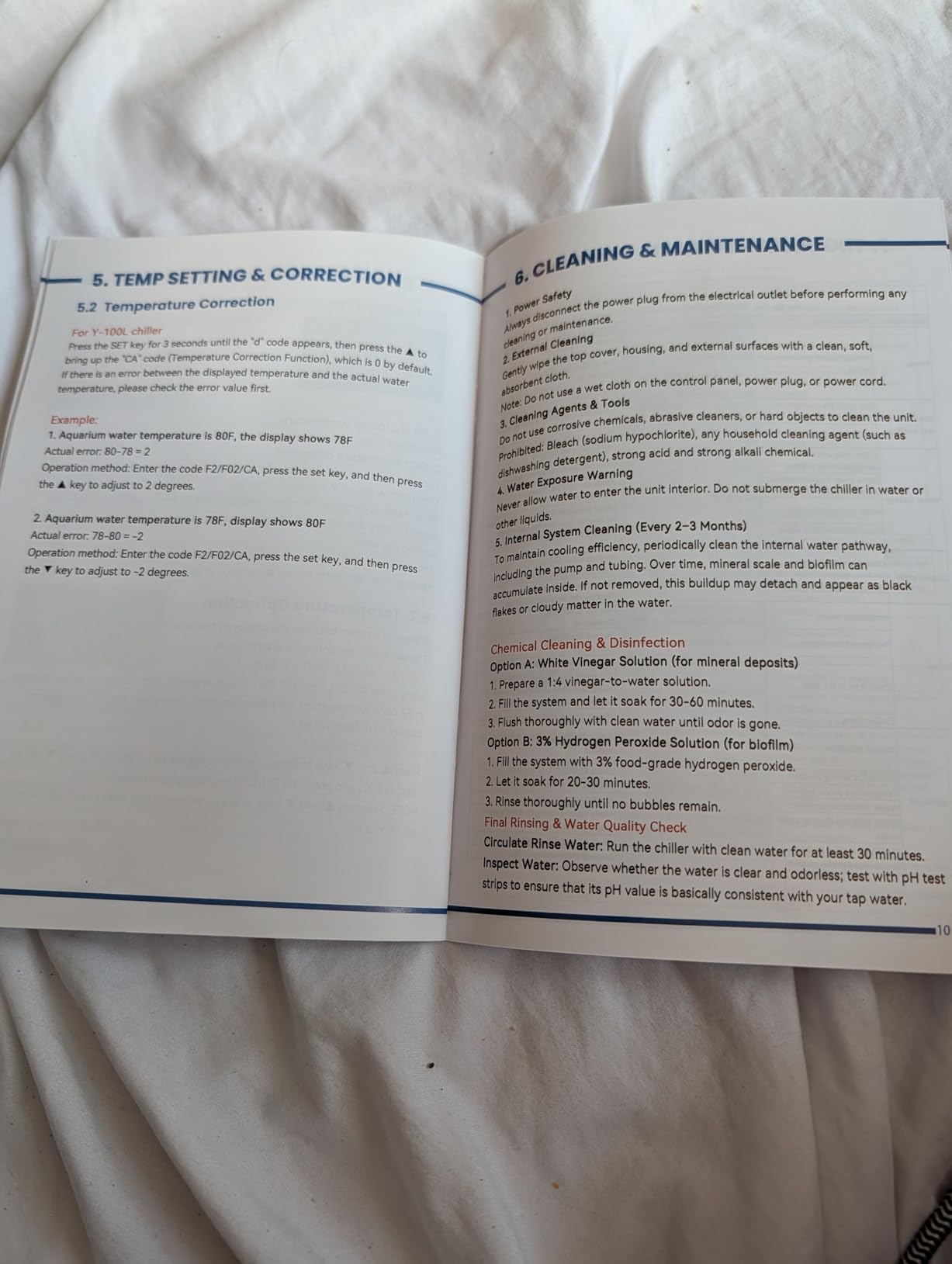
Two setup details tripped up our own install. First, the controller needs calibration against a real thermometer before you trust the display, and second, the kick-on delta setting decides whether the compressor short-cycles. We set a wider delta so it does not hammer on and off every few minutes. The internal battery that remembers the set temperature after an outage is a genuinely useful touch for anyone who travels.
What we liked about the kit that arrives in the box
This is a complete install. The package includes the chiller, a stainless steel shaft pump, water pipe, hose and clamps, so you are not making a second purchase before you can run it. For a first reef chiller that removes a real source of frustration, since matching a pump to a chiller is a step many beginners postpone and then pay for in poor flow rates.
The practical limitation is that the bundled pump is the weakest part of the package. Owners report it pushing a strong enough stream at the outlet to create a whirlpool that stirs sand out of place, and a few have replaced it outright. If you run this in a sump, use your own return or feed pump instead and let the included one go.
Where this chiller falls short
The documentation is the weak point. The printed manual is close to useless, so setup knowledge comes from the listing page and community user guides, and the display messages are written in Chinese characters only, which is awkward if you want to read a fault code. Expect to spend twenty minutes learning the F1 and F2 calibration steps before the unit runs the way you intended.
Reliability is not perfect. Across 499 reviews the average sits at 4.2 stars with roughly 64% five-star and 9% one-star, and the recurring complaint is compressor failure or sensor drift around the one-year mark. That is a real consideration, and it is the main reason we rate this as the best overall rather than a set-and-forget purchase.
2. Active Aqua 0.25 HP Titanium Chiller – Best Proven Mid-Size Pick
Active Aqua Water Chiller, 0.25 HP, Titanium, 40-92 Gal, Hydroponics
0.25 HP
40-92 gal capacity
Pure titanium evaporator
396-925 GPH
Digital interface
Pros
- Long reef ownership history
- Boost function for fast pull-down
- Pure titanium evaporator
- Also offered in 0.10 HP / 0.5 HP / 1 HP
Cons
- Pump and hoses sold separately
- High share of one-star reviews
- Bulky 19 x 14 x 19 inch footprint
Active Aqua is the name that keeps coming up when reef keepers talk about units that have simply run for years. A commenter on r/ReefTank recommended the brand directly, calling the units reliable, and that long-ownership reputation is the core of why we picked this for mid-size systems rather than a newer listing with a higher average score.
The 0.25 HP model covers 40 to 92 gallons with a listed circulation capacity of 396 to 925 GPH depending on the setup, which is a wide enough band to serve a mixed reef display plus sump. The Boost function is the feature most owners mention first, because it pulls the water down to the target temperature faster than the base cooling cycle during a hot afternoon rather than waiting hours for equilibrium.
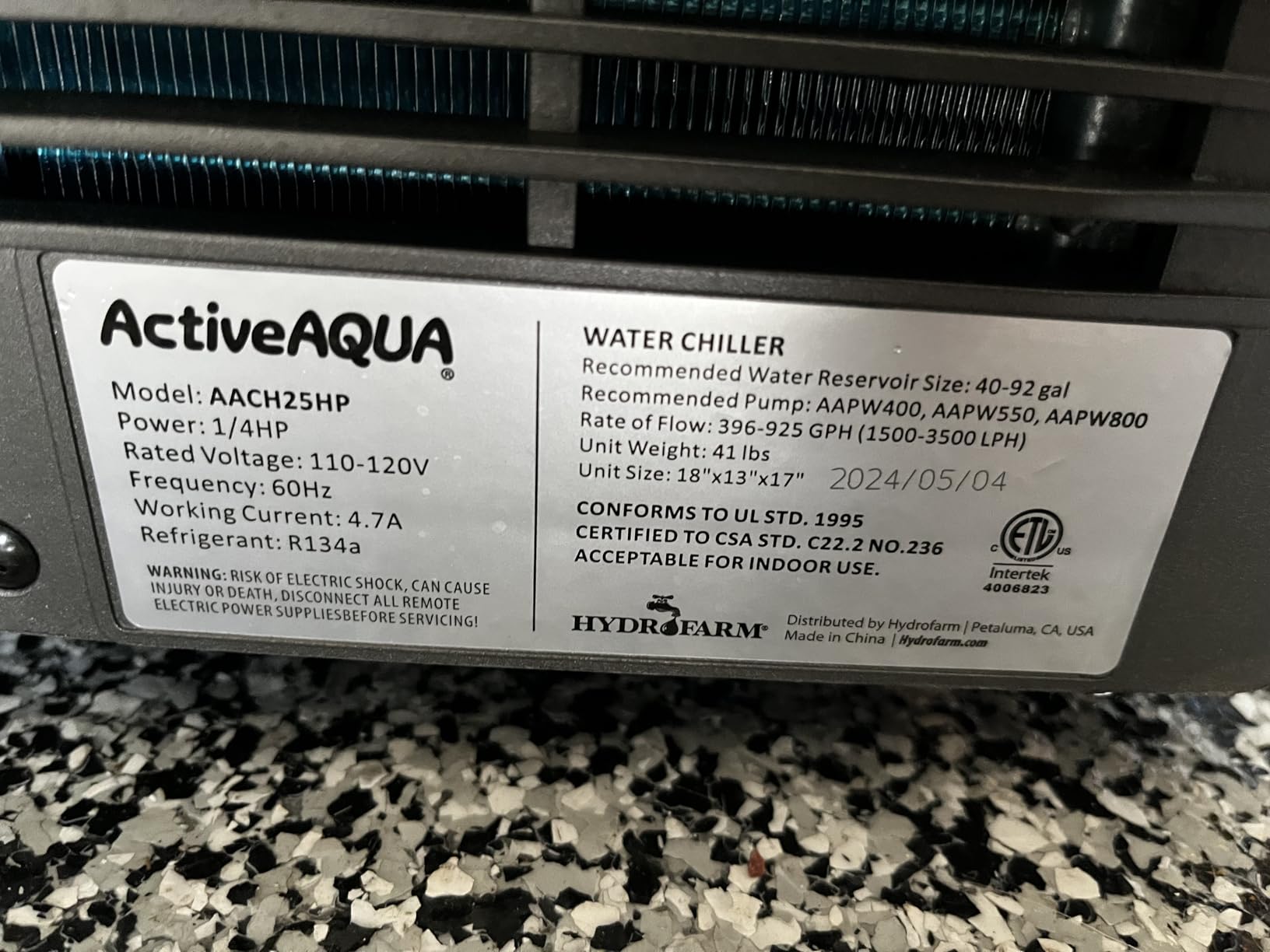
The evaporator is pure titanium, described by the manufacturer as anti-corrosive for both fresh and saltwater duty. The digital interface gives precise range control across a wide span, and the same chassis is offered in 0.10 HP, 0.5 HP and 1 HP versions, so a keeper who outgrows this unit can step up without changing the footprint convention.
Be realistic about the footprint. At 19 x 14 x 19 inches and 44.9 pounds, this is a heavy box, and it is rated for hydroponics, aquaponic reservoirs and cold plunge baths as well as aquariums, which tells you the coil is built for volume rather than for a nano display sitting next to a television.
Why reef keepers keep coming back to this brand
The answer is serviceability and range. Parts for this line are widely available, so a failed fan or board is a repair rather than a replacement, and the same model family covers everything from a 20 gallon cube to a commercial reservoir. That combination is rarer in this category than the marketing pages suggest.
It is also the pick if you already own a matching Active Aqua pump. The unit is designed to pair with the AAPW400, AAPW550 and AAPW800 pumps, and the fit is clean when you use the branded parts rather than adapting something else.
What you need to know before buying
The pump and hoses are not included. That is not a minor detail, because the flow through the titanium coil determines how much heat the unit can actually move, and a chiller starved of flow will run continuously without ever reaching setpoint. Budget for a dedicated pump and plumbing from the start.
Review sentiment is polarized, and we want to be straight about that. The 4.0 average across 351 reviews hides 68% five-star ratings alongside 17% one-star, a wide spread of happy and disappointed owners. Buyers who pair it with the matching pump report strong cooling; the one-star block is mostly durability and underperformance.
3. Poafamx 1/3 HP for 40-80 Gallons – Best for Hot-Room Reefs
Poafamx 1/3 HP Aquarium Chiller, Quiet Fish Tank Water Chiller 40-80 Gal
1/3 HP compressor
40-80 gal
Cools 10C below ambient
Under 45dB
R290
Pros
- Holds reef tanks steady in triple-digit indoor heat
- Under 45dB and leak-free
- Arrives fully assembled
- Titanium evaporator with R290 refrigerant
Cons
- Included pump pushes only about 158 GPH
- Some chillers stop chilling within 8-12 months
- Thermostat needs calibration
- Discharges heat out the rear vents
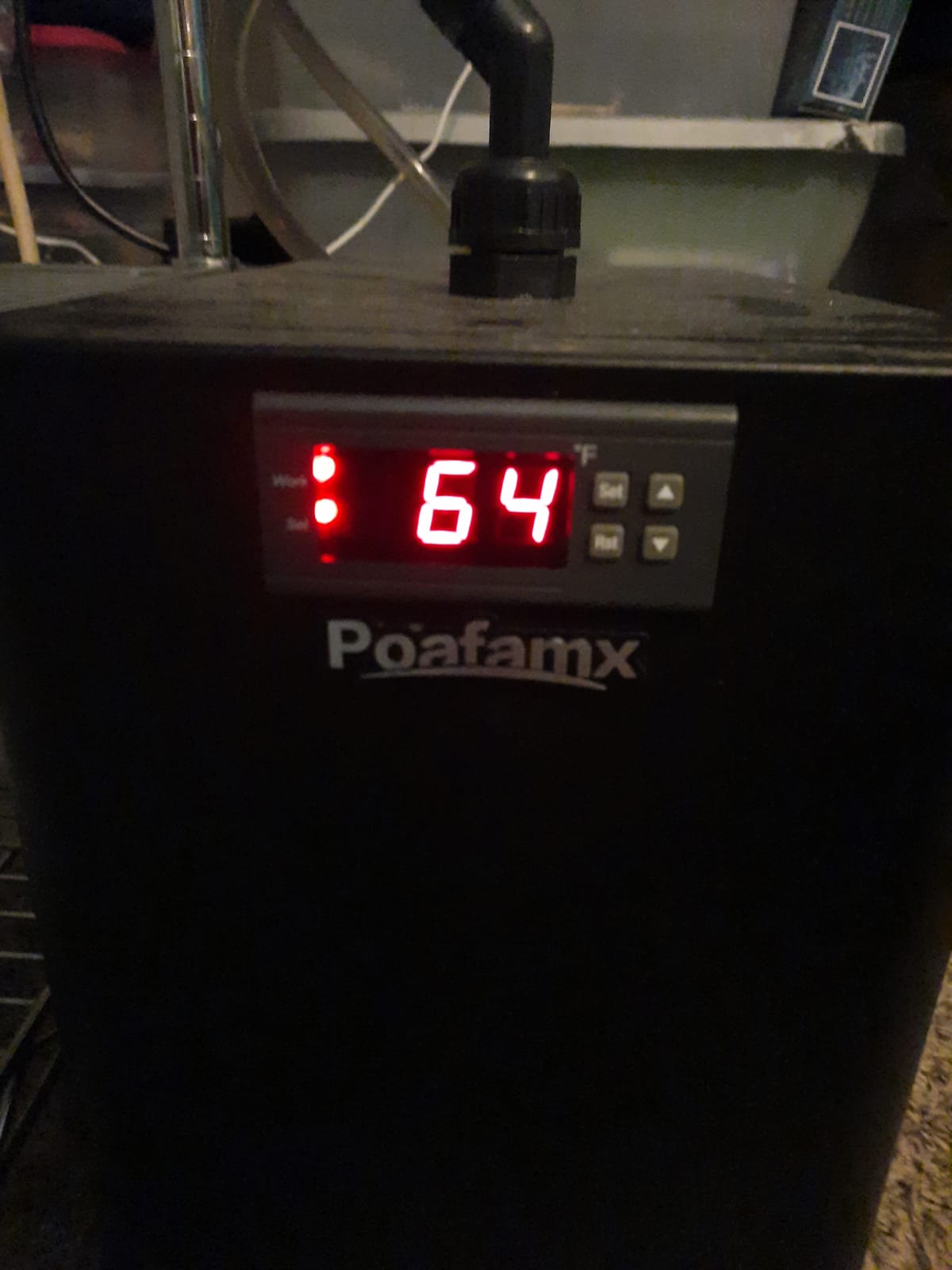
The Poafamx 1/3 HP is the unit we would reach for when the room itself is the problem, not just the tank. It holds a stable 65-80F range for corals and tropical fish and is rated to cool up to 10C below room temperature, which is a meaningful claim in a house that runs warm in July.
In practice, owners running these in axolotl and reef tanks report steady cooling even when indoor heat climbs into the triple digits, and the unit runs quietly enough to sit near living space. At 37 pounds and 12.6 x 12.6 x 7.28 inches, it is also a notably compact 1/3 HP compressor, which makes it far easier to find airflow around.
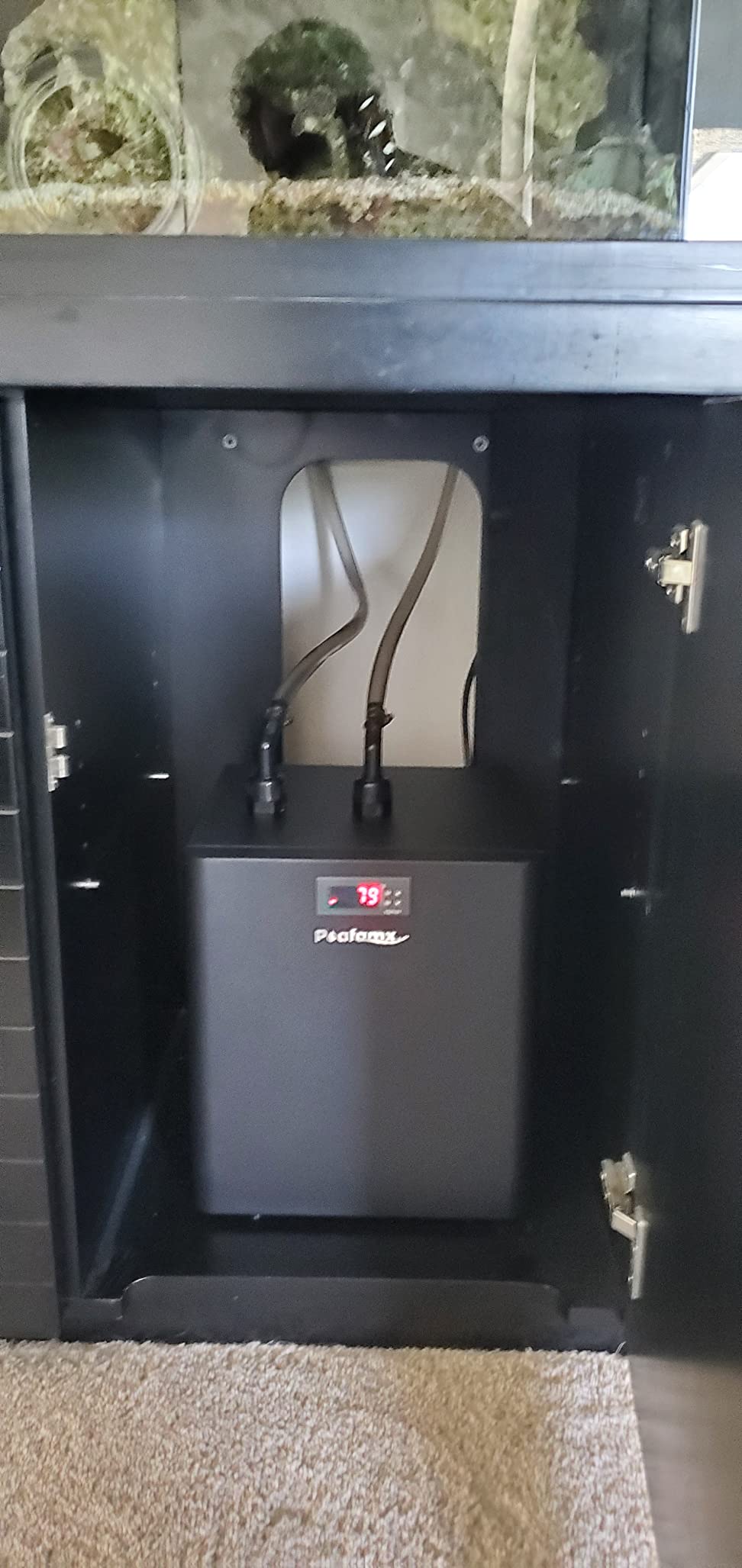
The titanium evaporator handles both fresh and saltwater, and the R290 refrigerant is a low-GWP option with zero ozone depletion potential. The package is complete, with chiller, water pump, hose, connectors and clamps, so installation takes minutes rather than an evening. Coverage is backed by a one-year warranty.
Size it to the middle of the stated 40-80 gallon range rather than the top. Owners using it near the upper rating point tend to report the compressor working hard, and the same chassis is also available in 42 gallon and 79 gallon variants if you would rather match the box to the system exactly.
What works well about this unit
Two things. The cooling headroom is genuinely good for the class, and the noise profile under 45dB means you can run it in an occupied room without it becoming the reason people leave. It also runs leak-free over long duty cycles, which matters when a fitting loosens in a cabinet behind a stand.
There is a long-ownership story here too. An owner on their third tank chiller reports years of trouble-free daily service on a small compressor unit. For a keeper who just needs reliable summer cooling, that is a defensible trade.
Where owners report problems
The included pump is the most common complaint, pushing roughly 158 GPH and being swapped out by many buyers in the first week. Flow is what moves heat across the coil, so plan on replacing it with a pump you trust rather than fighting the bundled one.
The second issue is reliability inside the first year. Several chillers stopped chilling within 8 to 12 months, and there are one-star reports of power switch and wiring failures, which is consistent with the 14% one-star share on a 4.0 average. Treat it as a two-season purchase and keep your coral temperature set one or two degrees more conservative than you would with a sealed titanium unit.
4. Nova Tec IceProbe – Best for Nano Reefs and Cube Tanks
IceProbe Thermoelectric Aquarium Chiller – 4 in. x 4 3/4 in. x 7 1/2 in.
50W thermoelectric
4 x 4-3/4 x 7-1/2 inch
Silent fan
External controller needed
Pros
- Effectively silent
- Mounts in-tank or in a sump back compartment
- Cheap repair path with swappable module and fan
Cons
- Only about 3F of usable cooling
- No built-in thermostat
- Installation usually means drilling glass
- Cooling power falls off badly in hot rooms
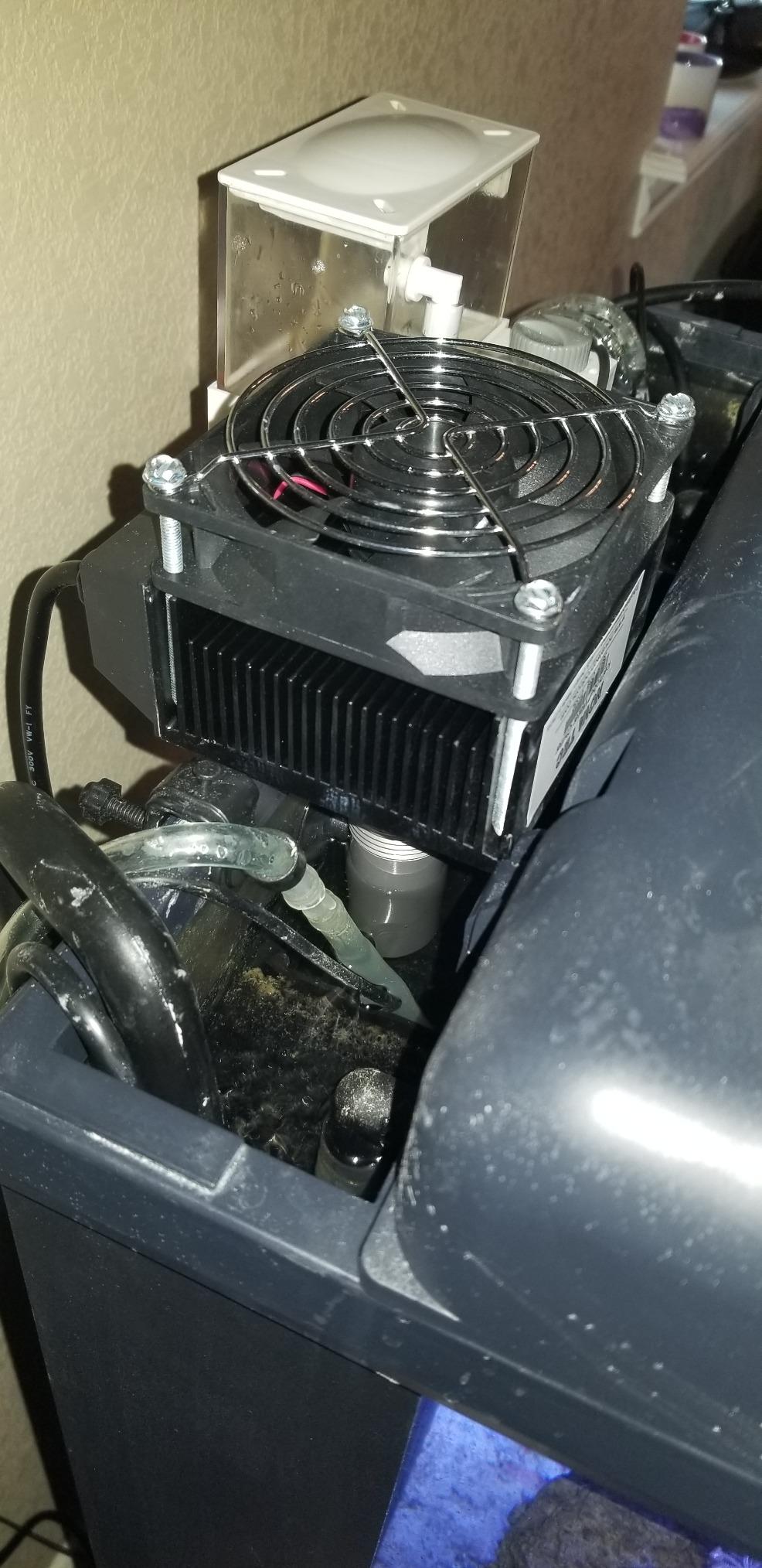
The IceProbe is the only thermoelectric unit in this roundup, and it solves a problem no compressor chiller can: silence. Only a 3.5 inch fan runs, which is quieter than anything else we tested, and at 4 x 4-3/4 x 7-1/2 inches including the probe it mounts in a back compartment, a sump or a plenum without taking cabinet space.
How it works is different too. Rather than pulling heat through a coil, the 50W Peltier module chills a probe that you place in the water column, and the water carries that cold away. That design is why it fits where a compressor unit cannot.
The limit is real and you should know it before you buy. Owners consistently measure only a 3 to 5F temperature drop, which is enough to stop a small tank from climbing past 80F in a temperate room and nowhere near enough for a 10F swing. Cooling power also degrades badly in a warm, unconditioned space, which is exactly the scenario where you need help most.
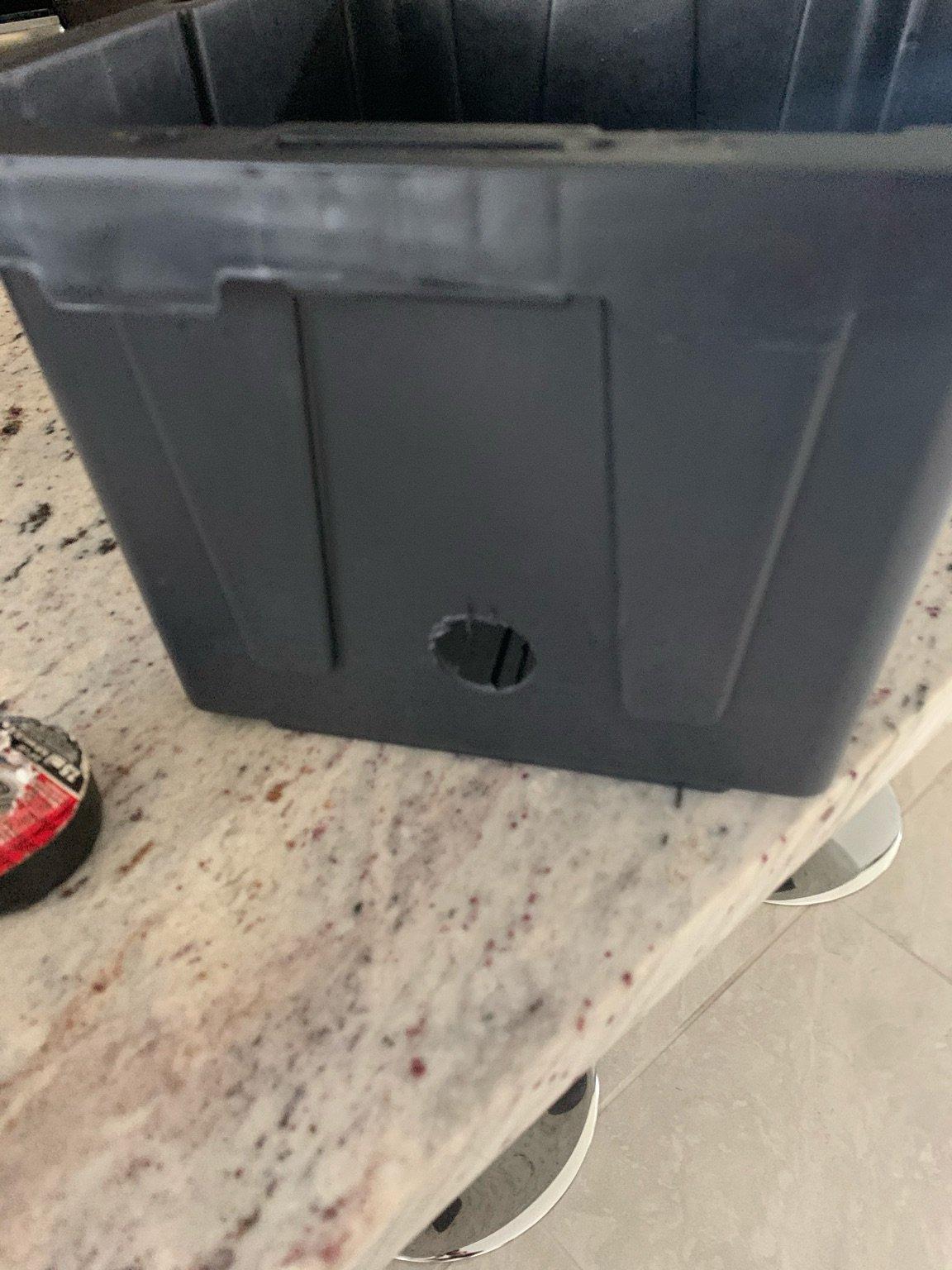
Plan the install carefully. The unit measures 4 in x 4-3/4 in x 7-1/2 in including the probe, ships a 5 ft 9 in power cord and a 6 ft probe cord, and typically means drilling a hole through glass or mounting it in a sump or plenum where the probe sits in the return path.
When the IceProbe is the right tool
A nano reef under 20 gallons, a cube, or a display in a room that sits reliably between 72 and 78F. In those conditions it acts as a trim cooler, holding a marginal tank a few degrees below ambient rather than chasing a setpoint, and it does that without a compressor ever starting.
It is also a genuinely cheap repair path. The Peltier module and the fan are the only failure parts, and both are straightforward to swap, which matters more than the purchase price over a five-year ownership horizon.
Why this is not a full reef solution
There is no built-in thermostat, so a separate controller and probe are required to switch heating and cooling. Skip that and the unit runs continuously, which both wastes power and sets up a fight with your heater controller.
Reviewers also report Peltier module failures well before the stated 3000-hour figure on some units, and the one-year warranty covers defects in materials and workmanship rather than long service. At 3.9 from 261 reviews, this is the only chiller in our group rated below 4.0 stars, and the reviews explain exactly why: the silence and mounting flexibility are loved, the cooling capacity is not.
5. Fitnet 79 Gallon Touch Screen Chiller – Best Control and Calibration
Fitnet 79 Gal Aquarium Chiller, 1/3 HP Fish Tank Water Chiller, Hydroponic Water Chiller with Touch Screen, Hydroponics System Axolotl Jellyfish Coral Reef 300L
1/3 HP, 79 gal
Digital touch screen with memory
68-79F range
R290 refrigerant
Pros
- One of the strongest rating profiles in the group
- Setpoint memory survives power loss
- Calibration offset matches a real thermometer
- Reaches low setpoints for cold plunge use
- Responsive support
Cons
- Printed instructions contradict the listing
- F1 delta setting is confusing to configure
- Some cooling stops that need a reset
The Fitnet has some of the strongest owner ratings in this roundup, and the reason is not raw cooling power, it is control. The digital touch screen stores your setpoint and restores it after a power outage, and the calibration function lets you match the chiller reading to an actual tank thermometer, which removes the single most common source of reef-tank confusion.
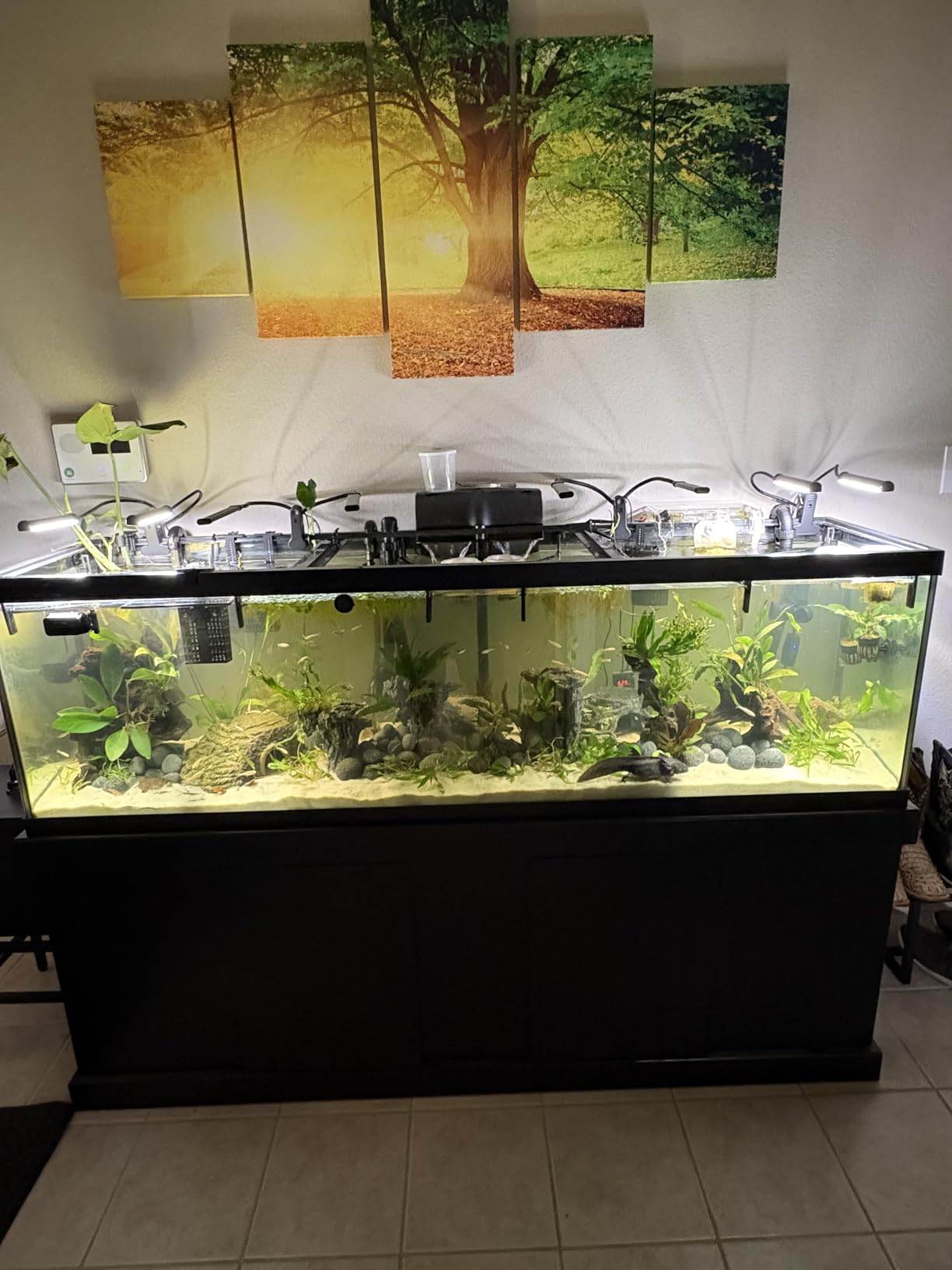
On capacity it is a 1/3 HP compressor rated to 79 gallons or 300 liters, using R290 refrigerant and holding water between 68 and 79F. One owner runs it on a 125 gallon aquarium well beyond its stated rating, which tells you how much headroom the compressor has in a normally conditioned room.
The heat exchange uses a corrosion-resistant pure titanium pump, and the complete set includes the water pump, pipe and connectors. Two built-in cooling fans and a vented chassis move the heat, with the manufacturer asking for 6 inches of clearance on all sides. It is also a good match for setups beyond aquariums, since the listing covers hydroponics, fish farms, coral, jellyfish and shrimp tanks, backed by a one-year guarantee.
It can also reach very low setpoints, down into the 38-41F range in a garage, which is unusual for a unit sold into the hobby market and makes it useful beyond reef keeping. For a cold-plunge or chilled livestock setup, that is a genuine capability rather than a spec-sheet line.
What makes the controller worth the extra setup time
Setpoint memory plus calibration is a combination you rarely see at this level. After an outage or a power cut, most cheap chillers come back at a default temperature and quietly cook the tank, and most cheap thermostats read a few degrees off. This one addresses both, and the support team is reported as responsive on missing parts and refunds.
It is also a straightforward install. The included pump, pipe and connectors mean setup is roughly fifteen minutes, which matters when you are chasing a heatwave with a tank already at 81F.
The setup trap to plan around
The F1 temperature-difference setting. Owners consistently succeed once they get past programming the delta, and the instructions that ship with the unit contradict the listing page, so read the F1 step twice before assuming the controller is faulty. Our other note is that a loose power connection has been reported once, vibration interrupting supply, and some models occasionally beep and stop cooling until reset.
At 4.4 stars with 73% five-star ratings and only 8% one-star, the owner feedback is consistently positive. The weakness is the smaller review base compared with the two picks above it, so we would treat it as the top-rated option rather than the proven one.
6. Poafamx 42 Gallon 1/10 HP – Most Versatile for Small Reefs
Poafamx Aquarium Chiller 42Gal, Quiet Water Chiller for Fish Tank 1/10 HP
1/10 HP, 42 gal
Cools 5-10F below ambient
19 pounds
R290
1-year warranty
Pros
- Compact and light at 19 pounds
- Quiet for a compressor unit
- Strong included pump
- Owners report years of daily service
Cons
- Front panel pops off in transit
- Display defaults to Celsius
- Hoses are short with no elbow included
- No cleaning instructions
The 1/10 HP Poafamx is the sensible entry point for a reef in the 20 to 40 gallon range, and at 19 pounds it is the easiest unit here to move, position and eventually replace. It typically cools 5 to 10F below ambient depending on volume, tank size and room temperature, which is the right shape of claim for a display plus small sump.
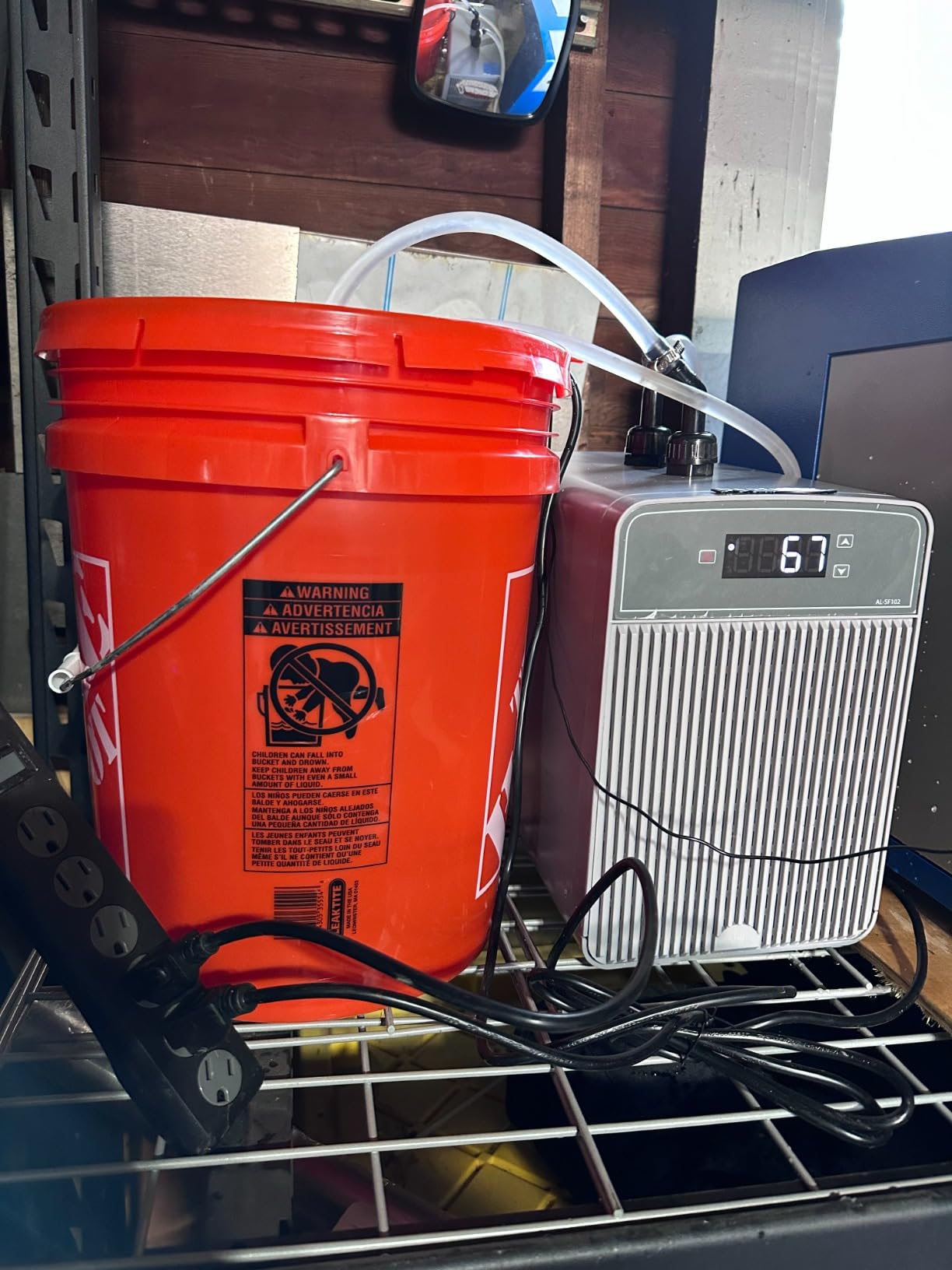
Owners report it holding 20 to 40 gallon reef tanks at 62 to 68F with no further adjustment, and describe the noise level as comparable to a refrigerator. The unit uses an energy-efficient 1/10 HP compressor with R290 refrigerant, two silent fans with pure copper heat sinks, and front and back cooling-hole ventilation.
The included pump is strong, and the whole set covers the chiller, pipe, water pump and nozzles, so this is a genuinely complete package. It is rated for 110V freestanding installation, usable for saltwater and freshwater, coral reef, jellyfish, axolotl and shrimp tanks, with a one-year warranty.
Two design choices help longevity here. The front panel is removable for inspection and cleaning, which is more than most units in this class offer, and the copper heat sinks behind the fans shed heat efficiently. The manufacturer asks for 6 inches of clearance around the unit, which is easy to give in a stand with the door open.
Best reasons to pick this one
Long-term reports are the standout. Multiple owners describe years of trouble-free daily service, including one on their third tank chiller, which is the kind of evidence you rarely get on a 52-review listing. The 4.2 average with 67% five-star ratings reflects a product that does a modest job quietly for a long time.
It is also the easiest unit here to run in a small space. The compact form factor and 19 pound weight mean you can pull it out for cleaning on your own, and the small footprint leaves room for airflow in a cabinet that larger chillers would choke in.
Small annoyances that shape your experience
The front panel is prone to popping off in transit and during use, which is cosmetic but irritating, and the display defaults to Celsius with no simple way to switch. The clear hoses are also a poor choice for hydroponics because algae grows inside them, though that is irrelevant to a reef install.
Most frustrating for setup is what is missing: hoses are short, no 90-degree elbow for the pump outlet is included, and there are no cleaning instructions anywhere in the box. Budget twenty minutes and a few feet of extra tubing before you start.
7. JBJ Arctica 1/10 HP Titanium – Best for Quiet Setups
JBJ Aquarium Arctica Titanium Chiller, 1/10 HP
1/10 HP titanium
R-134A refrigerant
Ultra-quiet compressor
Requires external pump
Pros
- Genuinely near-silent in real rooms
- Calibrates within 0.1F of a reference
- Reported 6 years of continuous service
- Pulls a 70 gallon tank down in about 2 hours
Cons
- Pump and plumbing sold separately
- Expensive for 1/10 HP output
- Dumps heat into the room
- A minority of units failed within weeks
JBJ is the reference point most reef keepers measure other chillers against, and the Arctica is why. Owners report not noticing it during computer meetings or with it sitting next to a bed, and the brand markets it as the quietest unit in its class.
This 1/10 HP titanium model is built around a highly efficient condenser designed to use less energy, and the titanium construction is rated for saltwater systems. The refrigerant is ozone-friendly R-134A, and the same chassis family is manufactured in 1/5 HP, 1/3 HP and larger sizes, so the product line scales with your tank.
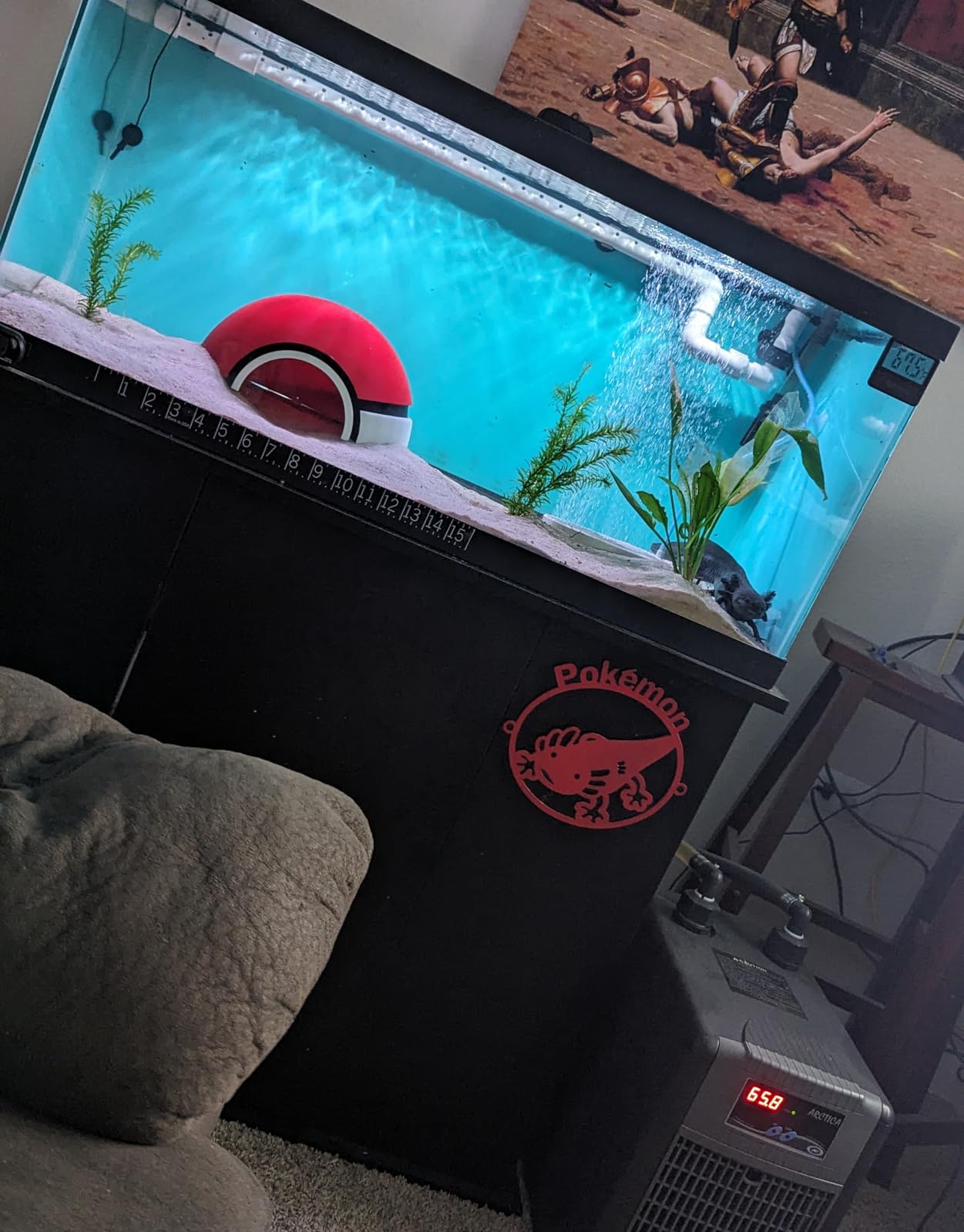
Calibration is the step that separates a good result from a frustrating one. After setup, the unit is calibrated against a reference thermometer, and owners who do this report accuracy tightened to within 0.1F. One owner reports a 70 gallon tank pulled from 75F to 68F in about two hours, and another reports six years of continuous operation.
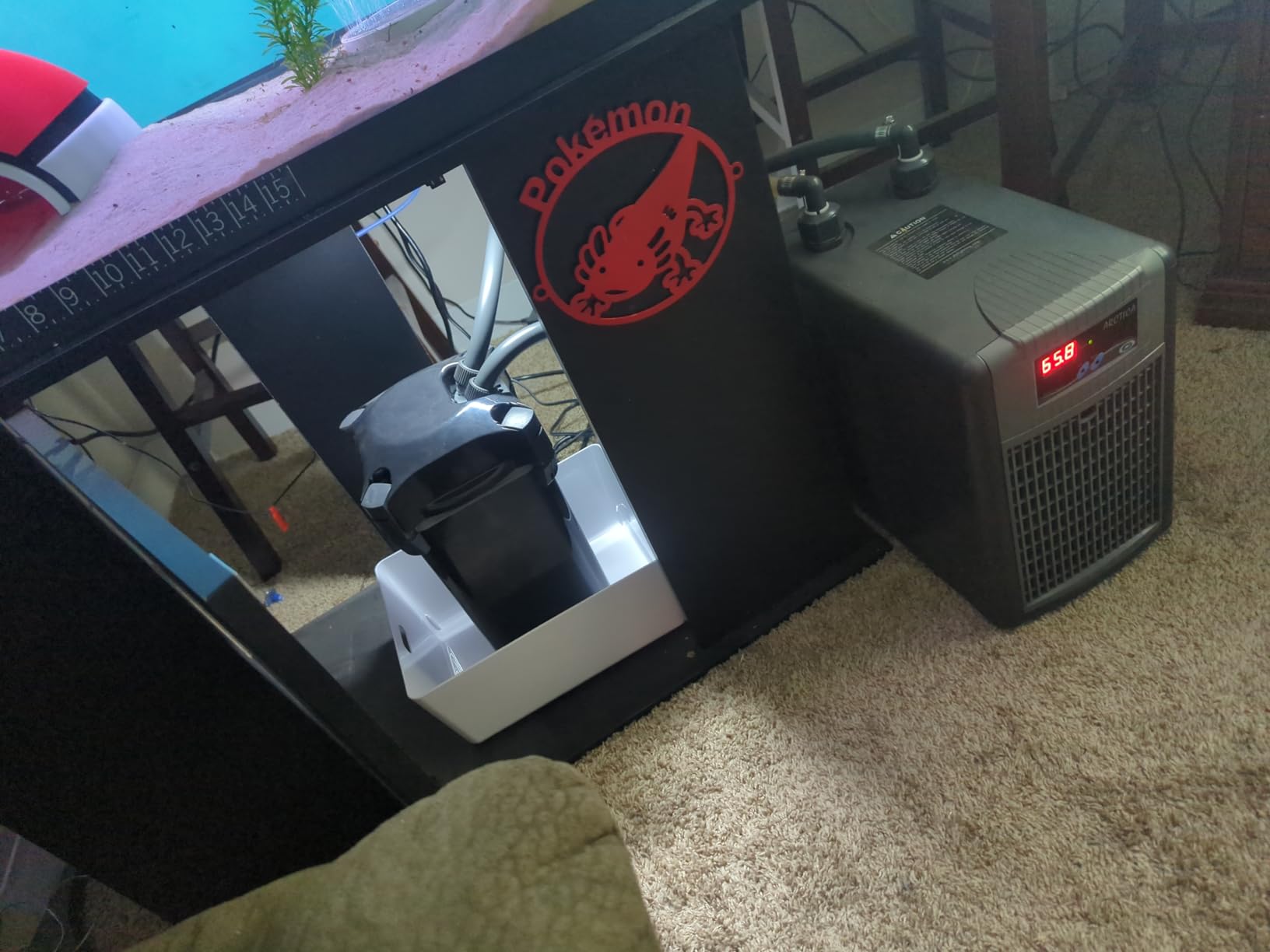
At 41 pounds and 13 x 19 x 20 inches, this is a full-sized compressor box, and it needs an external pump with adequate flow plus an adjustable flow regulator to work properly. Treat the pump as part of the purchase rather than an accessory.
What the build quality buys you
Durability and setpoint accuracy. When this unit works, the reviews describe a machine that holds a stable 59-62F cold-water setpoint indefinitely, and the 6-year continuous service report is a data point the smaller compressors here cannot match. For a bedroom, home office or a system where noise is genuinely disruptive, this is the pick.
It is also the safest bet for a reef with high-value SPS. Titanium throughout, ozone-friendly refrigerant and a well-proven platform mean the corrosion risk that kills lesser coils in saltwater does not apply.
The honest drawbacks
The 1/10 HP version is expensive relative to the cooling capacity you get, and that is a hard fact to soften when the compressor units below deliver more cooling. The pump and plumbing are not included, which pushes the real cost of ownership higher still.
Reliability is the other concern. Across 47 reviews the split is the widest here, with 74% five-star against 20% one-star, a wide split of happy and disappointed owners, the failures that do happen tend to happen early, with a minority of chillers stopping cooling within weeks. The condenser fins also need periodic cleaning, and the unit throws heat into the surrounding room, so it needs airflow on all sides.
8. VEVOR 52 Gallon 1/10 HP – Best Complete Fitting Kit
VEVOR Aquarium Chiller 52Gal 1/10HP Quiet Cooler with Titanium Evaporator
1/10 HP, 52 gal
65-80F range
1200 L/H circulation
Titanium evaporator
R290
Pros
- Complete kit including pump and fittings
- Strong 1200 L/H circulation
- Quiet for a compressor unit
- Reaches 68F in hot weather
Cons
- Included pump is noisy and fails early
- No settable hysteresis band
- Display reads about 4 degrees off
- One marine keeper reported skimmer interference
The VEVOR CL280 is one of the most completely equipped chillers in this roundup, and that is not a small advantage when you are assembling a loop for the first time. The fitting kit includes hose clamps in two sizes, pipe nuts, pipe connectors, O-rings, an SP-2500 water pump, two PVC hoses, a suction cup and a manual, so there is nothing left to source.
Performance is solid for a 1/10 HP. The compressor circulates up to 1200 L/H, a high flow figure for a 1/10 HP unit, holds water between 65 and 80F, and uses fluorine-free R290 refrigerant with a corrosion-resistant titanium evaporator rated for both fresh and saltwater. Owners report holding aquariums and ponds at 68F through hot weather, and one cooled 60 liters of hydroponic solution to 10C in a few hours.
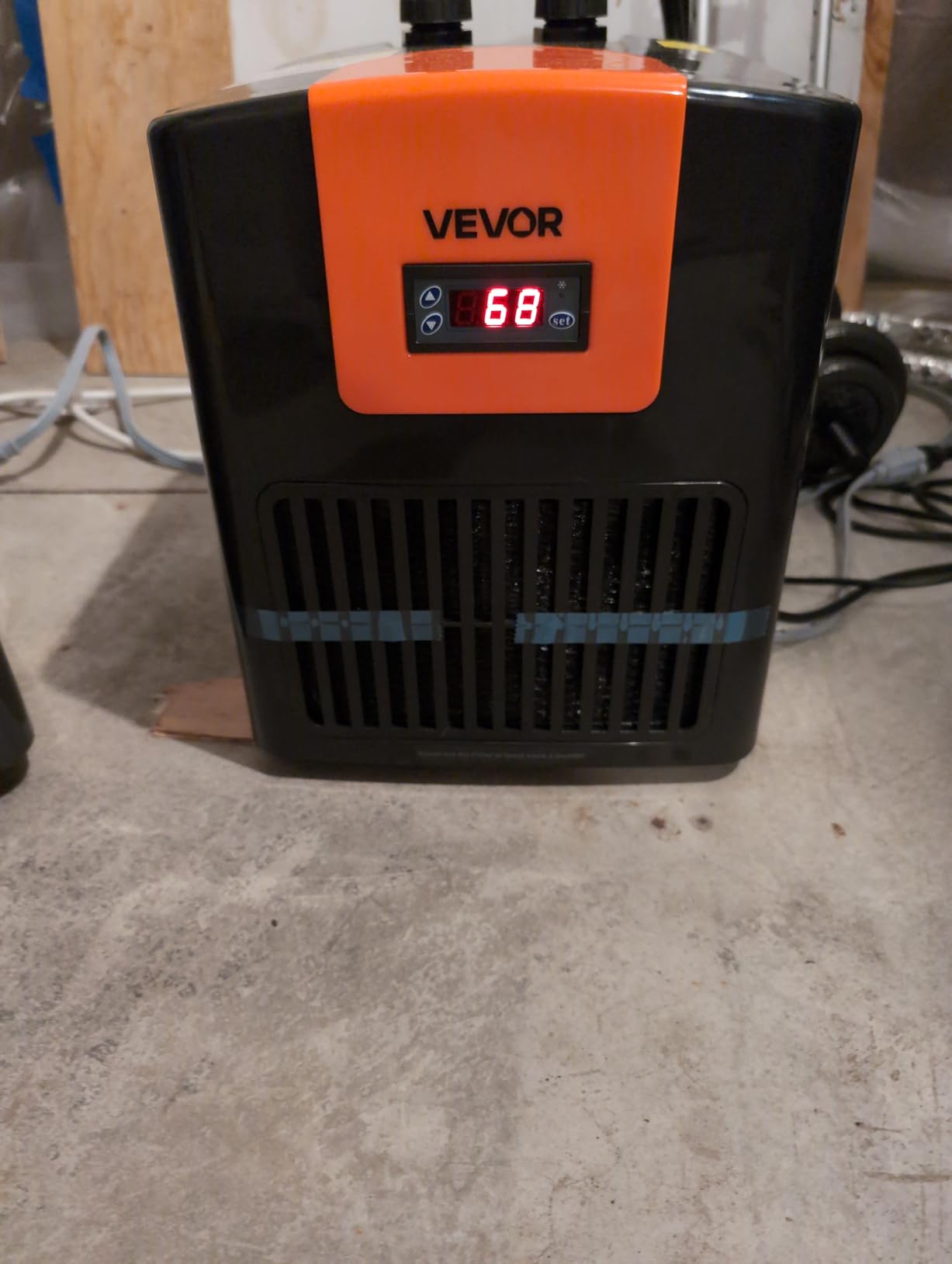
Noise is better than expected for a compressor unit, with owners describing it as quieter than a household refrigerator. At 30.9 pounds and 12.4 x 11.81 x 15.59 inches it is one of the lighter boxes here, and the same line is available at 1/4 HP and 1/3 HP.
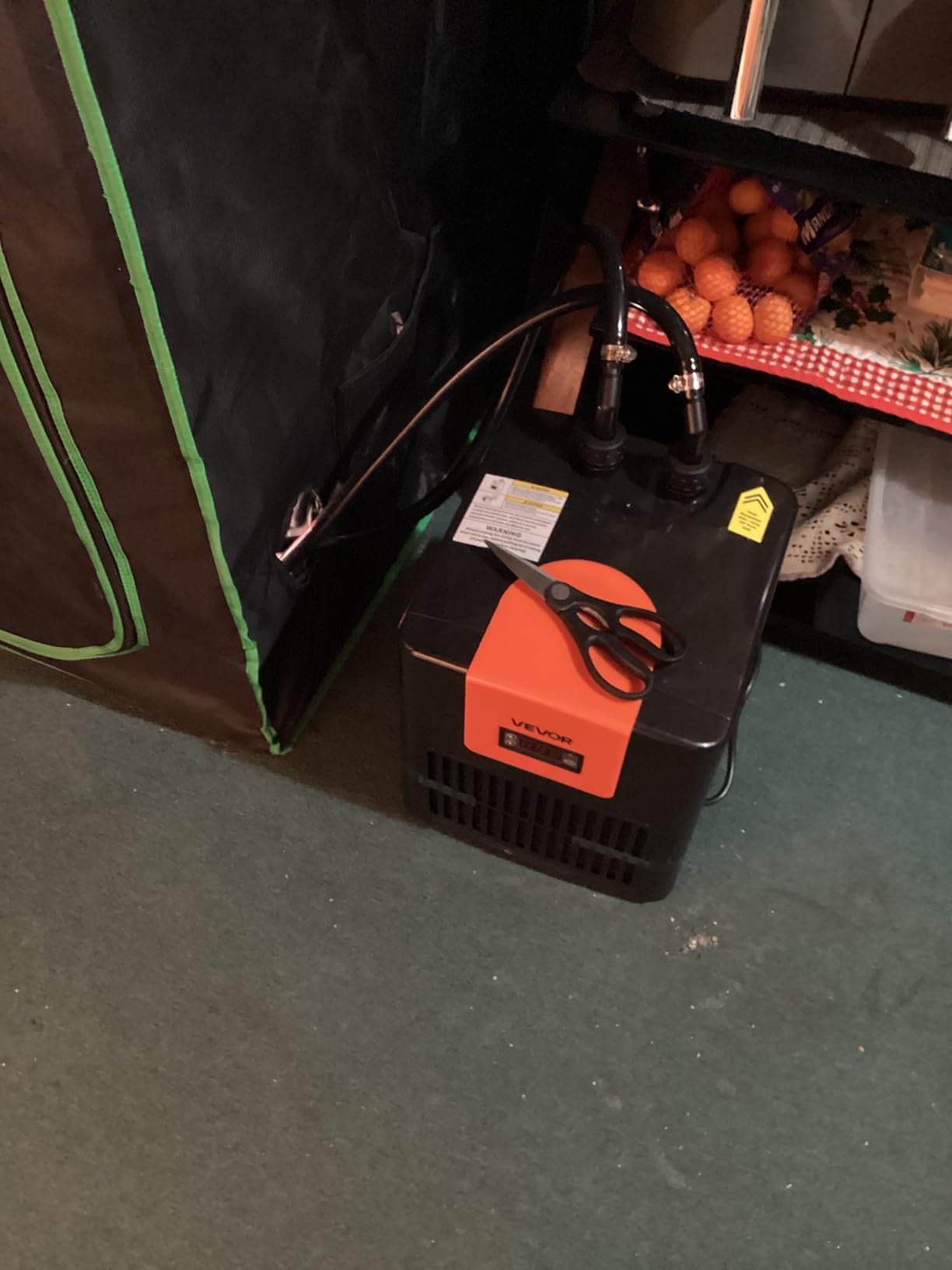
One installation detail is easy to miss: the manufacturer asks for at least 24 inches of clearance for airflow, which is double what the smaller units require. A chiller crammed into a tight cabinet will run warm and shut itself down, so measure before you commit to a position.
Where the value sits
The parts package is the reason to consider this one. Clamps, O-rings, connectors and a real pump are included, and owners confirm the kit is genuinely complete rather than a token hose and a bracket. Add a titanium evaporator and R290 refrigerant and the specification sheet holds up well for a 1/10 HP build.
It is also a good stepping stone. If you outgrow the 52 gallon rating, the 1/4 HP and 1/3 HP versions in the same line use the same fittings, so a future upgrade is a swap rather than a rebuild.
The reef-specific caution
One marine keeper reported the unit disrupting protein skimmer foam and causing gas bubble disease in dwarf angelfish, which is a serious enough symptom in a reef system that you should treat it as a real risk rather than an anecdote. If you run a skimmer, test on a non-critical system or monitor skimmer function closely during the first weeks.
Beyond that, the bundled water pump is the recurring weak point, reported as noisy, rattling or failing within days to months, and there is no settable hysteresis band, so the unit short-cycles rather than holding a range. The display can also read about 4 degrees off. At a 4.0 average on only 31 reviews, treat it as a capable budget build rather than a proven reef workhorse.
9. FIIRUS 1/3 HP Up to 79 Gallons – Best for App Control
FIIRUS 1/3 HP Aquarium Chiller for Up to 79 Gallons
1/3 HP, 79 gal
Wi-Fi app control
Programmable trigger range
Titanium heat exchanger
Pros
- App programming reduces compressor cycling
- Accurate readings within about a degree
- Complete kit with roughly 15 minute setup
- Quieter and smaller than larger compressor units
Cons
- App needs 2.4 GHz Wi-Fi
- Emits noticeable fan noise and heat
- Needs about 8 inches of side clearance
- Cooling depends on room conditions
The FIIRUS is the only unit in this roundup with app control, and for a long-distance reef that changes how you manage summer. You can change setpoints and program cycle settings from your phone, and the adjustable high and low trigger temperatures span roughly 3 to 4 degrees, which is the mechanism that keeps the compressor from short-cycling.
That range control is the feature owners praise most. Setting a wider trigger band lets the tank drift inside a safe window without the compressor running constantly, and multiple owners describe it as quieter and smaller than the compressor units they replaced, with good sound insulation around the housing.
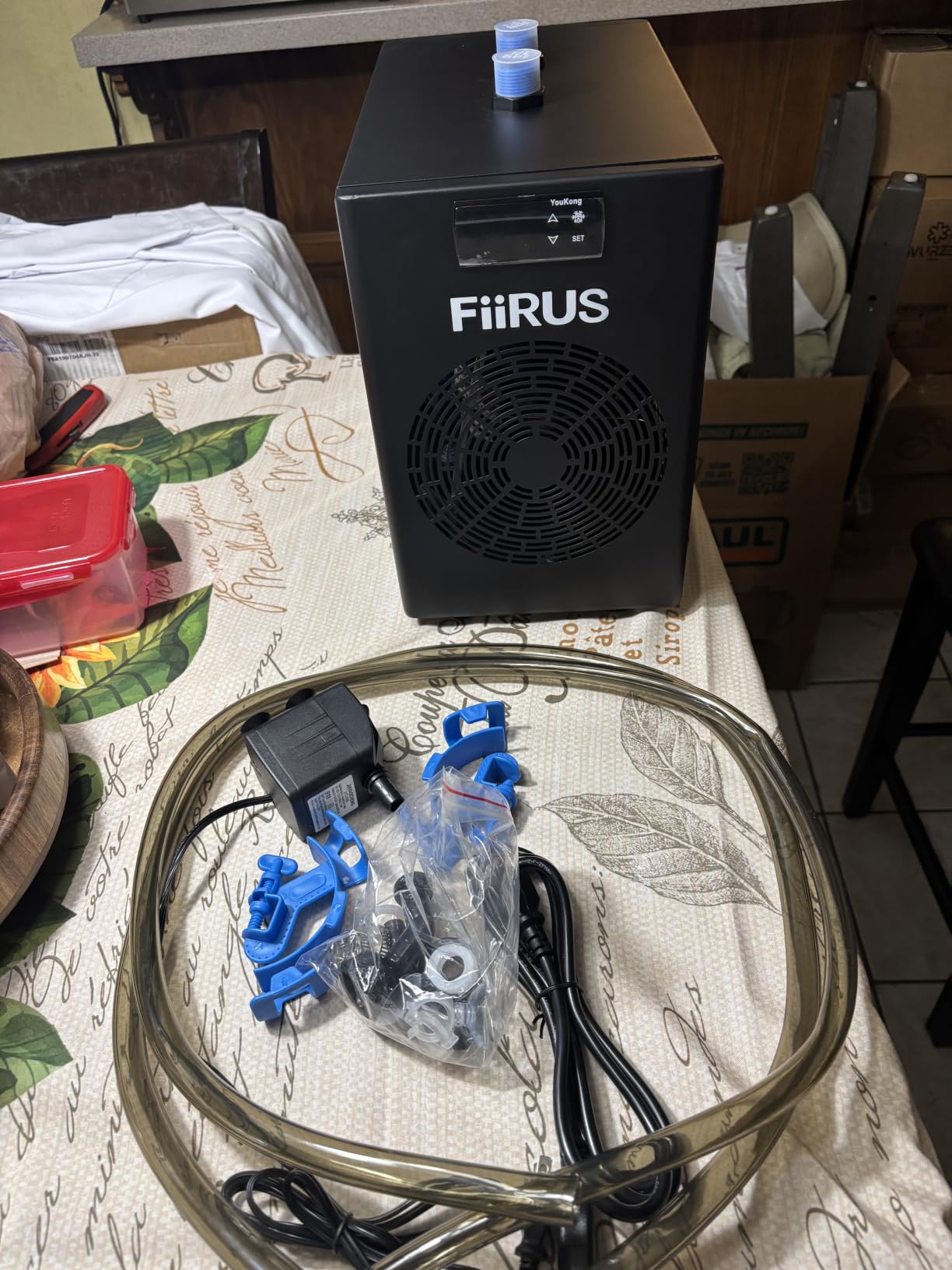
Underneath, it is a 1/3 HP compressor rated to 79 gallons with a pure titanium water-contact heat exchanger for fresh and saltwater, plus an on-unit digital control panel for when the app is not convenient. A complete circulation kit is supplied with water pump, tubing and connection accessories, and setup takes roughly fifteen minutes.
Temperature accuracy is the other strong point. Owners report readings within about a degree of an independent in-tank probe, and a 1/10 HP version is also offered for smaller systems.
Why the trigger range is the real feature
Short-cycling is what kills small compressors, and it happens when a chiller with a narrow tolerance switches on, overshoots, then switches off and back on within minutes. Giving the controller a 3 to 4 degree band between the high and low triggers removes most of that cycling, which means a longer compressor life and a lower energy bill over a season.
It also means your coral sees a steadier temperature, since the water is allowed to sit inside a range rather than being pinned to a single number. For SPS keepers holding a steady 77 to 78F, that matters more than raw BTU.
Caveats before you order
The app requires a 2.4 GHz network and will not connect on a 5 GHz-only router, which catches out a lot of buyers who have never had to think about the distinction. Check your router before you buy, not after.
The unit also emits noticeable fan noise and exhaust heat while actively cooling, and the manufacturer itself does not recommend bedroom placement for that reason. Plan for roughly 8 inches of clearance around the side vents, and remember that actual cooling depends heavily on water volume, room temperature, lighting and pump output. At 4.6 stars from 18 reviews and no low ratings at all, the owner feedback is excellent, but that is also the smallest evidence base in this roundup, so treat it as promising rather than proven.
How to Size a Chiller for a Reef Tank
Most undersized chiller problems start with counting display gallons only. Reef keepers on r/ReefTank routinely run a 50 gallon display with a 15 gallon sump on a unit rated for 125 to 175 gallons, because they size against total system volume and real summer load, not the glass you can see. Do the same.
Add up your display volume plus sump volume plus roughly 10% for displacement by rock and sand, then multiply by 8.3 to get BTU per hour per degree of temperature drop. Multiply that figure by the number of degrees you need to remove, and you have your required BTU per hour. If your 150 gallon system sits in an 80F room and you want it at 78F, you need 150 x 8.3 x 2, which is about 2490 BTU per hour.
Be honest about the degrees of drop. In an air-conditioned house holding 75F, a reef at 78F only needs 3 degrees. In an upstairs room hitting 88F on a heatwave, the same tank needs 10 degrees, and that is the calculation that tells you whether a 1/3 HP unit is enough or whether you are shopping for a 1/2 HP.
Chiller size chart for reef tanks
Use this as a starting point rather than a promise. All figures assume total system volume and a well-ventilated unit.
20 to 40 gallon system, up to 5F drop, roughly 1700 BTU/hr, 1/10 HP class. 40 to 70 gallon system, up to 8F drop, roughly 3600 BTU/hr, 1/3 HP class. 70 to 100 gallon system, up to 8F drop, roughly 5200 BTU/hr, 1/3 HP in an air-conditioned room or 1/2 HP in a hot room.
100 to 150 gallon system, up to 10F drop, roughly 10000 BTU/hr, a 1/2 HP model or two 1/3 HP chillers on separate circuits. Above 180 gallons, or any system in a garage or unconditioned space, plan on commercial-duty hardware and a dedicated electrical circuit.
The manufacturer recommendation that most reef guides repeat is to buy one size larger than the calculated figure. That is not padding, it is how you keep the compressor out of a permanent on state during a heatwave, and permanent-on compressors are the ones that fail early.
Chiller Types and What Each One Is Good For
Four designs cover almost everything the hobby buys. Inline compressor chillers are refrigerator-style vapor-compression units that sit outside the tank, with a titanium coil fed by a pump. They are the default choice for anything above 30 gallons, and every 1/3 HP unit in this roundup is one.
Drop-in submersible coil chillers lower a titanium coil directly into a sump. They need no separate pump, which is why they are popular, and they were once the best-known option in the hobby. None of the designs we could verify for this roundup are drop-in models, so we have not ranked one.
Thermoelectric units like the IceProbe use a Peltier module to chill a probe rather than pumping water through a coil. They are silent, compact and cheap, and they can only remove a few degrees, which makes them trim coolers for nano tanks rather than primary reef cooling.
IceProbe-style probe chillers and drop-in coil units share the same warm water. The important safety note applies to all of them: any chiller with copper or brass wetted parts will slowly poison a reef. Every unit in this roundup specifies a titanium evaporator, and that specification is the one to check before anything else.
Installation, Ventilation and Electrical Safety
Placement decides whether a chiller works. Every unit here asks for clearance around the vents, ranging from 6 inches on the smaller boxes to 24 inches on the VEVOR, and a chiller inside a closed cabinet heats the cabinet, which heats the room, which heats the tank. That loop is the single most common installation mistake we see.
Give it airflow, give it a level surface, and keep it away from direct sun. If your stand cannot provide that, a chiller on the floor of the room with its own loop is often the better build than a cramped cabinet install that never reaches setpoint.
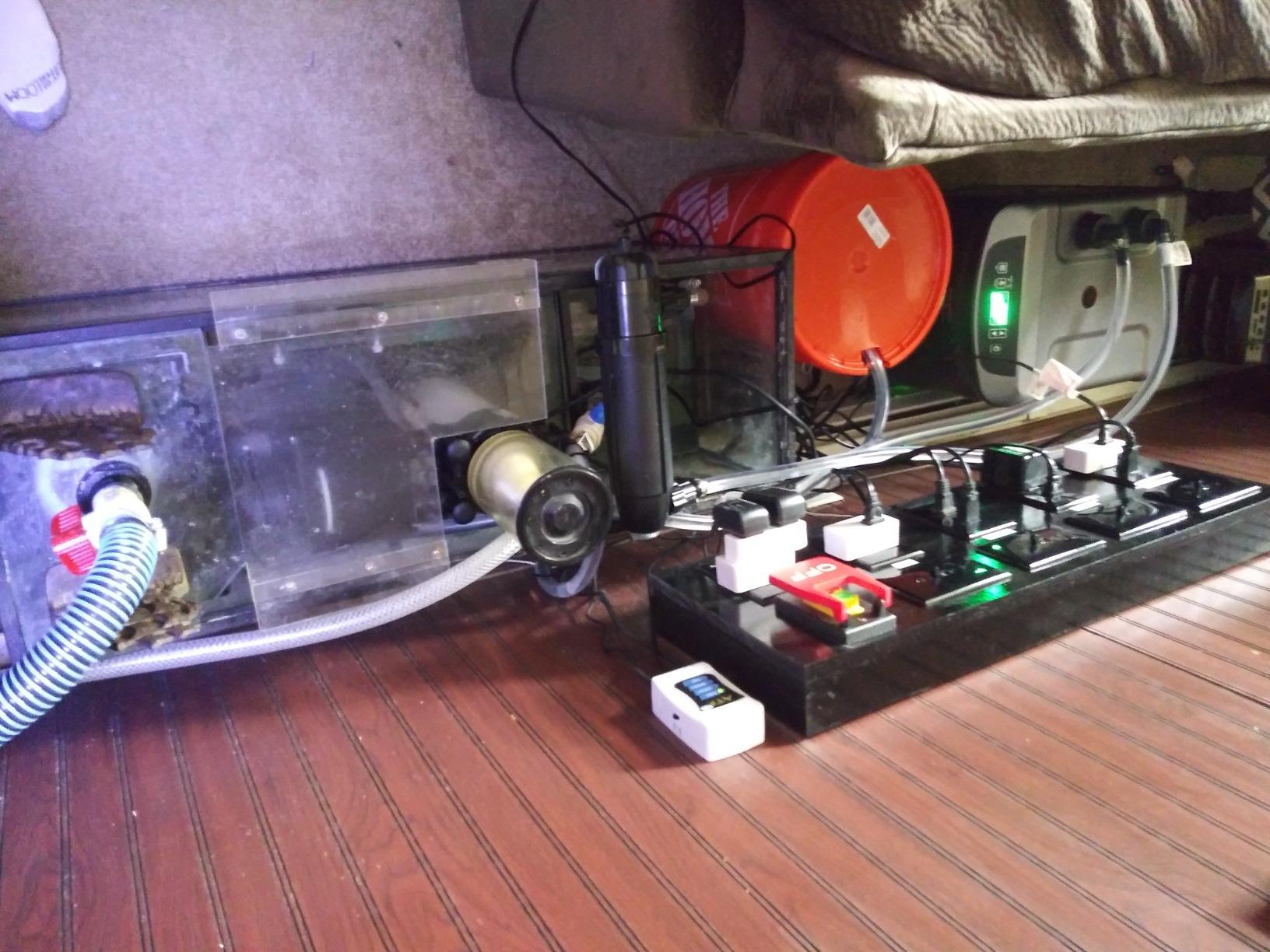
On power, do not put the chiller on the same circuit as the rest of the tank. A compressor starting up draws a real surge, and sharing a circuit with heaters and pumps is how you trip a breaker in the middle of a heatwave. A dedicated circuit with a heavy-duty power strip is the cheapest risk reduction in this whole guide.
Flow rate matters as much as capacity. Chillers need water moving through the coil, and several chillers in this roundup ship with a weak bundled pump that owners replace. Inline with the return pump, run on a dedicated feed pump, or use a sump manifold, and check the flow with the bucket method: run the pump for fifteen seconds into a five gallon bucket and count the fills.
Do not forget your heater. A chiller handles summer; a heater handles a cold snap and a power cut. Pair both with a single controller set with a proper hysteresis band, or the two devices will fight each other all season.
When a Fan Is Enough and a Chiller Is Overkill
Before you spend, be honest about the room. If your aquarium room stays under 76F with the house air conditioning running, a fan across the tank top plus reducing LED output and improving surface agitation can hold a mixed reef in a safe range for nothing. That is the budget-conscious path, and it works for plenty of softie and LPS systems.
A chiller earns its cost when the room cannot be held down, when you run SPS that need a steady 77 to 78F, or when your tank sits in a space with no air conditioning at all. If your house AC already holds the room at 75F, the same tank may only need a trim cooler like the IceProbe, and saving the difference funds a proper temperature controller instead.
Why Reef Chillers Are Expensive
The short answer is titanium and the compressor. A titanium evaporator has to be welded, pressure tested and corrosion-proofed, and a small high-quality compressor with an efficient condenser is a precision part rather than a commodity. A name-brand titanium chiller also carries a service network, which is worth something when a board fails in your second summer.
The more affordable chiller designs use the same vapor-compression principle with cheaper heat exchangers and less refined controllers, and for many tanks that is a perfectly rational trade. What you give up is usually the controller, the included pump and the long-term reliability record, not the cooling itself.
Troubleshooting a Chiller That Stops Cooling
When a reef tank starts climbing and the chiller will not respond, work through these causes in order. First, confirm the unit actually has airflow around its vents and that the condenser fins are not furred with dust, which is the most common cause of a gradual loss of performance across a season.
Second, check flow. A failed or swapped pump, a kinked hose or a closed barb fitting can cut circulation enough that the coil never sheds heat, and several chillers in this roundup have weak bundled pumps as the first thing to replace. Third, verify the thermostat reading against a real thermometer and recalibrate, since a controller reading a few degrees high will convince you the tank is cooler than it is.
Fourth, look at the ambient room temperature. A chiller cannot cool a tank much below the air around it, so in a hot unconditioned room the setpoint may simply be unreachable. Fifth, check the power supply and connections, since a loose plug or a failed power switch is a reported failure mode on more than one chiller here. Finally, if the compressor runs and blows warm air but the water never moves, the refrigerant circuit is likely the problem, and that is a service or replacement item rather than a settings fix.
A healthy runtime is 15 to 20 minutes per hour. If your chiller runs near-continuously, it is undersized, air-starved, or fouled, and all three are cheaper to fix than to accept.
Frequently Asked Questions
Is 82 degrees too hot for a reef tank?
Yes. Corals begin losing their symbiotic algae and bleaching when water stays above roughly 82F, and hot water holds less dissolved oxygen, so fish stress often shows up first. Sustained excursions into the 84 to 86F range are where losses become common, which is why most reef keepers target 77 to 78F for SPS and 78 to 80F for mixed systems.
What size chiller do I need for my aquarium?
Add display and sump volume plus about 10 percent for rock and sand displacement, then multiply total volume by 8.3 and by the number of degrees of drop you need. A 150 gallon system in an 80F room that you want at 78F needs about 2490 BTU per hour. Then round up one size so the compressor is not running permanently during a heatwave.
What is the best aquarium chiller?
For most reef keepers the answer is a titanium inline compressor chiller sized to your total system volume, with a titanium evaporator and an external temperature controller. The BAOSHISHAN 1/3 HP is our pick for mixed reefs up to about 63 gallons in peak summer, the Fitnet 79 gallon model for the strongest controller and ratings, and the JBJ Arctica when silence in a living space matters most.
Is 72 degrees too cold for a reef tank?
For most reef systems, yes, sustained 72F is below the safe range. Tropical corals and reef fish do poorly below roughly 75F, and colder water slows metabolism, feeding response and immune function. Colder-water marine species are the exception, and for those a dedicated chiller is what makes keeping them at 60F or below practical.
Do I still need a heater if I have a chiller?
Yes, keep one. Chillers handle summer peaks and a heater covers a cold snap, a power cut or a failed controller, and during a heatwave the heater is what stops the tank dropping too far if the chiller over-corrects. Run both from a single controller with a proper hysteresis band so the two devices do not fight each other.
Why is my reef tank chiller not cooling?
Work through airflow around the vents, dusty condenser fins, flow rate through the coil, thermostat calibration against a real thermometer, and the ambient room temperature. A chiller cannot pull a tank far below the surrounding air, so a hot unconditioned room will defeat a correctly sized unit. Healthy runtime is 15 to 20 minutes per hour, and longer than that points to undersizing or fouling.
Our Final Recommendation
The best aquarium chillers for reef tanks share three traits: a titanium evaporator, enough BTU per hour for your total system volume in a hot room, and a controller you can calibrate against a real thermometer. Get those three right and the brand matters far less than the sizing.
Our pick for most keepers is the BAOSHISHAN 1/3 HP, which pairs a claimed 8 to 15F drop with a pure titanium evaporator, a complete install kit and setpoint memory, backed by the largest review base in this roundup. If you want the most controllable unit, choose the Fitnet with its touch screen and calibration offset. If you need proven titanium hardware and already own a matched pump, the Active Aqua 0.25 HP is the long-ownership answer, and if silence in a bedroom or office is your constraint, the JBJ Arctica is the quietest compressor unit here.
Measure your total volume, work out your degrees of drop, and buy one size up. Then give the chiller airflow, a dedicated circuit and a pump you trust, and clean the condenser fins every few months.