
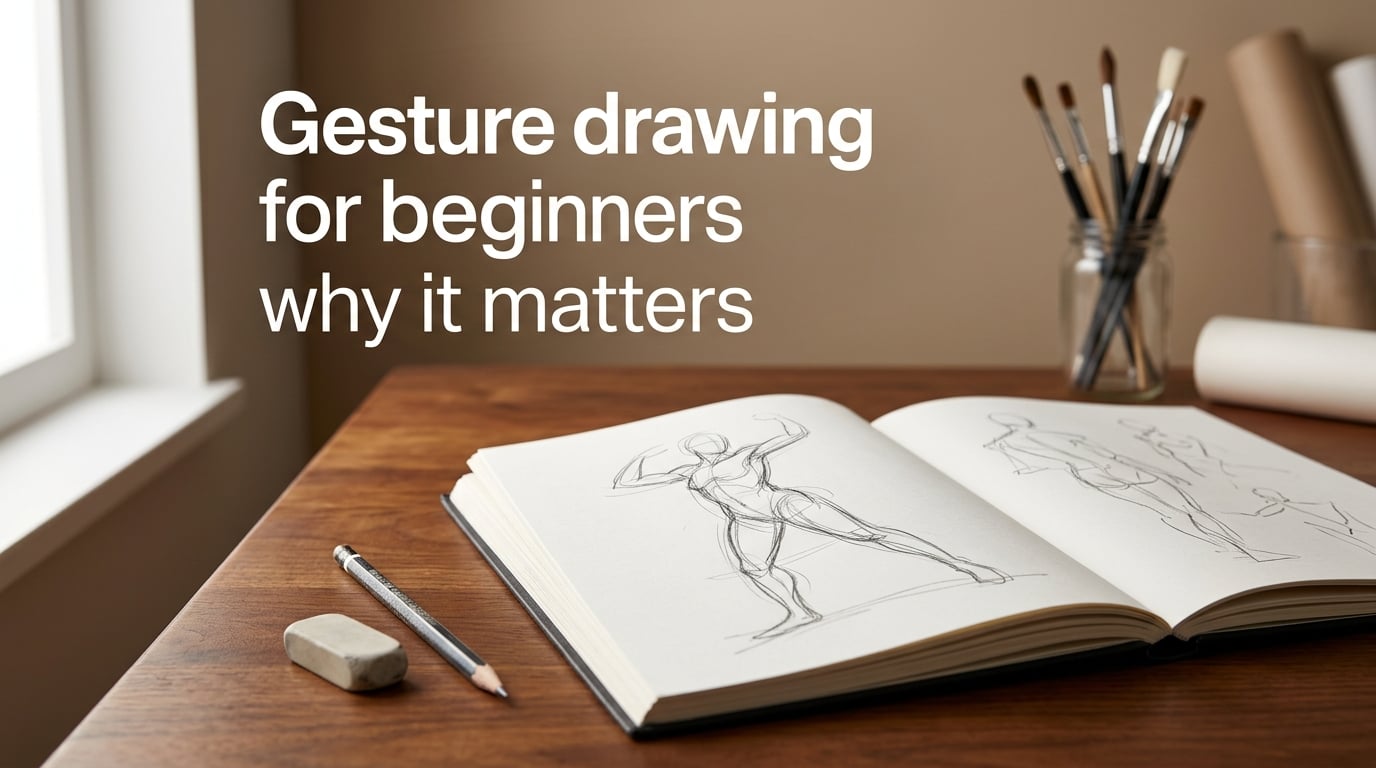
Gesture drawing is a quick sketching technique where artists capture the movement, pose, and energy of a subject in short timed sessions of 30 seconds to 5 minutes, focusing on flowing lines rather than details. For beginners, gesture drawing matters because it trains your eye to see the essential structure and rhythm of the human form before you ever pick up a detail brush. In this guide, I’ll walk you through what gesture drawing is, why it matters, the principles behind it, and exactly how to start practicing this week.
I picked up gesture drawing about a decade ago when I was struggling with figure work, and it single-handedly fixed my stiff poses. If you’re a beginner feeling overwhelmed by anatomy, this is the technique that will build your confidence fastest.
Table of Contents
What Is Gesture Drawing and Why It Matters for Beginners
Gesture drawing is a foundational exercise where an artist rapidly sketches the essence of a pose using loose, flowing lines. Poses are timed, usually between 30 seconds and 5 minutes, and the goal is to capture movement, weight, and balance rather than accurate anatomy or shading.
At its core, gesture drawing trains three skills at once: seeing, deciding, and moving your hand with confidence. When you only have two minutes, you cannot fuss over a perfect ear or the exact shape of a kneecap. You learn to see the big shapes first: where the weight sits, how the spine curves, which leg holds the load.
For beginners, this matters because most figure drawing tutorials assume you can already see these big shapes. Gesture drawing is the warm-up that builds that seeing ability. Without it, you tend to draw symbols (a head circle, a stick spine) instead of the actual person in front of you.
It is also the cheapest art exercise you can do. All you need is a pencil, a scrap of paper, and a timer. No expensive class, no fancy reference photos required.
Why Gesture Drawing Matters for Beginners
Beginners who skip gesture drawing often end up with stiff, posed-looking figures that look “drawn from a formula” instead of from life. The reason gesture drawing matters is that it reverses the order most beginners approach drawing. Instead of starting with details and hoping the proportions work out, you start with movement and let details emerge later.
Here is what changed for me when I committed to daily gesture drawing: after about three weeks, my longer figure studies started looking less wooden. The poses had a sense of weight. Arms and legs connected to a believable torso. I stopped drawing a person standing on a stiff stick and started drawing a person standing on one leg with the other relaxed.
Beyond personal results, gesture drawing is what most professional figure drawing courses, animation studios, and life drawing rooms start with. When you walk into a life drawing session, the instructor almost always opens with 10 to 20 minutes of gesture warm-ups before any long pose work. This isn’t a coincidence; it is industry-standard practice.
So when beginners ask whether gesture drawing is “good for beginners” or whether it is something to “graduate to later,” the honest answer is that it is the entry point, not the advanced level. Treat it as foundation work, like scales for a musician.
7 Core Benefits of Gesture Drawing for Beginners
Here are the seven benefits I see most clearly from teaching beginners over the past few years. Each one shows up in your work within a few weeks of consistent practice.
1. Trains your eye to see big shapes first. Beginners usually lock onto details (eyes, fingers, a nose). Gesture drawing forces your eye to zoom out and notice the whole shape: the curve from shoulder to opposite hip, the tilt of the head, the bend of the knees.
2. Builds confident mark-making. When you only have 60 seconds, you cannot erase or redo. Your hand learns to commit to a line. This carry-over into all your other art.
3. Develops hand-eye coordination. Your eye sees movement; your hand has to translate it to paper quickly. The repetition wires those two together faster than any other exercise.
4. Warms you up before longer work. Many artists use gesture drawing as a 10-minute warm-up before starting a serious piece. It loosens your wrist and clears your mental clutter.
5. Builds understanding of weight and balance. A figure leaning on one leg looks different from one standing square. Gesture drawing teaches you to feel the weight shift and put it on the page.
6. Reduces perfectionism. Because the timer forces speed, you learn that not every line has to be perfect. This breaks the beginner habit of erasing the same line 15 times.
7. Makes anatomy study easier later. When you later learn the ribcage, pelvis, and spine, you already know where they “live” in a pose. Anatomy clicks faster because gesture drawing gave you the map.
The Basic Principles of Gesture Drawing
Before you start, lock in these five principles. They are the difference between a gesture drawing and a tiny messy sketch of a person.
1. Capture the line of action first. The line of action is the single curve that runs through the whole figure, from the top of the head down through the spine and into the supporting foot. It is not anatomy; it is the energy of the pose. Draw this curve first, lightly and loosely.
2. Move from large to small. Always start with the biggest shapes (torso, pelvis, ribcage) and work down to smaller shapes (limbs, hands, head). Never begin with a finger or a face.
3. Use flowing, connected lines. Your strokes should feel like a single ribbon tracing through the figure, not separate stick segments. Let one line become the next.
4. Focus on weight, balance, and rhythm. Ask: where is the weight? Which leg or arm is doing the work? Where does the body tilt? These three questions give your gesture drawing life.
5. Skip details entirely. No faces, no fingers, no shading, no clothing folds. If you catch yourself drawing a fingernail, the timer is too long or you are thinking too small.
How to Start Gesture Drawing: Step-by-Step for Beginners
Here is the exact sequence I give beginners on day one. Follow it and you will have a usable gesture drawing within ten minutes.
Step 1: Set a timer for 1 minute. Use your phone or a kitchen timer. For your very first session, 1-minute poses are perfect. Speed is more important than perfection at this stage.
Step 2: Find a reference. Open a free online pose reference site, use a figure drawing app, or draw a family member standing in front of you. Photo references work for practice; life drawing works better but is harder to arrange at home.
Step 3: Look at the whole figure for 5 seconds before drawing. Identify the line of action. Where does the weight sit? Which way is the figure leaning? Do this before your pencil touches paper.
Step 4: Draw the line of action. With a loose, curved stroke, capture the main energy line from head through the supporting foot. Keep it light and confident.
Step 5: Add the three big masses. Sketch the ribcage, pelvis, and head as simple shapes (ovals or rounded boxes). Connect them with the spine line.
Step 6: Block in the limbs with single strokes. Draw each arm and leg as one flowing line, not a tube. Let joints bend where they bend in the pose.
Step 7: Stop when the timer goes off. Resist the urge to “fix” anything. Move to the next pose. Improvement comes from doing many, not from perfecting one.
Common Beginner Mistakes and How to Fix Them
Almost every beginner I have taught runs into the same handful of stumbling blocks. Here is how to recognize and fix them fast.
Mistake 1: Drawing a stick figure underneath. Many beginners unconsciously draw a vertical line and add limbs to it. Fix: tilt the line of action off vertical for almost every pose. People rarely stand straight as a plank.
Mistake 2: Erasing constantly. Erasing kills your flow. Fix: drop your eraser for the entire session. You will draw more boldly and learn faster from your “mistakes.”
Mistake 3: Obsessing over a single pose. One perfect 30-minute pose teaches less than 20 quick ones. Fix: trust the timer. If a pose feels wrong, let it go.
Mistake 4: Starting with the head. Heads are detail traps. Fix: cover the head with your thumb while looking at the reference for the first 10 seconds. This forces you to see the body first.
Mistake 5: Drawing symbols instead of the actual pose. The same triangle for a torso, the same circle for a head. Fix: ask “is this what I see, or what I expect to see?” then redraw based on the real reference.
Mistake 6: Going too long too soon. Beginners often start with 5- or 10-minute “gesture” drawings. That’s figure drawing, not gesture. Fix: stay at 1 to 2 minutes until you trust your eye to see big shapes.
Your First Two Weeks: A Gesture Drawing Practice Routine
One gap I see in most gesture drawing guides is a specific schedule. So here is a simple two-week starter routine you can follow exactly. Each session is short so it fits into a busy day.
Week 1: Build the habit.
Days 1 to 3: One 10-minute session daily. 10 poses at 1 minute each. Use photo references.
Days 4 to 5: One 15-minute session. 15 poses at 1 minute each.
Days 6 to 7: One 20-minute session. 10 poses at 2 minutes each.
Week 2: Add variety and challenge.
Days 8 to 10: 15 poses at 1 minute plus 5 poses at 2 minutes. Mix standing and seated figures.
Days 11 to 12: 10 poses at 30 seconds, then 10 poses at 2 minutes. Notice how 30-second poses sharpen your eye further.
Days 13 to 14: Pick the best 5 drawings from the past two weeks and do a longer 10-minute study of each. Compare them to week 1 to see your progress.
What you need. A sketchbook you don’t mind messing up, a soft pencil (2B or 4B), and a timer. No eraser for the first week on purpose.
After two weeks you will have completed roughly 130 to 150 gesture drawings. That is enough repetition for your hand and eye to start coordinating without you thinking about it. Improvement is genuinely noticeable around the 30-day mark for most beginners.
Frequently Asked Questions
Why is gesture drawing so important?
Gesture drawing is important because it trains your eye to see the big shapes, weight, and movement of a figure before any details. It builds hand-eye coordination, prevents stiff poses, and is the foundation almost every life drawing class and animation studio starts with. For beginners, it is the fastest way to develop confident mark-making.
What are the basic principles of gesture drawing?
The basic principles of gesture drawing are: capture the line of action first, work from large shapes to small shapes, use flowing connected strokes, focus on weight and balance, and skip all detail like faces and fingers. These principles turn a quick sketch into a true gesture drawing.
What are the steps for beginners to learn gesture drawing?
The steps for beginners to learn gesture drawing are: set a 1-minute timer, find a pose reference, study the whole figure for 5 seconds, draw the line of action first, block in the ribcage, pelvis, and head, sketch each limb with one flowing stroke, then stop when the timer ends. Repeat with many poses rather than perfecting one.
How long should a beginner gesture drawing take?
Beginner gesture drawings should take 30 seconds to 2 minutes each. Start with 1-minute poses for the first week. Short timed sessions force you to see big shapes and build confident mark-making. Longer poses belong to figure drawing, not gesture drawing.
Is gesture drawing good for beginners?
Yes, gesture drawing is the best exercise for beginners. It is the entry point taught in art schools and life drawing rooms, not an advanced technique. Beginners who practice gesture drawing for 10 to 20 minutes a day typically see noticeable improvement in their figure work within a month.
How often should I practice gesture drawing?
Aim to practice gesture drawing daily for 10 to 20 minutes. Consistency matters more than session length. A daily 10-minute session of 10 one-minute poses builds skill faster than one 2-hour session per week. Most beginners see meaningful improvement after about 30 days of daily practice.
Start Your Gesture Drawing Practice Today
Gesture drawing for beginners is the single fastest way to improve your figure work because it trains the eye, the hand, and the mind at the same time. It strips away the perfectionism that holds beginners back and replaces it with momentum and confidence.
If you take one thing from this guide, let it be this: set a 1-minute timer, find any reference photo, and draw the line of action. Do that ten times today. Then do it again tomorrow. Within a month, your figures will look less stiff, more alive, and more like real people.
The hardest part is not the technique. The hardest part is letting go of the need for each drawing to be good. Gesture drawing rewards volume, not perfection. Trust the timer, trust the process, and let your eye catch up to your ambition.
Your next step is simple: open a fresh page, set a timer, and start. You have everything you need.