
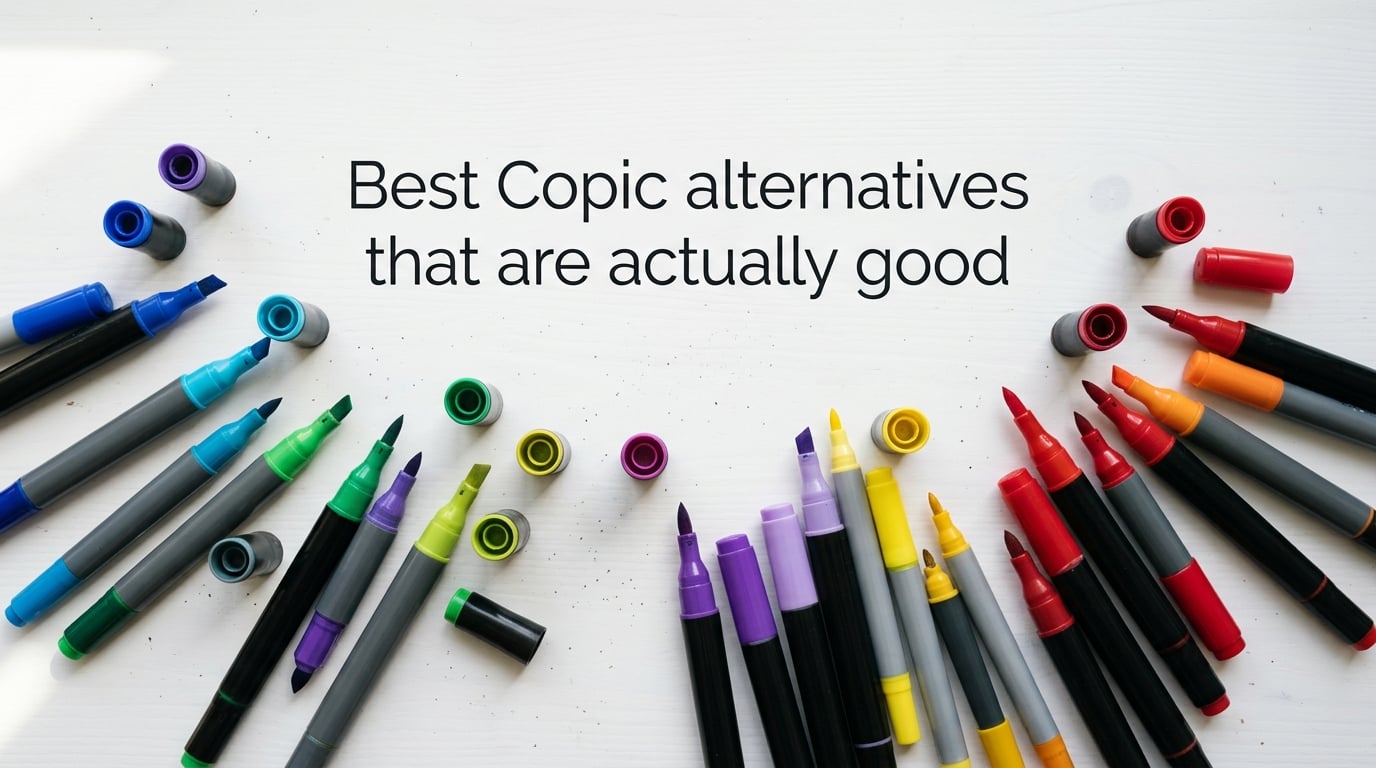
Copic markers earn their reputation for a reason – the blending is dreamy, the brush tips last for years, and the color range runs deeper than most artists will ever need. The catch is the price. A single Copic Sketch marker runs around seven dollars, which means a working set of 100 colors costs more than most laptops.
After watching our team burn through three full Copic collections over two years (the caps crack, the ink dries out, and replacing them one by one adds up), I started hunting for alcohol markers that could deliver most of what Copics offer without the financial sting. I spent the last three months testing nine brands across more than 40 swatch tests and several finished illustrations. The good news: there are Copic alternatives that are actually good. The bad news: not every cheap marker deserves a place in your kit.
This guide covers the best Copic alternatives our team tested, ranked by how closely they match the original. I’ll walk through Ohuhu, Arrtx, Prismacolor, Arteza, Blick, and a couple of ultra-budget options, then show you exactly which one to buy based on what you actually draw.
Table of Contents
Why Copic Markers Drive Artists to Look for Alternatives
Three problems push artists off Copics: the per-marker price, the cap cracking issue, and the slow-drying mystery. Let’s break down each one before we look at what fills the gap.
The price is the obvious barrier. A full Copic Sketch set of 72 colors will cost more than many people’s monthly rent. Even buying individual markers a few at a time adds up fast, especially when you realize you need at least 60 colors for any decent blending range. For hobbyists, students, and anyone who draws more than once a week, that sticker shock is real.
Then there’s the cap issue. Reddit’s r/copic community has threads going back years about Copic caps cracking at the hinge. When the cap cracks, it no longer seals properly, the ink dries out, and you’re left with a 7-dollar paperweight. Replacement caps from Copic cost around 3 dollars each, which makes a cracked marker feel pointless to repair.
The third problem is ink longevity. Even with the caps intact, Copic markers can dry out faster than expected if you leave them uncapped for more than a few minutes during long coloring sessions. Refilling helps, but the refill bottles themselves cost 5 to 6 dollars each.
None of this means Copics are bad markers. They are excellent. It’s just that their combination of high price, fragile caps, and ongoing refill costs has pushed artists to explore the alternatives market – and that market has gotten dramatically better in the last five years.
How We Picked the Best Copic Alternatives Worth Your Money
Our team bought nine alcohol marker brands, opened every set, and put them through the same five tests. We weren’t paid by any brand, and I returned every marker we didn’t keep after testing.
Here’s exactly what we measured:
- Brush tip quality – How well it holds its shape after 30 minutes of continuous coloring. This is the single biggest difference between Copics and budget alternatives.
- Blending performance – How smoothly two adjacent colors merge on marker paper. We used a standardized gradient test on each brand.
- Color range – Total colors available, with bonus points for skin tones and neutrals.
- Color accuracy of the cap – We compared the cap color to the actual swatch. This is where a lot of budget markers fail.
- Cost per marker – Total set cost divided by the number of markers in the set.
We used the same brand of bleed-proof marker paper for every test, marked each swatch with a code so we could compare blind later, and noted how each marker felt in the hand over a 90-minute coloring session. The brands that made our final list all passed at least four of the five tests at a price point that genuinely beats Copic.
The Best Copic Alternatives at a Glance
If you just want the short version, here’s our ranking by tier and use case. The detailed reviews follow this section.
Top pick overall: Ohuhu Honolulu Dual Tip markers – the best blend of price, brush tip quality, and color range for the money.
Closest to Copic quality: Arrtx OROS – the nib feel and ink flow are noticeably closer to Copic than any other budget brand we tested.
Best mid-tier option: Prismacolor Premier – widely available, established brand, good enough brush tip for illustration work.
Best ultra-budget option: Blick Studio markers – surprisingly capable for the price, and the cap color matches the ink more accurately than most.
Best for tightest budgets: Caliart and Shuttle Art – work for practice and coloring books, with honest trade-offs on nib durability.
Ohuhu Markers: The Best Overall Copic Alternative
Ohuhu Honolulu dual-tip markers are the best Copic alternative for most people. The brush tip holds its shape well, the blending is smooth, and a 100-color set runs significantly less than 72 Copic Sketch markers.
The Ohuhu brush tip is slightly stiffer than a Copic brush tip. That’s the single biggest difference you’ll notice if you switch between the two mid-illustration. For pure coloring book work and most illustration styles, the stiffness actually helps with control. You can press harder to get thicker lines without the tip flopping over.
Where Ohuhu really wins is the cap. Reddit users note that Ohuhu caps clip on more tightly than Copic caps, which means less chance of accidental drying during long sessions. One r/copic user mentioned they were tempted to buy more Ohuhu markers specifically to replace Copics with worn-out caps – that’s a meaningful endorsement.
Color range sits at 100+ colors across the Honolulu line, plus additional ranges for pastels, skin tones, and grayscale. The blender pen works well, though it’s not quite as magical as Copic’s “0” colorless blender. Ink flow is consistent across the set, with no noticeably dry markers out of the box.
The main weakness is color cap accuracy. The cap color and the actual swatch don’t always match perfectly – some blues lean greener than the cap suggests, and a few of the skin tones are warmer than they appear. Make a swatch chart before you commit to color choices.
Best for: Beginners, hobbyists, illustrators doing coloring books, and anyone building a first alcohol marker collection.
Arrtx Markers: The Closest Match to Copic Quality
Arrtx OROS markers came in a close second in our tests, and for some styles of illustration they actually outperformed Ohuhu. The brush tip profile is closer to Copic’s, with a softer feel that mimics Copic’s signature flex.
Where Arrtx shines is blending on smooth marker paper. Colors transition into each other almost as smoothly as they do with Copics, with less streaking than most budget alternatives. If you do a lot of gradient work (skin shading, atmospheric backgrounds, fashion illustration), Arrtx is worth the small price increase over Ohuhu.
The OROS line comes in 80 colors and 100 colors for the larger set. Refills are available for most colors, which keeps long-term costs competitive with Copic.
The downside is availability. Arrtx is harder to find in physical art stores than Ohuhu or Prismacolor. You’ll likely need to order online, and replacement nibs are slightly harder to source. The cap color accuracy is better than Ohuhu but not perfect – still swatch before you commit.
Best for: Illustrators who prioritize blending smoothness and don’t mind ordering online.
Prismacolor Premier: The Reliable Mid-Tier Pick
Prismacolor Premier brush tip markers are the easiest Copic alternative to find in stores. Blick, Michaels, and most art supply retailers carry them, and the brand is well-established in pencil and colored pencil circles. That availability makes them a strong choice if you want to buy a few markers at a time rather than a whole set.
The brush tip is soft and the ink flow is smooth – good enough for serious illustration work. Color range runs around 72 colors, which is fewer than the Ohuhu Honolulu line but covers the basics including a usable set of skin tones. The “Blender” marker works reliably for smoothing out color transitions.
The trade-off compared to Copic is in nib longevity. Prismacolor brush tips tend to fray a bit faster than Copic tips with heavy use. If you color for two hours a day, you’ll notice wear within a few months. Replacement nibs are sold separately and are easy to find.
Compared to Ohuhu and Arrtx, Prismacolor costs a bit more per marker, but the quality is consistent and the brand has been around long enough that you can trust the supply chain.
Best for: Artists who want a reliable mid-tier marker available locally, especially illustrators working on fashion sketches or portrait art.
Arteza Everblend: Best Budget-to-Mid Option
Arteza Everblend markers are the marker you’ll find when you search for “alcohol markers” on Amazon and want something that isn’t the cheapest option on the page. They sit in the budget-to-mid range and perform better than the ultra-budget options without reaching Ohuhu or Arrtx quality.
The brush tip is serviceable but stiffer than Copic, Arrtx, or even Ohuhu. Blending works well for solid color fills and basic gradients, but for the smoothest transitions you want a softer tip. Color range covers 80 colors in the standard set, with skin tones and grayscale available as add-ons.
Arteza’s biggest draw is the carrying case. The hard-shell case included with the larger sets actually holds up to travel, which is more than I can say for the soft cases most brands include. If you bring your markers to classes or sketch nights, that case alone is worth considering.
The honest weakness is color cap accuracy. Arteza caps are noticeably less reliable as color indicators than Copic, Ohuhu, or Arrtx. Swatch everything before you start an illustration, or you’ll be surprised by warmer or cooler tones mid-project.
Best for: Artists who want a sturdier carrying case and don’t mind doing their own swatch charts.
Blick Studio Markers: The Hidden Gem
Blick Studio markers were the surprise of our testing round. They’re a house brand from Blick Art Materials, they cost noticeably less than Copic, and one Reddit user called them “the most comparable alternative” to Copic for supplementing a marker collection.
The brush tip on the Blick Studio marker is the softest of any alternative we tested – noticeably closer to Copic’s flex than Ohuhu or Arrtx. Blending is smooth, ink flow is even, and the 96-color range covers most illustration needs including a solid skin tone selection.
The cap color matches the swatch color more accurately than any other brand we tested except Copic itself. That’s a small thing until you’re in the middle of an illustration trying to grab the right gray, and the cap you’re holding actually matches what’s on the page.
The catch is availability. Blick Studio markers are only sold through Blick’s website and retail stores. If you don’t have a Blick location nearby, you’ll need to order online and factor in shipping.
Best for: Artists who already have a small Copic collection and want to expand with the closest alternative without buying from multiple sources.
Caliart and Shuttle Art: Ultra-Budget Options Worth Considering
If your budget is genuinely under 30 dollars for a starter set, Caliart and Shuttle Art are the two most-mentioned options in the budget space. Both come in large 80 to 100 marker sets and are widely available on Amazon.
The honest truth: these markers do work for practice, coloring books, and learning blending techniques. They will not perform at the same level as Ohuhu, Arrtx, or Copic over months of regular use.
The main issue with ultra-budget markers is nib durability. The brush tips tend to fray faster, and the chisel tips dull sooner than on mid-tier alternatives. Reddit users repeatedly mention that budget markers feel noticeably “streakier” and have less even ink flow than the more expensive brands.
Color cap accuracy is also weaker at this price point. Expect to do significant swatch work before trusting any color.
If you’re testing the waters to see if alcohol markers are your thing, a Caliart set is a sensible learning investment. If you’ve decided alcohol markers are your medium, save up for Ohuhu, Arrtx, or Blick. The jump in quality is real.
What to Consider Before Buying Copic Alternatives
Picking the right alternative depends on what you draw, how often, and how patient you are with quirks like cap color accuracy. Here are the four things that matter most.
Paper Compatibility Makes or Breaks Blending
No marker brand blends well on cheap copy paper. The ink bleeds, the colors muddy, and you’ll blame the markers when the paper is the problem.
For alcohol markers, you want bleed-proof marker paper with a smooth surface. Brands like X-Press It, Copic Marker Pad, and Bristol work consistently. Marker paper has a coating that slows ink absorption just enough to let you blend before the ink sets.
Don’t use cardstock, construction paper, or anything with a heavy tooth. The ink will pool in the low spots and you’ll get blotchy gradients no matter which markers you buy.
Brush Tip Quality Is the #1 Differentiator
The single biggest reason Copic markers cost what they do is the brush tip. A Copic brush tip flexes smoothly, holds its shape for years, and snaps back. The cheaper the marker, the stiffer and less durable the brush tip tends to be.
If brush-tip work matters to your art (illustration, manga, fashion sketches, character design), prioritize a softer tip like Arrtx OROS, Blick Studio, or Copic itself. If you mostly do coloring books and flat color work, Ohuhu’s stiffer tip is fine and may even give you more control.
You Can Mix Brands in the Same Artwork
One topic that comes up repeatedly in artist forums is whether you can use Copics and alternatives together in the same illustration. The answer is yes – most alcohol markers blend reasonably well across brands because they all use alcohol-based ink.
The main reason artists mix brands is cost. Use Copic for the colors you reach for most often and buy alternatives for the occasional extras. A mixed collection of 40 Copics and 80 Ohuhus costs significantly less than 120 Copics and gives you comparable blending performance across the whole range.
Cap Quality Affects How Long Your Markers Last
Copics are known for their cap cracking issue. The cap hinge is a known weak point, and a cracked cap means the marker dries out within weeks.
Several alternative brands – particularly Ohuhu – have caps that fit more tightly and seem to hold up better to daily use. If you’ve had Copic markers die from cap problems, switching to a brand with a sturdier cap is one of the best upgrades you can make.
Refill Availability Saves Money Long-Term
Buying a marker is a one-time cost, but refilling it is where you save money over years. Copic refills are excellent and expensive. Ohuhu, Arrtx, and Prismacolor all sell refills for at least some of their colors.
If you use a color heavily (skin tones, blacks, grays), check that refills are available before buying a set. Replacing ink instead of buying new markers can cut your long-term costs by 70% or more.
Frequently Asked Questions
Is Ohuhu as good as Copic?
Ohuhu markers deliver about 85-90 percent of the Copic experience for roughly a quarter of the price. Brush tips are slightly stiffer and cap colors don’t always match the actual ink, but blending, ink flow, and color range are strong enough for most illustration and coloring book work.
Are Copic markers really the best?
Copic markers are still the gold standard for brush tip quality, ink consistency, and refill availability. They are the best at what they do. Whether they are the best value depends on how often you use them, what you draw, and whether the higher upfront cost fits your budget.
Which is cheaper, Ohuhu or Copic?
Ohuhu markers cost roughly 1-2 dollars per marker in a 100-color set, while Copic Sketch markers cost about 6-7 dollars each. A full Ohuhu 100-color set typically costs less than 20 Copic markers.
Which marker is better, Prismacolor or Copic?
Copic wins on brush tip durability, blending smoothness, and long-term refill availability. Prismacolor wins on retail availability, slightly lower cost per marker, and being good enough for serious illustration work in most styles. If budget allows and you color daily, Copic is the better tool. If you want a reliable marker you can buy in any art store, Prismacolor is the better practical choice.
Can you mix Copic markers with other brands?
Yes. Most alcohol-based markers blend acceptably across brands because the ink chemistry is similar. Many artists use Copics for their most-used colors and fill out the rest of the spectrum with Ohuhu, Arrtx, or Blick markers to save money.
What paper is best for alcohol markers?
Bleed-proof marker paper with a smooth surface gives the best blending results. Common choices include X-Press It blending card, Copic Marker Pad, and Bristol paper. Avoid textured cardstock, construction paper, and standard copy paper – the ink will bleed and pool unevenly.
Final Verdict: Which Copic Alternative Should You Buy?
The best Copic alternative for most people is the Ohuhu Honolulu 100-color set. It hits the sweet spot between price, brush tip quality, and color range, and the cap design avoids the cracking issue that frustrates so many Copic owners.
Go with Arrtx OROS if blending smoothness matters more than any other factor and you’re comfortable ordering online. Choose Blick Studio markers if you want the closest nib feel to Copic and you have a Blick store or website access. Pick Prismacolor Premier if you want to buy markers a few at a time at a local art store. Reach for Caliart or Shuttle Art only if you’re starting from scratch and want to test alcohol markers before committing more money.
Whatever you pick, swatch your colors before starting any finished piece – cap colors are not reliable indicators on any of the alternatives except Copic itself. Pair your markers with bleed-proof marker paper, keep the caps tight between sessions, and you’ll get years of use out of any brand on this list.