
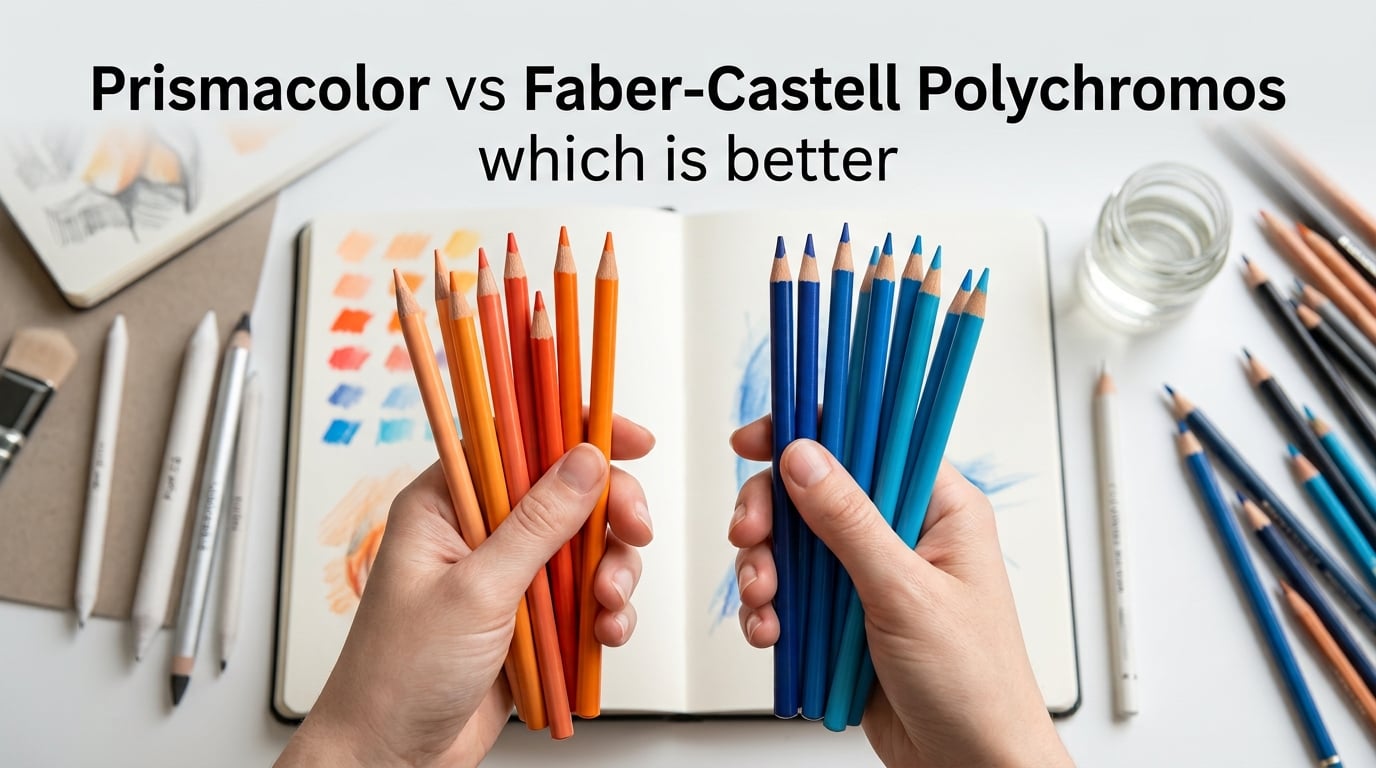
Prismacolor Premier and Faber-Castell Polychromos are the two most debated artist-grade colored pencils on the market. If you’re trying to decide between them, here’s the short answer: Polychromos win on durability, lightfastness, and precision work — while Prismacolor wins on softness, vibrancy, and buttery layering. The better pencil depends entirely on what you draw, how you work, and whether your finished pieces need to last decades.
I’ve used both brands extensively over the years, and I’ve tested them side by side on everything from portrait commissions to casual coloring books. This guide breaks down every difference that actually matters so you can pick the right set for your style.
Table of Contents
Prismacolor vs Faber-Castell Polychromos: Quick Overview
Before diving into the details, here’s a snapshot of how these two brands compare on the specs that matter most:
| Feature | Prismacolor Premier | Faber-Castell Polychromos |
|---|---|---|
| Binder Type | Wax-based | Oil-based |
| Color Range | 150 colors | 120 colors |
| Core Softness | Very soft (3.5mm core) | Medium-hard (3.8mm core) |
| Lightfastness | Variable (ASTM II-III) | Excellent (ASTM I-II) |
| Build Quality | Cedar wood, standard bonding | Cedar wood, SV bonding |
| Country of Origin | Mexico (previously USA) | Germany |
| Best For | Vibrant illustrations, coloring, beginners | Portraits, fine art commissions, archival work |
| Open Stock | Yes | Yes |
Wax-Based vs Oil-Based: The Core Difference
The single biggest difference between Prismacolor and Polychromos is the binder that holds the pigment together. Prismacolor uses a wax binder, which makes the core soft and creamy. Polychromos uses an oil binder, which produces a harder, more resistant core.
What does this mean in practice? Wax-based pencils like Prismacolor lay down color quickly with minimal pressure. They feel buttery on the paper and blend almost effortlessly. Oil-based pencils like Polychromos require a bit more pressure and patience, but they build up layers that stay put without the wax binder migrating to the surface.
Neither binder is objectively better — it’s about matching the tool to the technique. If you love burnishing and rich, saturated color in fewer passes, wax-based pencils deliver. If you prefer controlled layering that won’t shift or bloom over time, oil-based pencils are the safer bet.
Softness, Texture, and Layering
Prismacolor Premier pencils feel noticeably softer than Polychromos. Many artists describe the Prismacolor experience as “creamy” or “buttery” — the pigment releases easily and covers large areas fast. This softness makes them incredibly satisfying to use, especially for beginners who want instant gratification on the page.
Polychromos, by contrast, feel harder and slightly scratchy at first. Some artists on Reddit’s r/ColoredPencils have described using Prismacolors as feeling like “wax crayons,” while Polychromos feel more controlled and precise. The harder core of Polychromos means they take longer to build up saturation, but the layers stack cleanly without the muddy blending that can happen with soft wax cores.
For layering capacity, Polychromos have a clear edge. You can pile on 10, 12, even 15 layers without the surface becoming waxy or resistant. Prismacolor starts to resist additional layers after about 6-8 passes, especially on smooth papers, because the wax binder fills the paper’s tooth.
Blending and Wax Bloom
Blending is where Prismacolor really shines — until it doesn’t. The wax binder makes blending feel effortless. You can burnish colors together with a colorless blender or even just heavy pressure, and the result is a smooth, painterly gradient. This is why so many coloring book enthusiasts and hobbyists gravitate toward Prismacolor.
However, wax bloom is the trade-off. Over time — sometimes within days — the wax binder migrates to the surface of your artwork, creating a cloudy, whitish film. This is especially visible on dark layers. You can wipe it away with a soft cloth, but it comes back. Artists who sell commissioned work or display their pieces long-term find this unacceptable.
Polychromos don’t suffer from wax bloom because there’s no wax in the binder. Their oil-based formula stays where you put it. Blending requires more effort — you’ll want solvents like Gamsol or a dedicated blending pencil — but the result is cleaner and more permanent. As one forum artist put it: “Polychromos take a battering when it comes to adding layers, whereas the Prismas become speckled with dark spots quite quickly.”
Sharpening, Breakage, and Build Quality
This is the category that drives the most passionate opinions — and the most frustration. Prismacolor pencils have a well-documented breakage problem. The lead frequently snaps inside the sharpener, splinters during use, or arrives pre-cracked in the box. Multiple artists report going through entire sessions with Prismacolor pencils breaking repeatedly.
The breakage issue became more pronounced after Prismacolor moved manufacturing from the United States to Mexico (and partly to China for some components). Forum discussions consistently correlate the quality decline with this shift. Faber-Castell Polychromos use a patented SV bonding process (Secural Bonding) that glues the lead to the cedar casing along its full length. This makes the Polychromos lead dramatically more resistant to breakage, even when dropped.
For point retention, Polychromos hold a sharp tip far longer than Prismacolor. The softer Prismacolor core wears down quickly, meaning more frequent sharpening sessions. If you do a lot of fine detail work — hair strands in portraits, tiny architectural elements — the Polychromos’ staying power is a real advantage.
Lightfastness: Which Pencils Last Longer?
Lightfastness measures how resistant a pigment is to fading when exposed to light over time. For artists who sell original work, create commissions, or display their art, this is non-negotiable.
Faber-Castell Polychromos rate significantly higher on lightfastness scales. Most Polychromos colors carry an ASTM rating of I (excellent) or II (very good), meaning they’ll resist fading for 50+ years under museum conditions. Faber-Castell publishes detailed lightfastness charts for each color, which lets artists plan around any weaker pigments.
Prismacolor Premier lightfastness is more variable. While some colors rate well (ASTM II), many fall into category III (fair) or IV (poor), meaning they can fade noticeably within a few years of light exposure. Prismacolor does not publish comprehensive lightfastness data, which makes it harder for artists to plan archival-safe palettes.
If your work will be displayed, sold, or kept for decades, Polychromos are the safer investment. For casual coloring books or sketchbook work that stays closed, Prismacolor’s lower lightfastness isn’t a practical concern.
Color Range and Vibrancy
Prismacolor offers 150 colors versus Polychromos’ 120 colors. That 30-color gap matters if you need very specific hues — certain skin tones, unusual greens, or pastel shades that Polychromos simply don’t cover.
But raw color count isn’t the whole story. Prismacolor pigments are more saturated out of the box. They look brighter, punchier, and more vibrant on the page. Polychromos colors tend to be more muted and natural-looking — closer to traditional artist’s media like oil paints or soft pastels. Some artists describe Prismacolor as producing “poster-like illustrations” while Polychromos create more subtle, sophisticated tonal work.
Both brands offer open-stock purchasing, so you can buy individual replacement pencils or fill gaps in your set. This is especially useful since both brands’ full sets are significant investments, and you’ll inevitably use some colors far more than others.
Paper Compatibility
Paper choice affects both brands differently. Prismacolor’s soft wax core works best on papers with moderate tooth — enough texture to grab the pigment but smooth enough for blending. Popular picks include Strathmore Bristol, Stonehenge, and Canson Mi-Teintes. On very smooth paper, Prismacolor can feel slippery and resist layering; on very rough paper, the soft core wears down too fast.
Polychromos are more forgiving across paper types. Their harder oil-based core handles both smooth and textured surfaces well. They perform beautifully on Pastelmat, standard mixed-media paper, and even lighter-weight sketchbooks. If you switch between papers frequently, Polychromos give you more consistent results without adjusting your technique.
Who Should Buy Which? A Recommendation Matrix
This is the question everyone actually wants answered, so here’s a straightforward breakdown:
Choose Prismacolor Premier if you are:
- A beginner who wants soft, forgiving pencils that deliver vibrant results without advanced technique
- A coloring book enthusiast who values fast coverage, rich saturation, and effortless blending
- An illustrator working on poster-like designs, greeting cards, or digital-scan artwork where long-term lightfastness isn’t critical
- Someone on a tighter budget — Prismacolor sets typically cost less than comparable Polychromos sets
Choose Faber-Castell Polychromos if you are:
- A portrait artist who needs fine detail, point retention, and realistic skin tones that won’t shift
- A commission artist selling original work that clients will display for years
- An experienced colorist who enjoys building up many layers and wants maximum control
- Someone who values durability — less breakage, less frustration, fewer replacements
Can’t decide? If you’re brand new to colored pencils, start with a small Prismacolor set (24 or 48 colors) to learn techniques without frustration. Once you outgrow them or start selling work, upgrade to Polychromos for the archival quality. Many professional artists keep both sets on hand and reach for whichever suits the specific piece.
Can You Mix Both Brands in One Drawing?
Absolutely — and many professional artists do exactly that. Carrie Lewis and Ioanna Ladopoulou, both experienced colored pencil artists, routinely use Prismacolor and Polychromos together in finished work. The key is understanding how each layer interacts.
A common approach is to use Polychromos for the foundational layers and fine detail work, then add Prismacolor on top for vibrant accents and smooth blending. Because Polychromos are oil-based and Prismacolor are wax-based, they don’t repel each other the way two wax-based layers might. Just be cautious about putting too many wax layers on top — you’ll lose the paper tooth and risk wax bloom.
Frequently Asked Questions
Are Polychromos better than Prismacolor?
Neither brand is universally better. Polychromos excel at durability, lightfastness, and fine detail work, making them ideal for professional artists and commissioned pieces. Prismacolor excels at vibrancy, softness, and ease of blending, making them perfect for beginners and hobbyists.
Do Prismacolor pencils break easily?
Yes, Prismacolor pencils are known for breakage issues, particularly after manufacturing shifted from the USA to Mexico. The soft wax core and standard bonding make them more prone to snapping inside sharpeners and during use compared to Polychromos, which use SV (Secural) bonding.
Which colored pencils do professional artists use?
Professional artists use both brands depending on their style. Portrait artists and fine art illustrators often prefer Polychromos for their lightfastness and precision. Illustrators and coloring enthusiasts frequently choose Prismacolor for their vibrancy and smooth blending. Many professionals keep both sets available.
Are Polychromos worth the higher price?
For artists who sell their work, create commissions, or need archival quality, Polychromos are worth the investment. Their superior lightfastness, breakage resistance, and point retention mean fewer replacements and artwork that lasts decades. For casual hobbyists, Prismacolor offers excellent value at a lower entry cost.
Can I mix Prismacolor and Polychromos in the same drawing?
Yes, many professional artists combine both brands. A common technique is using Polychromos for base layers and detail work, then adding Prismacolor on top for vibrant accents and smooth blending. The oil-based and wax-based binders are compatible when layered thoughtfully.
Final Verdict
When comparing Prismacolor vs Faber-Castell Polychromos, there’s no single winner — only the right pencil for the right job. If you value vibrant color, effortless blending, and a forgiving learning curve, Prismacolor Premier is the way to go. If you need archival lightfastness, breakage-resistant construction, and precise control for professional work, Polychromos earn their higher price tag. Many experienced artists eventually own both and reach for whichever suits the piece in front of them.